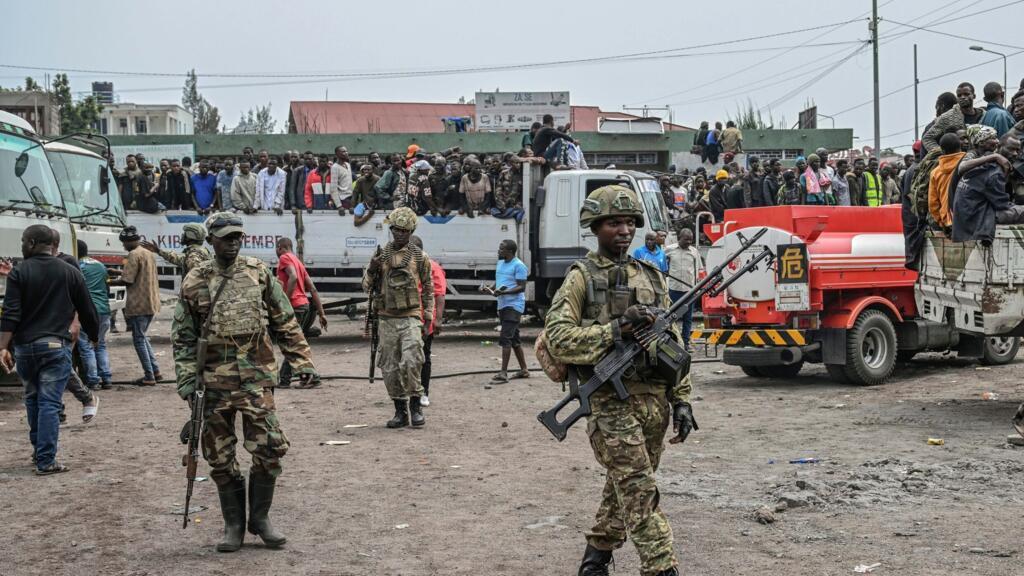
Negotiated settlements in the eastern region of the Democratic Republic of Congo fail because they repeatedly mistake procedural agreements for structural realignments. When state officials and armed faction representatives sign peace roadmaps, observers routinely register premature optimism about stabilization. This analytical breakdown exposes the structural incentives, enforcement deficits, and economic drivers that routinely invalidate diplomatic breakthroughs in the Kivu provinces.
The Incentive Architecture of Armed Faction Integration
Peace frameworks in the Democratic Republic of Congo routinely rely on a single core mechanism: the absorption of insurgent combatants into the national armed forces, known as FARDC, or their demobilization through transitional cash programs. This approach misreads the economic and security rationality of non-state actors.
Armed groups do not operate primarily as ideological entities. They function as decentralized security franchises and tax collection agencies controlling mineral supply chains, agricultural trade routes, and illicit taxation nodes.
The Rent Extraction Loop
- Control of territory yields immediate taxation rights over coltan, cassiterite, and gold extraction sites.
- Integration into the national military often disrupts this revenue stream by replacing decentralized looting with state-managed centralization.
- Faction leaders evaluate peace roadmaps based on whether the proposed command structures preserve their regional monopolies of violence.
When a roadmap promises disarmament without offering equivalent or superior alternative rent streams, faction commanders face a severe prisoner dilemma. Disarming unilaterally guarantees the loss of territorial leverage before state protection materializes. Consequently, signatories frequently use ceasefire phases to reposition forces, recruit replacement cadres, and rebrand through new political facades.
State Capacity Deficits and the Enforcement Vacuum
A peace agreement requires a credible third-party enforcer capable of imposing prohibitive costs on defectors. In the Congolese theater, this enforcement mechanism remains structurally compromised. The central government in Kinshasa exercises attenuated administrative control over territories situated over one thousand five hundred kilometers from the capital.
The security vacuum is exacerbated by several operational constraints:
- Logistical paralysis caused by impassable terrain and underdeveloped infrastructure across North Kivu and South Kivu.
- Pervasive institutional corruption within the security sector, where military logistics are frequently monetized by corrupt commanders.
- Over-reliance on fluctuating external peacekeeping mandates that lack offensive enforcement authority against embedded proxy networks.
Without a monopoly on the legitimate use of force across the borderlands, the state enters negotiations from a position of chronic administrative weakness. Concessions granted to rebel groups during peace talks are rarely backed by the threat of decisive military coercion if terms are violated. This creates an asymmetric hazard where insurgents extract political legitimacy and amnesty while retaining their operational autonomy.
Regional Geopolitical Spillover and Proxy Dynamics
Internal peace talks in the Democratic Republic of Congo are persistently undermined by exogenous variables. The conflict space functions as an integrated regional security complex involving Rwanda, Uganda, and Burundi. Each neighboring state maintains distinct security imperatives, economic interests, and historical security buffers within Congolese territory.
Bilateral peace roadmaps between Kinshasa and localized rebel movements ignore the operational lifeline provided by external patrons. When a domestic faction signs a cessation of hostilities, its logistical support lines often originate across international borders.
[External State Patron] ---> [Logistical & Financial Support] ---> [Rebel Proxy]
                                                                        |
[Kinshasa Government]   <--- [Conditional Ceasefire Roadmap] <-----------+
As long as the structural incentives for proxy warfare persist among regional neighbors, domestic peace accords function as temporary holding patterns. Once the regional calculus shifts, proxies receive new directives, rendering prior roadmaps obsolete within months of signature.
Economic Distortion and the War Economy Equilibrium
The persistence of armed conflict in eastern Congo is sustained by an institutionalized war economy that generates higher risk-adjusted returns for local elites than formal economic integration. Artisanal mining economies, cross-border smuggling networks, and protection rackets involve a complex web of actors ranging from local customary chiefs to transnational trading houses.
Peace roadmaps rarely dismantle these economic networks. Instead, integration agreements often institutionalize war profiteers by granting them official ranks, security oversight over mining corridors, or political appointments within provincial administrations.
This dynamic rewards violent mobilization. Commanders who successfully scale their insurgency secure better integration terms than peaceful civil society actors who lack coercive leverage. The rational response to this incentive structure is the continuous generation of localized insurgencies designed purely to force the central government back to the negotiating table for higher pay-offs.
Strategic Execution Matrix for Security Stabilization
To transition from recurring diplomatic failures to durable stabilization, intervention strategies must shift from political appeasement to structural coercion and economic restructuring.
- Implement mandatory asset forfeiture and international financial tracking against leadership cadres of designated armed groups to sever cross-border capital flows.
- Establish joint administrative oversight bodies with independent international auditing to manage mineral supply chain transparency, neutralizing the taxation capacity of rogue factions.
- Replace unconditional mass integration models with vetted individual disarmament programs paired with guaranteed regional agricultural and infrastructural employment zones.
- Condition all bilateral security cooperation with neighboring states on verifiable border monitoring and the cessation of logistics provisioning to non-state actors.
Stabilization will not arrive via another signed roadmap. It requires dismantling the economic rationality of insurgency through relentless financial constriction and verified state capacity projection across every contested borderland.