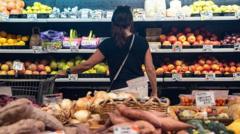
The milk cost four dollars and seventy-five cents on a Tuesday morning in October, and Elena stood by the dairy case in her neighborhood market, staring at the plastic jug as if it might solve a quadratic equation.
It was not a dramatic price. Not the terrifying, headline-grabbing number she had memorized over the previous two years—the numbers that felt like a slow leak in a tire, hissing away her family's savings week by week. Four seventy-five was simply what milk cost now. But two weeks ago, it had been four eighty-five. A month before that, five dollars flat.
She did not celebrate. People rarely celebrate a discount on groceries because the damage has already been done, like paying off a medical bill long after the cast has come off. Yet, standing there under the hum of the fluorescent lights, a strange physical sensation crept over her shoulders. The knot of muscle at the base of her neck loosened just a fraction.
For the first time since the world began vibrating with an erratic, unpredictable cost-of-living panic, the air felt slightly less thin.
Across town, at a small independent logistics firm, Marcus looked at a spreadsheet that didn't make his stomach drop. For thirty-six months, diesel fuel had acted as a quiet predator in his operating costs, eating the margins of every delivery route from the distribution center to the suburban storefronts. Every time he filled the tanks of his fleet, it felt like an arbitrary tax levied by invisible hands on distant oceans.
Today, the numbers on the pump were different. Not collapsing, not plummeting into some utopian past, but stabilizing. The frantic spike had flattened into a plateau.
This is what economists call easing inflation. This is the sterile language of central banks, quarterly reports, and cable news chyrons: US inflation eases as food and fuel costs cool.
Those eight words are printed like a weather forecast, suggesting that the storm has passed and everyone can now put away their umbrellas. But weather metaphors fail to capture the reality of living through an economic tremor. Prices do not drop because they are sorry; they cool because the fever has broken. And a broken fever leaves a household exhausted, shivering in the bedsheets, trying to remember what normal felt like.
To understand why this moment matters, we have to look past the bureaucratic percentages and examine the machinery of everyday survival.
Inflation is fundamentally an emotional condition disguised as math. When the cost of a gallon of gasoline climbs past four dollars, it alters human behavior in ways spreadsheets never quite capture. People stop visiting their aging parents two towns over because the trip costs thirty dollars in gas. Parents lie to their children about why the brand-name cereal is no longer in the cart. Small business owners postpone hiring the person who desperately needs the job, choosing instead to work seventy-hour weeks until their eyes burn.
This quiet contraction of life is the true cost of unchecked price growth. It is not just about having less money; it is about having a shrinking horizon. Your world gets smaller because your wallet gets lighter.
So when the U.D. Bureau of Labor Statistics drops its monthly consumer price index report, showing that the relentless upward march has slowed, the immediate reaction in the streets is not jubilation. It is suspicion.
Is this a trap? Elena would think, scrolling through her banking app at night. Or is the next bill going to jump again?
The cooling of food and fuel costs is not a singular event born of charity; it is the clumsy, complicated result of global supply chains finally untangling themselves after years of pandemic-era knots, shipping lanes clearing, and interest rate hikes acting as a heavy iron foot on the accelerator of the economy.
Consider the journey of a single loaf of bread. Two years ago, the wheat was harvested by a farmer paying record prices for fertilizer. It was milled by a factory facing exorbitant electricity bills. It was trucked across state lines by a driver paying three times as much for diesel. By the time that bread reached the supermarket shelf, every single link in the chain had added its own panic-induced markup.
When fuel costs cool, the friction in that chain vanishes. Diesel prices drop, and the truck driver keeps a little more of his pay while the distributor stops passing panic down to the retailer. The farmer pays less to run tractors through the dirt. It is a cascading release of pressure.
Yet, cooling inflation does not mean things are getting cheaper. This is the great psychological misunderstanding of modern economics.
When a news anchor says inflation is easing, millions of people hear that prices are going down. They are not. Prices are simply climbing at a slower, more civilized rate. The damage inflicted over the past few years—the forty percent jump in used cars, the fifty percent leap in beef, the astronomical rent hikes—remains locked into the bedrock of the economy. A loaf of bread that rose from two dollars to four dollars does not return to two dollars when inflation cools. It stays at four dollars, daring your paycheck to catch up.
This is why the public mood remains sullen even as the macroeconomic graphs point toward recovery. The economy is healing, but the patient is still limping.
Marcus felt this contradiction firsthand. While his fuel costs stabilized, his employees were still walking into his office asking for raises to cover the cumulative weight of rent increases that had happened twelve months prior. You cannot tell an employee whose apartment lease just jumped by two hundred dollars a month that they should feel grateful because diesel is down ten cents a gallon.
Human memory is long when it comes to pain. We measure our well-being not against last month, but against the memory of ease before everything went wrong.
And yet, the cooling is real. The panic buying has subsided. Global crude oil markets have found a fragile equilibrium, buffering against geopolitical shocks that once sent gasoline prices skyrocketing overnight. Agricultural supply chains have adapted, finding alternative routes and local redundancies to bypass traditional bottlenecks.
In the quiet corners of the financial world, strategists talk about soft landings—the delicate, nearly mythical art of slowing an overheating economy without driving it straight into a ditch. For the past few years, every sharp turn made by central bankers felt like driving a freight train blindfolded down a mountain pass. Every tap of the brakes sent passengers flying out of their seats.
Now, the train is finally tracking straight. The brakes are off, or at least loosened.
What does this mean for Elena as she walks out of the market with her four-dollar-and-seventy-five-cent milk? It means she can plan for next month without holding her breath. It means the terrifying guesswork of grocery shopping has retreated from a daily crisis to a manageable annoyance. It means she can perhaps, for the first time in a very long time, put twenty dollars into a savings account instead of watching it vanish before the direct deposit even clears.
Economics is often taught as a science of numbers, charts, and cold rational actors making calculated choices in a frictionless vacuum. But real life has friction. Real life is sticky, emotional, and haunted by the memory of empty shelves and exorbitant fuel pumps.
The cooling of food and fuel prices is not the end of the story. It is simply the moment the smoke clears enough for us to take stock of the landscape we have built.
As Elena walks down the autumn sidewalk, the cold wind catches the collar of her coat. She pulls it tight, checks her receipt, and puts the groceries in the trunk. She doesn't smile, not yet. But she doesn't look over her shoulder either. For the first time in years, the road ahead looks wide enough to walk on.


