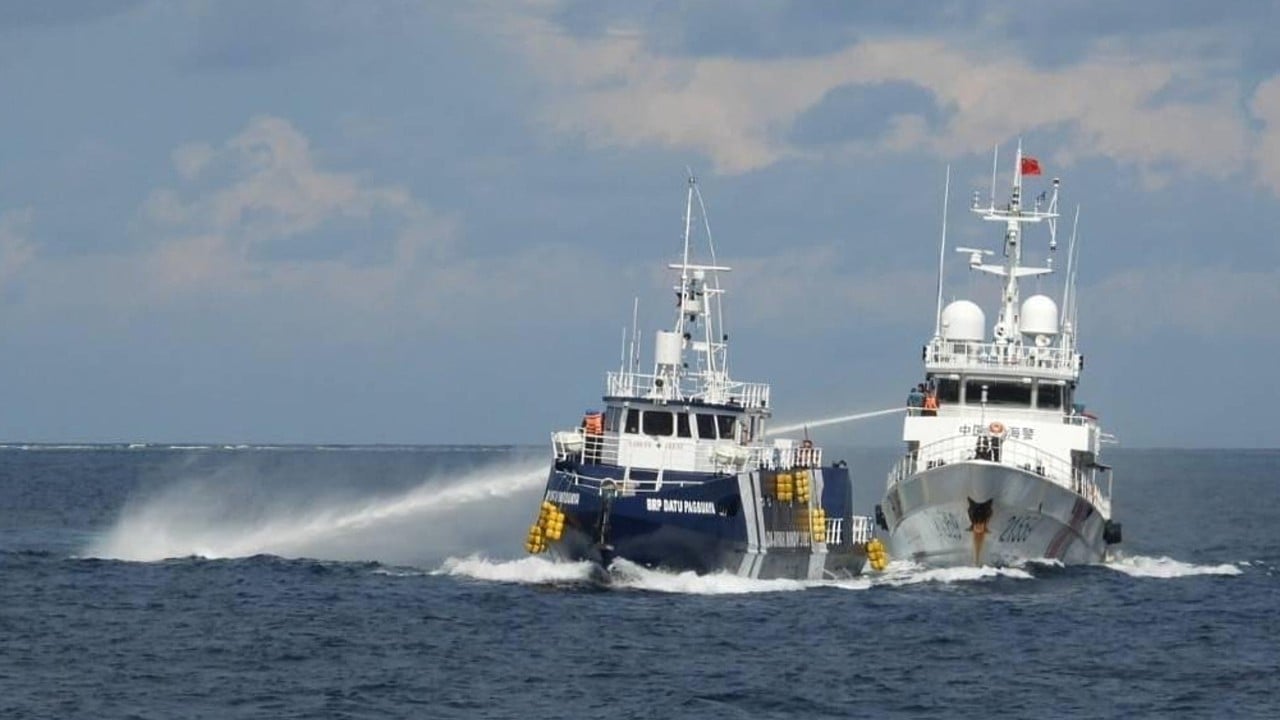
Paper victories usually fade, but China can't seem to shake the ghost of July 12, 2016. A decade after the Permanent Court of Arbitration in The Hague thoroughly dismantled Beijing's expansive maritime claims, the ruling remains a raw nerve. You can see it in the aggressive diplomatic pushback and the escalation of water cannons in the Spratly Islands.
On the tenth anniversary of the landmark verdict, the battle lines look exactly as they did ten years ago, only louder. Chinese Foreign Ministry spokesperson Mao Ning fired back at the international community, calling the decision "illegal, invalid, and lacking binding force." State media took it a step further, branding the legal decision a "poisoned legacy" and a "cynical parody of justice."
Why the sudden surge in anger? Because the law isn't fading away. A massive coalition of 14 countries—including the United States, Japan, Australia, the United Kingdom, and the Philippines—along with the European Union, issued a coordinated statement reminding the world that the ruling is final and legally binding. For Beijing, the fact that the international community refuses to let the ruling die is a constant threat to its maritime strategy.
The Verdict That Redrew the Map
To understand why Beijing is still furious, you have to look at what the tribunal actually did. When the Philippines filed its case back in 2013 after a tense standoff at Scarborough Shoal, it took a massive gamble. Beijing simply refused to show up, assuming that ignoring the proceedings would strip the court of its legitimacy.
The strategy backfired. The tribunal proceeded under the United Nations Convention on the Law of the Sea (UNCLOS) and delivered a sweeping, unanimous blow to China's maritime ambitions.
The core of the dispute was the famous nine-dash line. This map-based claim allowed Beijing to assert "historic rights" over roughly 80 percent of the South China Sea. The judges didn't mince words. They ruled that any historic rights China claimed were completely extinguished the moment it signed onto UNCLOS. The law of the sea replaced ancient maps with clear, modern rules.
The court also looked at the physical features of the sea. It ruled that none of the islands or reefs in the Spratly chain could generate a 200-nautical-mile Exclusive Economic Zone (EEZ). Features like Mischief Reef and Second Thomas Shoal were declared part of the Philippine EEZ. Legally, the ruling stripped China of its justification for building artificial islands and driving away local fishermen.
Law is the Cheapest Security Architecture
Critics often point out that international law has an enforcement problem. The Hague doesn't have a navy. China ignored the paper, built its military garrisons anyway, and deployed its massive maritime militia. If Beijing can just ignore the law, did the Philippines really win anything?
The answer is yes. Philippine Solicitor General Darlene Marie Berberabe pointed out that the award supplied certainty. It clarified exactly who owns what. Before the ruling, maritime boundaries were blurry, allowing Beijing to exploit the ambiguity. Today, every time a Chinese Coast Guard vessel blocks a Philippine resupply mission at Second Thomas Shoal, it does so as an explicit violator of international law.
This legal clarity has huge economic consequences. Instability at sea gets priced into shipping insurance premiums, re-routed cargo flights, and delayed energy exploration. By locking in the legal framework, the ruling acts as a load-bearing wall for the global economy. It keeps the South China Sea a sea governed by rules rather than sheer military dominance.
How the Fight Moves from Courtrooms to the High Seas
Beijing's biggest fear is that the 2016 ruling provides a legal anchor for deeper military cooperation against it. We're seeing that fear play out in real-time. The Philippines isn't standing alone anymore.
Manila has leveraged its legal victory to build a dense web of security alliances. The United States has repeatedly stated that its Mutual Defense Treaty applies directly to armed attacks on Philippine forces, public vessels, or aircraft anywhere in the South China Sea. Japan and the Philippines have also steadily tightened defense ties, negotiating reciprocal access agreements to allow troops to train on each other's soil.
This leaves China in a tough spot. It can't convince the world that its actions are legal, so it relies entirely on coercion. The maritime militia uses laser pointers, aggressive maneuvers, and high-pressure water cannons to bully smaller neighbors. Yet every act of aggression pushes regional players closer to Washington, achieving the exact opposite of what Beijing wants.
The Path Forward for the South China Sea
If you think this dispute will settle down anytime soon, you're looking at it wrong. Beijing wants Manila to abandon the 2016 ruling entirely and return to bilateral negotiations—a setup where China holds all the leverage. The Philippines has made it clear that its legal victory is non-negotiable.
The international community needs to move past simply signing statements every July. To keep the ruling meaningful, nations must take practical steps:
- Expand joint patrols: The US, Japan, Australia, and the Philippines need to regularize joint naval transits through the West Philippine Sea to enforce freedom of navigation.
- Fund maritime transparency: Projects like the SeaLight initiative, which tracks and exposes Chinese maritime militia movements in real-time, strip Beijing of its deniability.
- Lock down regional codes: ASEAN nations must resist Chinese pressure to sign a watered-down Code of Conduct that ignores the 2016 arbitral award.
The 2016 ruling didn't stop China's ships, but it fundamentally changed the geopolitics of the region. A decade later, the law remains the strongest weapon the international community has to keep the South China Sea open, free, and stable.