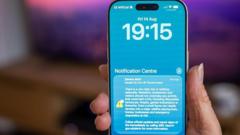
The phone doesn't just ring. It claws its way out of the silence.
When you live with someone who measures your worth by your obedience, a sudden sound is never just a sound. It is a physical weight dropping onto your chest. It is a spike of cold adrenaline that steals the air from your lungs before your brain can even process what is happening. Meanwhile, you can read other events here: The Subpoena Bottleneck Analyzing the BBC Legal Defense Strategy Against Trump.
I remember that specific, sickening drop. The sudden vibration on the kitchen counter. The harsh, piercing wail slicing through the evening quiet.
To anyone else, it was a government broadcast. A public safety test. A routine blip in the modern matrix of connectivity. To understand the bigger picture, we recommend the excellent report by USA Today.
To us, it was a homing beacon.
(Note: The following scenario is a hypothetical illustration grounded in the real-world safety concerns raised by domestic violence campaigners regarding unfiltered emergency broadcast alerts.)
Imagine sitting in a quiet room, carefully managing the atmosphere. Every movement is calculated. Every word is chosen to avoid setting off the quiet storm simmering across the table. You have hidden your burner phone deep inside a winter coat at the back of the closet. You have memorized the shelter's hotline number because writing it down is an unforgivable risk. You are surviving in the margins.
Then, every device in the house simultaneously screams.
It does not matter that you hit mute. It does not matter that you buried the handset under a pile of laundry. The emergency broadcast system cuts through silence with absolute authority. It overrides volume settings. It hijacks screens.
And in that fraction of a second, the abuser's head snaps toward you.
"What was that?"
Silence.
"Whose phone is that?"
The sheer design of modern emergency alerting assumes a universal baseline of safety. It assumes a home is a refuge. It assumes that when a notification blares, everyone in the room shares the same objective: receiving information, taking cover, preparing for a flood or a storm.
The architects of these systems forgot something crucial. For millions of people, the primary threat is not outside the front door. The threat is sitting right beside them on the couch.
Campaigners and advocates who work daily on the front lines of domestic abuse understand this terrifying reality intimately. When the national emergency alert systems were deployed across various regions, researchers and support networks immediately sounded the alarm. They pointed out a glaring, dangerous oversight. Secondary phones, hidden devices, and unlisted lines kept by survivors as lifelines were suddenly forced into the open.
A hidden phone is an anchor. It is the only thread tethering a victim to reality when their main communication channels are monitored, tracked, and controlled. Abusers routinely check call logs, read text messages, and demand passwords. To survive, victims learn the art of stealth. They acquire cheap, prepaid devices—burner phones—and keep them completely powered down, tucked away in dark corners, waiting for the precise moment when escape becomes possible.
When an automated emergency test or alert hits the airwaves, it forces every dormant device within range to light up and sound off.
Suddenly, a phone that has not made a sound in six months begins shrieking from the bottom of a laundry basket.
The consequences are not theoretical. They are immediate, brutal, and swift. Advocacy groups have documented cases where these unwanted signals exposed hidden devices, leading directly to escalated violence, confiscation of the lifeline, and intensified isolation. When a survivor's secret weapon is neutralized by a well-meaning public safety initiative, the walls close in just a little bit tighter.
Why did this happen?
Because technology is rarely built with empathy. It is built for scale. It is built for efficiency.
Engineers think in terms of populations, coverage maps, and decibel levels. They look at a nation as a single, uniform entity. They do not picture the woman huddled in a bathroom, pressing her hand over the speaker of a secret phone to muffle a tone designed to pierce steel. They do not picture the teenager hiding a device under a mattress, praying the vibration does not rattle the bedsprings.
Complexity is hard to code. Safety for the majority is easy to measure. But true safety cannot be systemic if it leaves a vulnerable fraction of the population exposed in the crossfire.
Consider how other safety mechanisms have evolved to account for domestic risk. Domestic abuse shelters do not publish their addresses. Hotlines use discreet website designs so a browser history does not reveal a desperate search for help. Support organizations teach digital hygiene—how to clear caches, how to turn off location sharing, how to spot spyware on a smartphone.
Yet, against this backdrop of meticulous caution, a government-mandated broadcast can override every protective measure in a single second.
The system operates on an assumption of universal trust. It assumes that when a warning sounds, the recipient is free to look at it, react to it, and discuss it openly with whoever is nearby. It assumes a baseline of autonomy that is entirely absent in an abusive household.
Fixing this is not an impossible engineering feat. It requires a fundamental shift in perspective. It demands that technologists, policymakers, and public safety officials consult directly with the people who understand the shadows.
We need opt-out mechanisms that do not compromise public safety at large. We need architecture that recognizes the existence of secondary, unmonitored devices without demanding their exposure. We need a system that understands safety is not one-size-fits-all.
Until then, the alarms will keep sounding.
And in thousands of quiet homes across the country, hearts will skip a beat, breath will catch in throats, and survivors will hold their ground in the dark, waiting for the noise to stop.