History is rarely made in the bright glare of midday. More often, it arrives in the dim, hushed antechambers of state rooms, carried by the murmur of old ghosts.
Walk through the cavernous marble halls of Beijing, and you can still hear the echoes. They are not the raucous shouts of revolution, nor the iron clanks of industrial quotas being met. They are softer. They sound like paper sliding across a mahogany desk. They sound like the careful, measured cadence of a man who believed that survival depended entirely on remaining quiet while the storm raged outside. If you enjoyed this post, you should look at: this related article.
That man was Jiang Zemin.
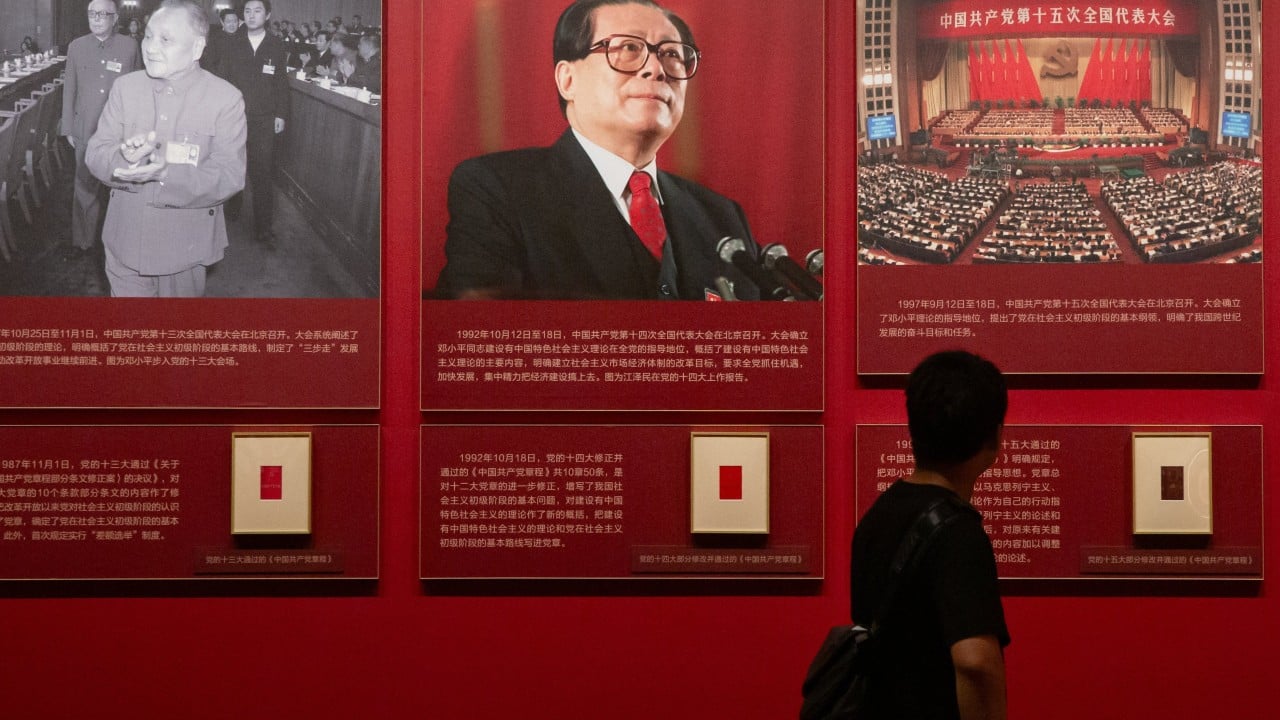
For a decade, the West dismissed him as a transitional figure—a bespectacled technocrat with a penchant for playing the accordion and reciting American poetry in front of bewildered journalists. We misread him. We looked at his high-waisted trousers and his stiff grin and missed the absolute steel beneath. Jiang inherited a party fractured by the acrid smoke of Tiananmen Square, isolated from a hostile global economy, and unsure of its own tomorrow. He did not yell. He absorbed. He opened the doors just enough to let foreign capital flood in, locking the political bolts behind closed doors while the nation transformed into an industrial beast. For another perspective on this event, refer to the recent coverage from The Washington Post.
Now, decades later, his ghost has been summoned back to the banquet table.
Why? Because power always looks backward when it feels the ground shifting beneath its feet.
To understand the current political choreography in Beijing, you have to step away from the dry syntax of state press releases. You have to look at the human anxiety underneath. When the Communist Party of China invokes Jiang’s legacy in a coordinated, synchronized call to rally round Xi Jinping’s leadership, it is not an academic exercise in historiography. It is an act of political self-preservation. It is a whispered warning to the ranks: Look at where we were. Look at what division cost us. Fall in line.
Consider the weight of that inheritance.
When Jiang passed away, the eulogies were remarkably telling. They praised his "firm belief" and his ability to navigate turbulent waters. But political nostalgia is never neutral. In the high-stakes theater of Zhongnanhai, invoking a predecessor is a method of borrowing their legitimacy. It is a shield. Xi Jinping commands a party that has achieved unprecedented global reach, yet it faces economic headwinds that would make any central planner sweat. Real estate bubbles groan under their own weight. Youth unemployment numbers quietly vanish from public dashboards. Foreign investment cools into a cautious chill.
When the present feels precarious, the past is dragged into the present tense to anchor it.
Picture a provincial party official sitting in a sterile conference room in a second-tier industrial city somewhere in Henan. Outside, the gray winter smog presses against the double-paned glass. Inside, the television hums with the evening news broadcast. The anchors speak in that familiar, rhythmic monotone, weaving together the ideological threads of yesterday and today. The official listens not out of pure devotion, but out of survival instinct. In this system, loyalty is not an emotion; it is an atmosphere. You breathe it, or you suffocate.
The invocation of Jiang’s era serves a very specific psychological function. It reminds the party elite of a golden rule they dare not forget: collective strength through centralized authority. Jiang managed the delicate balancing act of integrating China into the global capitalist machinery while keeping the party's iron grip intact. By tying Xi’s modern-day centralization directly to the foundational stability laid down during Jiang’s tenure, the party apparatus is attempting to construct an unbroken line of historical inevitability.
It says: We have always done it this way. We survived the storms of the nineties. We will survive the storms of today.
Yet, ghosts are notoriously difficult to control once you let them out of the crypt.
Jiang Zemin represented an era of opening, of technocratic pragmatism, of a China that actively sought to blend into international systems while accumulating power in the shadows. Xi Jinping’s era is different. It is louder. It is prouder. It is defined by reclaimed sovereignty, assertiveness on the global stage, and a deliberate turning inward of ideological purity. To invoke Jiang in service of Xi’s distinctively muscular vision requires a subtle rewriting of history—smoothing over the rough edges of an era that was defined precisely by its compromises with the West.
This is the invisible friction of modern governance.
Power requires continuity, even when the direction has radically shifted. You cannot completely break with the past because the past is the only proof of your right to rule. And so, the party reaches back across the decades, pulling Jiang Zemin from his mausoleum of memory, dressing him in the contemporary rhetoric of discipline and unity, and placing him back at the head of the table.
The silence that follows these declarations is deafening.
It tells you everything you need to know about the state of modern power. It is not built on chaos. It is built on the meticulous, unyielding orchestration of memory. Every historical reference is a brick in the wall of authority. Every ghost summoned is a sentry posted at the gates of tomorrow.
The banquet hall is full. The glasses are raised. And somewhere in the dark, the accordion plays on, its tune dictated entirely by those who remain.