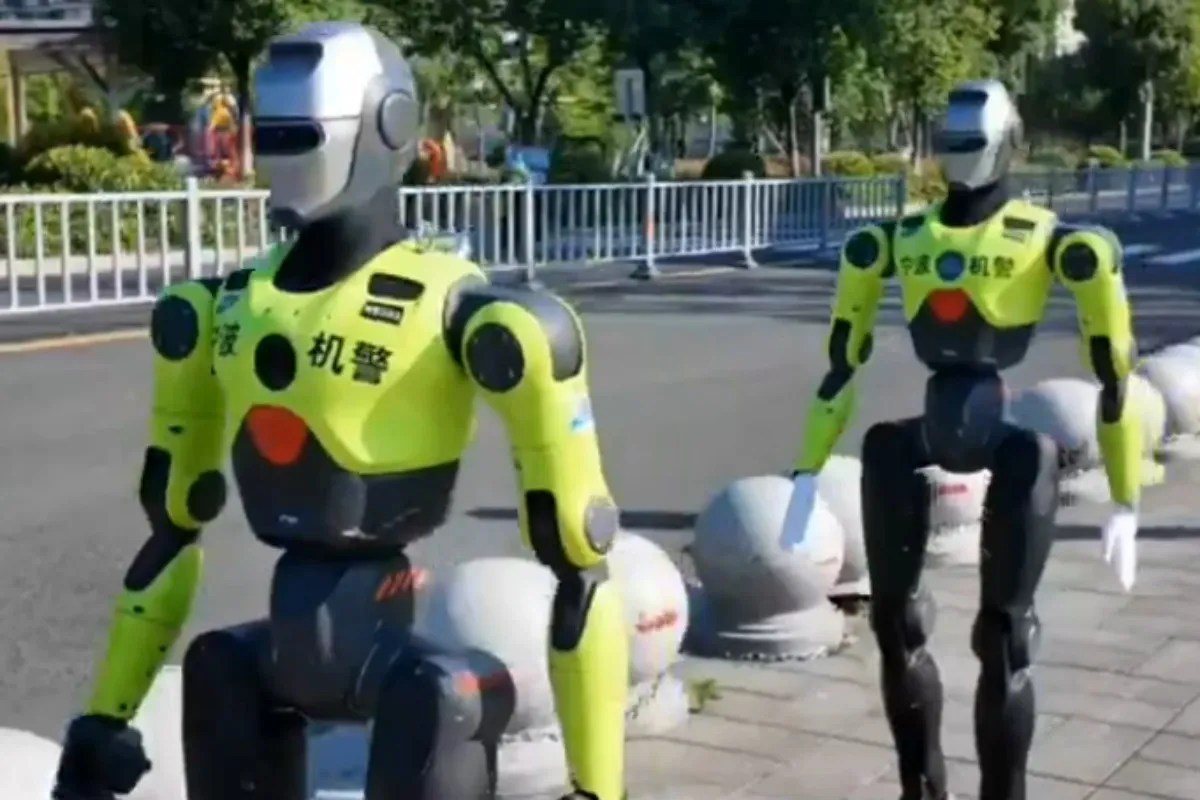
The sight of a 1.88-meter humanoid robot standing at a busy intersection in Hangzhou, waving its mechanical arms in rhythmic synchronization with traffic signals, is designed to leave a lasting impression. These units, developed by SUPCON Information, have been presented as a high-tech solution to the perennial headache of urban congestion and traffic safety. They monitor for helmetless e-bike riders, pedestrians crossing against lights, and vehicles encroaching on marked stop lines. While the reported 95% accuracy in violation detection sounds impressive, the reality behind these machines is far more nuanced than a simple jump in police efficiency.
These robots are not replacing human officers, nor are they autonomous enforcers. They are mobile, public-facing data collection nodes. When the T2 robot detects an infraction, it does not issue a fine. It does not initiate an arrest. Instead, it triggers a verbal warning and logs the event, transmitting the footage to a centralized traffic bureau for human review. This is the crucial distinction that often gets lost in the headlines. By keeping the authority to penalize firmly in the hands of human officers, municipal authorities sidestep the legal and ethical quagmire that would arise if an autonomous machine mistakenly flagged an innocent person for a ticket. For a deeper dive into similar topics, we recommend: this related article.
The mechanical nature of these units offers clear advantages in endurance. They do not succumb to heat exhaustion in the sweltering summers of eastern China, nor do they lose patience during peak rush hours. SUPCON claims that since the pilot program began in May 2026, these machines have issued over 170,000 warnings, contributing to a reported 40% reduction in specific violations like helmetless riding. Yet, these figures remain unaudited by independent third parties. In the world of public-sector tech deployments, such internal data should be viewed through a skeptical lens. The metrics of success are provided solely by the developer and the state-sanctioned media, lacking the transparency required to verify if the behavior change is a result of improved safety or simply the novelty of being watched by a machine.
Beyond the immediate utility, these robots serve as a massive field experiment in data ingestion. For the Chinese robotics sector, which is pushing aggressively to move humanoid systems out of controlled laboratory environments and into real-world applications, these intersections are invaluable. Every hour spent monitoring a chaotic street junction provides environmental variables—glare, precipitation, erratic pedestrian movement—that are impossible to replicate in a factory setting. This is the real game for companies like SUPCON and their peers. They are building a sensory map of human movement, refining their computer vision models on the backs of thousands of unsuspecting commuters. To get more context on this issue, comprehensive coverage can also be found on Engadget.
This expansion is rapid. With nearly 50 robots already in operation across eight cities and plans to hit 200 by the end of 2026, the strategy is shifting from a localized pilot into a standard feature of urban management. Executives at AI-backed firms are already eyeing international markets, particularly regions like the Middle East or Southeast Asia, where high temperatures make traditional, human-led roadside traffic duty physically grueling. However, the export of such technology is far more complex than shipping a piece of hardware. These robots are not merely traffic controllers; they are mobile surveillance platforms. Integrating them into foreign jurisdictions would require overcoming immense hurdles regarding data privacy, local cybersecurity regulations, and the fundamental question of whether foreign governments would permit Chinese-made sensory networks to operate on their public infrastructure.
The limitations of the current design are also telling. When conditions become too adverse, such as during heavy downpours or blinding sunlight, the efficiency of their sensors drops. Even the developers admit that the hardware is susceptible to the same environmental failures that plague modern autonomous vehicles. A robot that freezes during a storm is a nuisance; a robot that misidentifies a bicycle as a vehicle is a liability. By restricting their function to warnings rather than actual enforcement, the cities using them have effectively buffered themselves against the fallout of these inevitable technical errors.
Ultimately, these humanoid robots represent a specific vision of smart city integration. They act as the public interface for a backend system that is already performing the actual enforcement. The robots serve to normalize the presence of constant surveillance, providing a non-threatening, almost whimsical face to a system that is fundamentally about behavior modification. The goal is to correct habits before they become entrenched, using the machine as a persistent, unblinking reminder that the state is watching.
Whether these machines will prove to be a sustainable fix for traffic flow or just a passing fad in the broader push for automation remains to be seen. The hardware will continue to improve, and the sensors will eventually overcome current weather limitations. But the fundamental truth remains: these robots are not there to serve the public. They are there to monitor it. Until these systems can prove their value through third-party audits and show that their presence actually improves safety—rather than just increasing the volume of reported incidents—they should be seen for what they are: highly sophisticated tools for the collection of behavioral data in the public square.
The move to place them in more cities is not a sign of total success, but a expansion of the trial. Keep watching the deployments. The real story isn't the robot; it's the data it leaves behind.