Silence.
That is what greets you when you walk the furrowed, wind-scoured fields of the Isle of Man in the dead of a winter morning, before the gulls wake up and before the Irish Sea begins its relentless, rhythmic hammering against the coastal cliffs. You hear the squelch of your own boots sinking into peat-heavy clay, the hiss of damp grass brushing against waterproof trousers, and the steady, hypnotic hum of a metal detector’s search coil sweeping an inch above the dirt. Don't miss our recent post on this related article.
Most days, that hum yields nothing but heartbreak.
If you have never spent six hours in freezing rain swinging a three-pound carbon-fiber shaft across plowed earth, you might romanticize the hunt for buried treasure. You might picture golden doubloons spilling out of rotted oak chests, or the sudden, cinematic chime of a jackpot signal. The reality is vastly more humbling. For ninety-nine percent of the hours a detectorist puts into the soil, the ground rewards them with oxidized iron nails, crushed aluminum drinks cans, lead shotgun pellets, and the jagged, deceptive scream of nineteenth-century tractor parts. Your shoulder aches. Your fingers go numb inside wet gloves. You begin to wonder if the earth has swallowed everything worth keeping and left only modern garbage behind. To read more about the context of this, NBC News offers an informative breakdown.
Daniel Crowe knew that ache intimately.
In early 2026, Crowe was out on Manx farmland—with full permission from the landowner, following the strict protocols that separate responsible heritage stewards from nocturnal looters—doing what thousands of amateur historians do every weekend across the British Isles. He was listening to the dirt. When his detector finally broke its monotonous drone with a crisp, unmistakable high-conductivity tone, he did not expect to rewrite a chapter of tenth-century Norse history. He expected another Victorian penny, or perhaps a dropped brass button from a farmer’s coat.
Instead, kneeling in the cold mud, Daniel Crowe reached into the earth and shook hands with a ghost.
The Architecture of a Panic
To understand why a handful of battered silver pulled from Manx soil matters so deeply, you have to stop looking at the metal as jewelry or currency and start seeing it for what it actually was: a heartbeat frozen in terror.
Picture a hypothetical Norse settler on the Isle of Man around the year 950 AD. Let us call him Thorfinn, though his true name dissolved into the salt air a millennium ago. Thorfinn was not a horned-helmet cartoon marauder fresh off a Hollywood longship; he was a farmer, a trader, a husband, and a pragmatist living at the crossroads of the Irish Sea. The Isle of Man sat squarely in the middle of the Viking maritime highway—a strategic stepping stone linking Dublin, York, the Scottish Hebrides, and the fjords of Norway. Wealth flowed through its ports in the form of hacked-up silver arm rings, Arab dirhams carried north along Russian river routes, and intricately stamped Anglo-Saxon pennies.
Now, imagine the smoke rising over the ridge.
In the tenth century, political stability on the Isle of Man was as fragile as thin ice over a millpond. Rival Norse warlords clashed over tribute routes; Irish kings launched retaliatory raids across the water; power shifted violently between seasons. When word reached a farmstead that longships were rounding the headland—or that a local chieftain’s tax collectors were riding inland with drawn swords—you did not have a bank vault. You did not have an offshore account or a safe deposit box.
You had a spade, a leather pouch, and the cover of darkness.
When Daniel Crowe excavated his find on the Isle of Man, he uncovered a Viking-age hoard consisting of silver arm rings, cut silver ingots, and coins—what archaeologists classify as a bullion economy stash. Consider what happens when a person buries their life savings in a rush: they do not arrange it neatly for a museum display case. They cram their portable wealth into a hole beneath a recognizable landmark—a boundary stone, an ancient oak, the corner of a turf wall—intending to return in three days, or three weeks, once the bloodshed stops and the smoke clears.
Thorfinn never came back.
Every Viking hoard ever discovered in Britain or Ireland is, at its core, an unfinished story. It is proof of a sudden death, a capture into slavery, or a desperate flight across the sea from which the owner never returned. When Crowe lifted that silver out of the Isle of Man mud, he was not just recovering antique metal. He was holding the exact artifacts a human being gripped with trembling hands during the worst night of their life, more than a thousand years ago.
Hack-Silver and the Mathematics of Survival
Look closely at the pieces recovered in finds like Crowe’s, and you notice something unsettling. Many of the silver arm rings are not intact. They are bent, flattened, or deliberately chopped into jagged chunks with a cold chisel.
To modern eyes, destroying a finely crafted piece of silver jewelry feels like vandalism. Why take a heavy, twisted-wire arm ring—a status symbol worn proudly at feasts to show allegiance to a warlord—and hack it into ugly, asymmetrical stubs?
Because in the tenth-century Irish Sea world, beauty did not buy bread. Weight did.
The Vikings operated on a weight-based bullion economy long before native coinage took hold on the Isle of Man. Think of it like carrying a solid gold watch into a modern crisis where credit card networks have collapsed and paper currency has turned to confetti. The brand name on the dial ceases to matter; the only question the merchant asks is how many grams of pure metal sit on the scale.
When a Norse trader on the Isle of Man needed to buy a barrel of salted herring, a bolt of wool, or passage on a vessel bound for Dublin, he pulled out a pair of folding bronze scales, set a lead weight in one pan, and used a heavy iron blade to hack slices off his silver arm rings until the pans balanced. Archaeologists call these fragments hack-silver. Every notch, every test-mark where a suspicious merchant nicked the edge of an ingot with a knife to verify it wasn't cheap lead plated with a thin wash of silver, tells a story of human distrust and survival.
I still remember the first time I held a piece of tenth-century hack-silver in an archival handling session—the unexpected density of it, far heavier than modern aluminum or steel, and the razor-sharp burr along a chisel cut made a thousand winters ago. You run your thumb over that cut edge and realize a sobering truth: the metal has not aged a day, even though every empire, language, and border around it has crumbled and reformed a dozen times.
Why the Isle of Man Is a Time Capsule
People often ask why the Isle of Man produces such an astonishing density of Viking discoveries compared to its modest size—a rock barely thirty-three miles long and thirteen miles wide, anchored in the middle of the Irish Sea.
The answer lies in geography and law.
Geographically, the island was the Grand Central Station of the Viking Age. You could not control trade between Ireland, England, and Scotland without controlling Man. Norse settlers arrived in the ninth century, initially as raiders, before marrying into the local Celtic population and forging a hybrid Norse-Gaelic culture that still echoes in the island’s Tynwald parliament—the oldest continuous legislative assembly in the world—and in place names ending in -by and -ay. Because so much silver passed through Manx harbors, and because internal feuds were so frequent, an extraordinary amount of wealth went into the ground.
Legally, however, the Isle of Man operates differently from England, Wales, or Scotland, and this is where Daniel Crowe’s discovery becomes a masterclass in civic integrity.
Under the Manx Treasure Act of 2017, any object found on the island that is at least 300 years old and contains precious metal—or is part of an archaeological hoard—belongs legally to the Crown, administered through Manx National Heritage. Finders are legally obligated to report discoveries to the Manx Museum within fourteen days. Unlike the Wild West of private antiquities markets, where historical context is obliterated the moment a dealer scrubs the dirt off a coin and lists it on an auction site, Manx law treats the soil around the artifact as just as precious as the silver itself.
Think about what would have happened if Crowe had kept his mouth shut.
Had he pocketed the silver, washed the Manx clay off in his kitchen sink, and sold the pieces privately to collectors, historians would have lost ninety percent of the discovery’s scientific value. Without the exact GPS coordinates, without an archaeological excavation of the surrounding soil strata to look for traces of a rotted leather pouch, a ceramic vessel, or nearby post-holes of a longhouse, the silver becomes orphaned. It becomes pretty scrap metal with no biography.
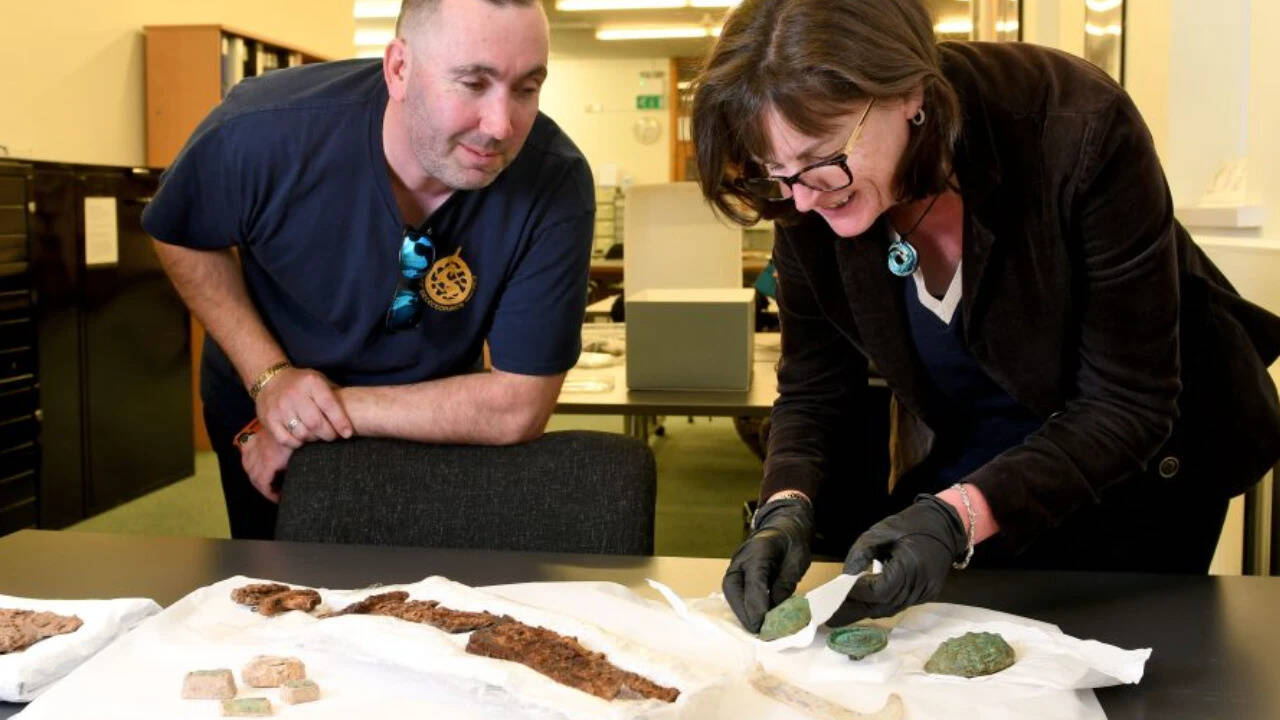
Instead, Crowe stopped digging, marked the spot, and notified Manx National Heritage. By doing so, he allowed professional archaeologists—including Allison Fox, Curator of Archaeology at Manx National Heritage—to step in, document the stratigraphy, and preserve the hoard intact for the public. When the Coroner of Inquests formally declares such a find to be Treasure, the museum acquires it for the nation, and an independent valuation committee awards a financial reward split fairly between the finder and the landowner.
Everyone wins, especially the dead.
The Invisible Stakes of the Soil
There is a quiet crisis unfolding beneath the feet of Europe right now, and it has nothing to do with climate change or housing developments. It is the silent erasure of unwritten history.
For every Daniel Crowe who follows the rules, reports a find, and preserves the context of the past, there are "nighthawks"—illegal detectorists who sneak onto scheduled monuments under cover of darkness, rip artifacts out of their resting places, and leave gaping craters behind. When a nighthawk loots a site, they do not merely steal an object; they tear the pages out of a book that has never been read.
We live in an era obsessed with digital permanence—cloud backups, blockchain ledgers, infinite photo libraries—yet we remain shockingly casual about the physical archive beneath our boots. Most people walk across farmland or coastal paths seeing only mud, grass, and scenery. They do not realize they are walking across a palimpsest where Bronze Age cremation urns, Roman trade coins, Viking hack-silver, and medieval pilgrim badges lie stacked in dark, silent layers inches below the plow zone.
And modern agriculture is slowly chewing through that upper layer. Every pass of a deep-tine plow brings fragile artifacts closer to the surface, exposing them to oxygen, fertilizer acids, and mechanical shattering. Responsible metal detectorists like Crowe sit on the front lines of rescue archaeology. They are the ones pulling history out of the plow zone before the next tractor blade snaps a thousand-year-old silver arm ring in half.
What Remains When the Mud Washes Away
When the curators at the Manx Museum in Douglas place Daniel Crowe’s hoard under conservation lights, gentle brushes will lift away the last stubborn grains of Isle of Man clay. Under magnification, the silver will gleam with that cool, milky luster unique to high-purity Norse bullion. Visitors will lean against the glass cases, peering at the stamped geometric patterns on the arm rings and the tiny Arabic calligraphy on worn dirhams minted thousands of miles away in Samarkand or Baghdad before traveling north in the saddlebags of Viking merchants.
Schoolchildren will press their noses to the glass and ask how much it is worth in modern pounds.
The true answer cannot be calculated on a jeweler’s scale. Its value lies in the bridge it builds across a thousand years of silence—connecting a modern Manxman standing alone in a cold field with a long-dead Norseman who knelt in that exact same dirt, pressed his silver into the dark, and whispered a prayer that he would live long enough to dig it back up.
Somewhere beneath another quiet field on the Isle of Man tonight, wrapped in peat and waiting out the rain, another handful of silver is still listening for footsteps that never returned.