Mathematics makes people uncomfortable. You sit in a dim classroom, stare at a chalkboard covered in Greek letters, and wonder when you will ever need to factor a quadratic equation in real life. Most of us treat numbers like chores. We balance checkbooks, track calories, and calculate tips, missing the actual point entirely.
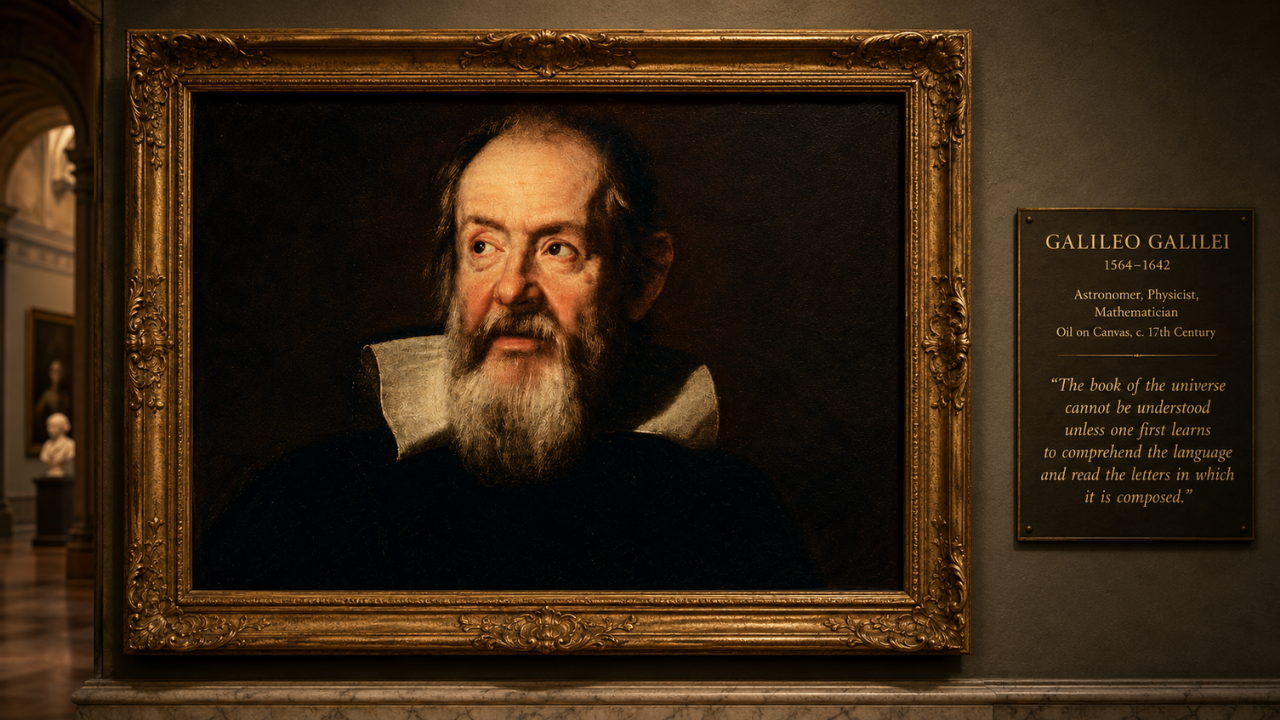
Galileo Galilei saw something entirely different when he looked at numbers. He wrote that the grand book of the universe cannot be understood unless one first learns to comprehend the language and read the letters in which it is composed. That language, he argued, is mathematics.
Think about that claim for a second. It is a bold statement. Galileo wasn't just talking about doing taxes or engineering bridges. He meant that reality itself is written in equations, geometry, and logic. If you don't speak math, you are essentially illiterate in the library of existence. You are staring at masterpieces in a foreign gallery and only seeing colored smudges on canvas.
The Shift From Words to Numbers
For centuries before the seventeenth century, natural philosophy relied on qualitative arguments. Scholars read ancient texts, debated Aristotle, and used poetic prose to describe why heavy objects fall faster than light ones or why planets move the way they do. It sounded sophisticated. It was also completely wrong.
Aristotle guessed that heavier objects fell faster because it made intuitive sense. Words are slippery. Words let you argue endlessly without ever checking if your premises hold weight. Galileo changed the rules of the game by dropping objects from towers, rolling bronze balls down grooved wooden ramps, and timing their descents with a water clock.
He didn't write essays about the beauty of motion. He measured distance against time. He squared the numbers. Suddenly, physical reality revealed a precise, predictable pattern. The universe stopped being a mysterious realm governed by whims and started looking like a massive, intricate clockwork mechanism.
When you strip away poetic descriptions of the sky, you are left with orbital mechanics. When you stop talking about the warmth of a fire and start measuring molecular kinetic energy, you can actually build a steam engine. Galileo realized that words deceive us, but numbers keep score.
Reading the Alphabet of Reality
What did Galileo mean by the letters of this cosmic language? He meant triangles, circles, spheres, and numerical ratios. These are the fundamental shapes and quantities that recur everywhere you look, from the spiral of a nautilus shell to the curved trajectory of a cannonball.
Consider how gravity operates on Earth. An object accelerates downward at a constant rate of roughly nine point eight meters per second squared. That isn't a vague philosophical concept. It is a hard, unyielding mathematical rule. Drop a smartphone, a baseball, or a grand piano in a vacuum, and they all obey that exact ratio. They don't negotiate. They don't care about their cultural background or their market value. They just compute the physics in real time.
When astronomers point telescopes at distant galaxies, they do not find foreign physics. They find the exact same hydrogen emission spectra, the exact same gravitational constants, and the exact same geometric relationships we observe in our local solar system. Light bends around massive objects according to Einstein's field equations, which are just extensions of the geometric principles Galileo championed.
You do not need a telescope to see this alphabet in action. Music is pure applied mathematics. The interval between an octave is a frequency ratio of two to one. A perfect fifth is three to two. When a chord sounds pleasing to your ear, your brain is subconsciously calculating ratios of sound wave frequencies. Your favorite song is just a series of mathematical relationships packaged in rhythm and melody.
Why Modern Education Fills Us With Math Anxiety
We teach mathematics backward. We treat it like an administrative test you have to pass to get a diploma, rather than an alphabet for reading reality. Students memorize formulas to regurgitate on Friday exams and forget by Monday morning.
This approach turns people off from science entirely. If you tell a child that math is just about finding the value of x in a textbook problem, they will hate it. Why wouldn't they? It feels pointless.
We need to flip the script. Mathematics is the underlying source code of nature. When you study fluid dynamics, you are learning how rivers carve canyons and how blood flows through your capillaries. When you study probability, you are learning how genetic traits pass down generations and how markets react to uncertainty.
You don't need a PhD in theoretical physics to appreciate this. You just need curiosity. The next time you look at the phases of the moon, watch a pendulum swing, or listen to rain hit your window, remember that you are witnessing equations in motion.
Start small. Pick up a book on popular physics, or watch a breakdown of how algorithms shape digital networks. Look past the numbers on the page and see the physical phenomena they represent. Once you train your brain to spot the underlying geometry of everyday life, the world stops feeling random and starts looking remarkably coherent. Turn off your calculator apps sometimes, put down the abstract problem sets, and go outside. Look at the stars, trace the parabola of a thrown ball, and realize you are reading sentences written billions of years ago.