The plastic bag is heavy. It smells of damp cabbage leaves and last night’s stale rice, bound tight with a red rubber band that bites into greasy polyethylene. For most of us, getting rid of this mundane burden involves nothing more than an automatic shuffle down a brightly lit hallway to a stainless steel chute or an automated bin. We drop the weight. We forget it.
Now, imagine an eighty-year-old concrete stairway in a winding lane of Chongqing, where the steps are slick with morning mist and steep enough to punish knees that have spent seven decades standing, scrubbing, and walking. Don't miss our recent post on this related article.
For Grandmother Chen, that ten-liter bag of kitchen refuse used to be a mountain.
In the hyper-accelerated engine of modern Chinese urban life, convenience has a price tag, and speed is the only currency that matters. Entire industries exist to shave seconds off your day. Delivery riders on electric scooters weave through gridlock like angry hornets, carrying everything from piping-hot hotpot to a single forgotten phone charger. But while the digital giants battle for the billion-dollar e-commerce crown, a quieter, much more human economy has taken root in the shadows of the skyscrapers. To read more about the context of this, ELLE provides an informative summary.
It costs fifteen dollars a month.
That is roughly one hundred yuan. In the grand ledger of metropolitan survival, it is the price of two mediocre lunches or three fancy coffees. Yet, in neighborhoods across China, that modest monthly fee is buying something far more valuable than basic sanitation. It is buying dignity. It is buying mobility. It is buying time for people the rushing world forgot.
To understand why a fifteen-dollar rubbish collection service has become the unlikely darling of the urban economy, you have to look at the geometry of aging populations. China’s cities grew upward faster than their inhabitants grew old. Millions of seniors now find themselves marooned in older walk-up apartment blocks—concrete relics built decades ago before elevators were standard, let alone mandatory. These buildings do not care about bad hips. They do not care about failing eyesight or shortness of breath.
Step inside one of these stairwells. The walls are stained with the ghosts of decades past, peeling paint sharing space with thick tangles of fiber-optic cables installed by panicked utility workers. For an older resident living on the fourth or fifth floor, the daily trip to the communal waste station down on the street is not a chore. It is an expedition. A physical hazard.
Enter the neighborhood waste entrepreneur.
(Note: While independent door-to-door collectors operate under various local informal arrangements, the mechanics of this service rely on a direct, personal contract between resident and worker.)
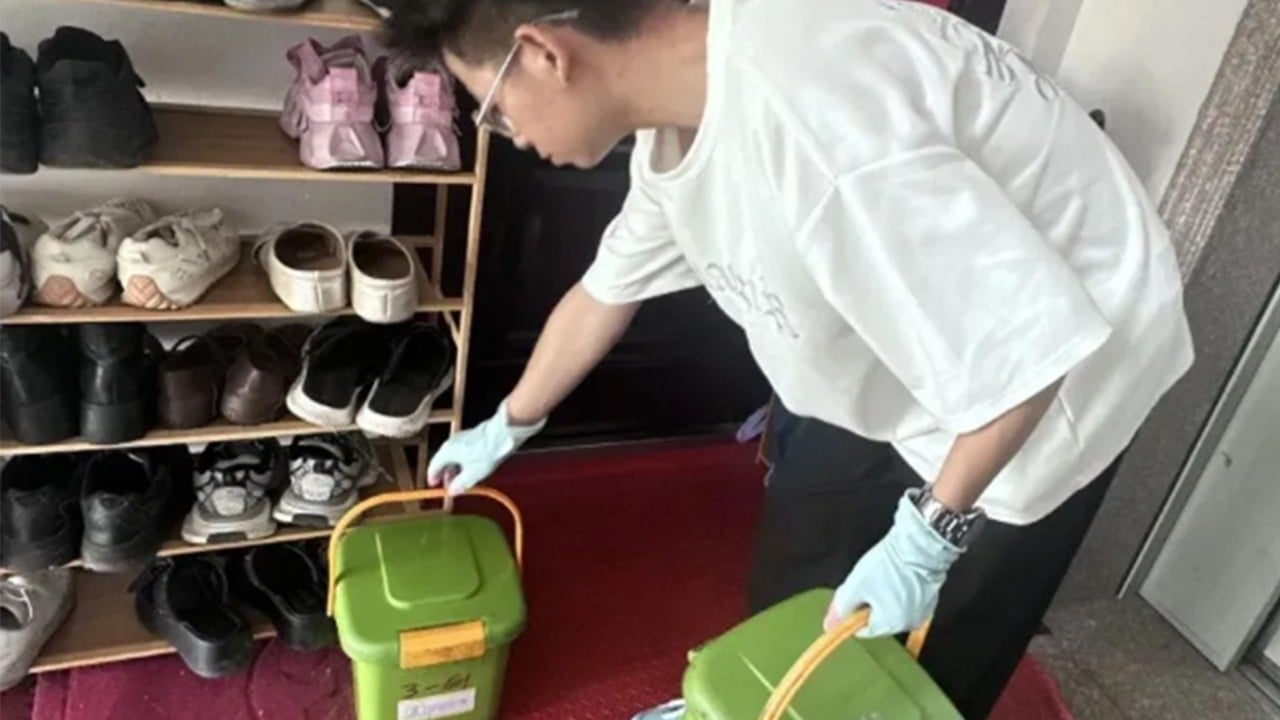
Every morning at precisely eight o'clock, Uncle Zhang knocks on apartment 402. He is sixty-two himself, sporting a weather-beaten windbreaker and knees that creak like old floorboards, but compared to the tenants he serves, he is an athlete. He doesn't wait for an answer; he knows the routine. The door clicks open just an inch, and a knotted plastic bag appears through the gap.
"Morning, Uncle Zhang," a frail voice whispers from the dark hallway inside.
"Morning, Mrs. Wang. Leave the bin clean today," he replies, his voice raspy from decades of smoking cheap cigarettes.
He takes the bag, drops it into a larger sack slung over his shoulder, and moves on to the next door. By noon, he will have cleared three entire residential blocks. He collects from fifty households. Fifty times one hundred yuan is five thousand yuan a month—roughly seven hundred US dollars. In a tier-two or tier-three Chinese city, it is a respectable living for a retired factory worker whose pension isn't quite enough to keep up with the rising cost of medicine and fresh fruit.
Economists call this the silver economy. The phrase smells like a whiteboard in a corporate consulting firm, sterile and bloodless. But walk with Uncle Zhang for twenty minutes, and you realize how deeply flawed that vocabulary is. This isn't just a market trend or an aging demographic dividend. It is a social safety net woven out of sweat, trust, and small change.
The gig economy usually gets written about through the lens of algorithmic oppression—faceless apps driving algorithms that squeeze exhausted couriers to the absolute brink. But this micro-economy operates on an entirely different frequency. It is hyper-local. It is analog. It is built on eye contact and mutual reliance.
Mrs. Wang doesn't use an app to summon Uncle Zhang. She doesn't rate him with five digital stars on a glowing screen. Her guarantee is the heavy wooden door of her apartment and the fact that she has known his older brother for forty years. If she forgets to leave the garbage out, Uncle Zhang will give a gentle, two-tap knock just to make sure she is still breathing.
The transaction expands far beyond waste management. Once you enter someone's apartment threshold every single day, you cease to be a service provider and become part of their perimeter fence against absolute isolation.
Consider what happens next: Uncle Zhang doesn't just take the rubbish. He notices that Mrs. Wang’s lightbulb in the hallway has burned out. He stops at the local hardware stall on his way back, buys a replacement for five yuan, and screws it in without being asked. Two days later, he helps her carry a heavy bag of rice up the stairs, refusing the extra ten yuan she tries to slip into his coat pocket.
This is the hidden architecture of mutual aid. In a society where adult children often migrate hundreds of miles away to tech hubs like Shenzhen or Hangzhou for high-paying engineering or corporate jobs, aging parents are left behind in the old quarters. They have money sent home via WeChat Pay, but money cannot climb stairs. Money cannot check if your blood pressure is spiking.
The fifteen-dollar rubbish collection service bridges that exact gap. It provides adult children—stuck in cubicles thousands of miles away—with a profound sense of psychological relief. They know someone local is checking in on their aging parents daily. They are essentially outsourcing peace of mind.
Critics might look at this and see a symptom of structural failure—a society where seniors are forced to rely on informal, low-wage micro-services just to manage basic sanitation because their neighborhoods lack modern infrastructure. There is truth in that critique. Urban planners in rapidly developing nations are learning harsh lessons about the speed of demographic aging versus the painfully slow pace of architectural retrofitting. Installing elevators in twenty-thousand aging walk-up blocks is an engineering nightmare that will take decades and billions of dollars.
You cannot retrofit a city overnight. But people must live today.
While governments debate urban renewal grants and smart-city retrofits, the market—driven by sheer human ingenuity and economic necessity—fills the vacuum with human hands and plastic sacks. It turns a systemic vulnerability into a localized livelihood.
The economics are astonishingly lean. There is zero overhead. No venture capital funding rounds, no sleek headquarters in glass towers, no marketing spend. The infrastructure consists of a shoulder pole or a sturdy bicycle cart, a pair of calloused hands, and a deep, intimate knowledge of who lives behind every peeling green door in the lane.
As afternoon settles over the lane, the sunlight cuts through the narrow gap between the concrete eaves, illuminating swirling dust motes in the stairwells. The plastic bags are gone, hauled away to the neighborhood collection point down on the main thoroughfare. The hallways are quiet again.
Down on the corner, Uncle Zhang leans against his cart, wiping sweat from his forehead with a stained towel. He counts a few crumpled bills pulled from his pocket, smoothing out a creased twenty-yuan note with his thumb. It is grueling, unglamorous work. It smells of decay and exertion.
Yet, as another resident calls down from a second-floor window to ask if he can pick up a broken stool tomorrow, Uncle Zhang simply nods and smiles. In the quiet machinery of survival, the fifteen-dollar bag of rubbish has kept the neighborhood alive for another day.