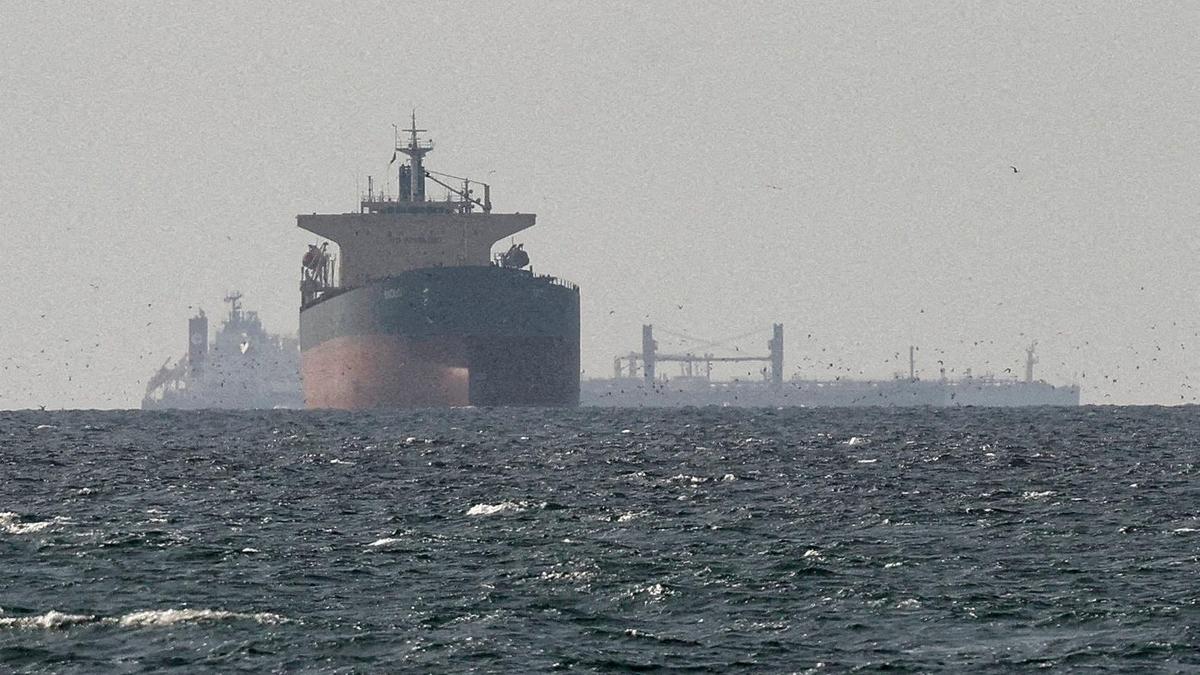
The salt air in the Strait of Hormuz doesn't smell like the ocean. It smells like gasoline and old iron. It is a narrow, claustrophobic ribbon of blue that dictates the temperature of your home and the price of your groceries. When a merchant sailor looks out from the bridge of a Panamax tanker, they aren't looking at a map. They are looking at a hair-trigger.
Two days ago, that trigger was pulled.
Three merchant vessels, laden with the literal lifeblood of global commerce, found themselves boxed in by the aggressive silhouettes of Iranian fast-attack craft. Tracers lit the sky. Steel met lead. This wasn't a skirmish over territory. It was a message sent in the language of ballistics, aimed directly at the mahogany tables in Washington where diplomats were trying to revive the ghost of a nuclear deal.
The Captain and the Chessboard
Consider a man like Elias. He’s a hypothetical third mate on a bulk carrier, the kind of person who spends six months a year vibrating to the hum of a massive diesel engine. For Elias, the "resumption of U.S.-Iran talks" isn't a headline. It is a terrifying reality that manifests as a radar blip closing at forty knots.
When the Iranian Revolutionary Guard Corps (IRGC) vessels swarmed, Elias didn’t think about the Joint Comprehensive Plan of Action. He thought about the quarter-inch of steel between his boots and the crushing weight of the Gulf. The IRGC operates on a philosophy of "asymmetric friction." They know they cannot win a conventional war against a superpower. Instead, they turn the Strait into a pressure cooker.
The Strait is barely twenty-one miles wide at its narrowest point. Two miles of that are the actual shipping lanes. If you park a few sunken hulls or a minefield there, the global economy stops breathing. By firing on these ships, Tehran is reminding the world that while the U.S. controls the global financial system, Iran holds the physical "off" switch.
The Invisible Stakes of a Cold Engine
We often treat international relations like a game of Risk, moving plastic pieces across a board. In reality, it is a delicate web of insurance premiums and supply chains.
The moment those first shots were fired, the "war risk" insurance for every vessel in the region spiked. That isn't a theoretical cost. It’s a tax on existence. It means the grain headed to East Africa becomes more expensive. It means the components for the smartphone in your pocket sit on a dock in Jebel Ali because the risk of transit has bypassed the threshold of profit.
The U.S. Navy’s 5th Fleet, based in nearby Bahrain, scrambled assets. But the ocean is vast, and a fast-attack boat is small. It’s a ghost in the machine. This tactical reality creates a massive diplomatic headache. How do you negotiate a nuclear stand-down with a partner who is simultaneously trying to sink the merchant ships of your allies?
The irony is thick enough to choke on. The talks were supposed to be a bridge back to stability. Instead, the water is boiling.
Why the Silence Breaks
Tehran's strategy is transparent yet effective. They feel the walls of sanctions closing in. Their currency is a memory of its former value. In their eyes, the only way to get the West to take them seriously is to make the West feel their pain.
They use the Strait as a megaphone.
Every bullet fired at a hull is a sentence in a negotiation. It says: We are not a secondary character in your story. This recent escalation wasn't an accident or a rogue commander acting on a whim. It was a calculated calibration. By targeting three ships, they ensured the incident was too large to ignore but just small enough to avoid a full-scale kinetic response from the U.S. Navy. It is a tightrope walk over a shark tank.
The Ghost at the Table
In the sterile rooms of Vienna or Geneva, the air-conditioning hums, and the coffee is always hot. Diplomats speak in the passive voice. They talk about "milestones," "frameworks," and "transparency measures."
But the ghost at the table is the sound of a 12.7mm heavy machine gun hitting the side of a tanker.
The U.S. finds itself in a strategic vice. If they pull back from the talks to punish the aggression, they lose the chance to contain Iran’s nuclear ambitions. If they continue the talks as if nothing happened, they signal to every maritime bully in the world that the sea lanes are open season.
There is no easy exit. Diplomacy requires trust, or at least a mutual understanding of the consequences of betrayal. When the bullets fly, trust doesn't just erode—it vaporizes.
The Weight of the Horizon
For the crews on those ships, the horizon is no longer a symbol of hope or the path home. It is a source of anxiety. They watch the dark shapes of the coast, knowing that the geopolitics of two nations are being played out on their decks.
We talk about "complicating efforts" to talk. It’s a sterile phrase. The reality is much messier. It’s the smell of smoke on the wind and the sight of a gray hull cutting through the surf. It’s the realization that the world’s most powerful nations are being held hostage by a few miles of water and the will of men who have nothing to lose.
The sun sets over the Strait of Hormuz, turning the water the color of bruised fruit. Somewhere out there, a radar operator is watching a blip. Somewhere else, a diplomat is checking their watch. Both are waiting for the same thing: to see who blinks first in the dark.
The world waits for the next blip. The next shot. The next reason to believe that the bridge to peace is actually a pier built on shifting sand.