Every time the skies open over West Africa and the streets of Abidjan turn into lethal torrents, the international press runs the exact same script. They point to the dark clouds, quote a couple of macro-level climate models, and blame global carbon emissions for the tragic loss of fifty-nine lives in Côte d’Ivoire.
It is a convenient narrative. It is clean. It shifts the blame from human failure to planetary inevitability.
It is also completely wrong.
Stop looking at the sky. The catastrophe unfolding in West Africa is not an act of God or an unavoidable consequence of a warming planet. It is an engineering failure, a governance disaster, and an urban planning grift. Rainfall is a meteorological event; a flood is a human creation. By treating these annual tragedies as unpredictable climate anomalies, international observers and local politicians are letting the real culprits off the hook.
I have spent years analyzing urban development and infrastructure life cycles across developing economies. I have seen municipal governments burn through millions of dollars in foreign aid while ignoring the literal foundations of their cities. The hard truth about Abidjan is simple: the city was built to fail, and the current approach to fixing it ensures that more people will die next year.
The Myth of Unprecedented Rain
The standard media report framing the recent floods relies on a lazy consensus: the rain was simply too heavy for any city to handle. This is mathematically provable nonsense.
West Africa has always experienced intense monsoon seasons. The regional climate mechanics dictate heavy, concentrated precipitation events between May and July. Hydrological data from the region shows that while intensity fluctuations exist, the volume of rainfall recorded during these fatal weeks falls well within historic parameters.
The variable that changed is not the volume of water falling from the clouds. The variable is what happens to that water when it hits the ground.
In a naturally functioning ecosystem, the coastal lagoons, wetlands, and heavily forested hills of southern Côte d’Ivoire act as a massive sponge. They absorb peak flows and slowly release water into the Atlantic Ocean. Today, that sponge is entirely gone. It has been paved over with asphalt, concrete, and unregulated high-density housing.
When you replace thousands of hectares of absorbent earth with impermeable surfaces, you create a hydraulic accelerator. Rainwater that used to take hours to infiltrate the soil now turns into surface runoff within seconds. It creates a flash flood asset class—engineered disasters where water has nowhere to go because the natural drainage corridors have been choked out of existence.
The Architecture of a Man-Made Disaster
To understand why fifty-nine people died, you need to understand the structural layout of Abidjan's rapid expansion. The city has grown at an exponential rate over the last two decades, fueled by economic centralization and rural-to-urban migration. Districts like Cocody, Yopougon, and Abobo have swollen past their historical boundaries.
But look beneath the surface. The infrastructure did not grow with the population.
The Concrete Chokehold
In wealthy enclaves like Cocody, luxury villas and modern apartment complexes have been built directly over natural drainage channels (talwegs). Property developers with political connections routinely bypass zoning laws, filling valleys with concrete to maximize real estate footprints. When a heavy rainstorm hits, the water follows its historical path. If a multi-million dollar villa is sitting in that path, the water goes through it, or builds up behind it until a retaining wall collapses, wiping out informal settlements downstream.
Informal Vulnerability
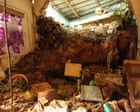
At the other end of the socioeconomic spectrum, marginalized populations are pushed into the lowest-value land available: steep, unstable hillsides and low-lying marshlands. These areas lack basic municipal services. There are no engineered drainage networks, no retaining walls, and no paved roads. When saturation hits a critical threshold, the hillsides simply liquefy. The majority of the casualties in the recent floods did not drown in open water; they were buried alive in mudslides because they were forced to build homes on terrain that should never have been zoned for human habitation.
The Solid Waste Crisis
Even where engineered drainage systems exist, they are functionally useless. Abidjan’s municipal waste management system is chronically broken. Tons of plastic bottles, household refuse, and construction debris clog the primary stormwater drains every single day. When the rainy season arrives, these massive concrete channels are already packed tight with solid waste. The water cannot flow through them, so it surges upward, converting roads into raging rivers. Clean the drains, and you solve half the flooding problem overnight. But cleaning drains is unglamorous work that does not generate international headlines or photo opportunities for politicians.
The Climate Change Exculpation Grift
Why do local administrators and international NGOs love the climate change narrative so much? Because it provides absolute immunity from accountability.
If a flood is caused by a failure to clear garbage from storm drains, or a failure to enforce basic building codes in Cocody, then the blame sits squarely on the shoulders of local mayors, infrastructure ministers, and municipal inspectors. It means someone accepted a bribe to approve a building permit on a wetland. It means someone pocketed the budget allocated for seasonal drain maintenance.
But if the flood is blamed on global climate change, the responsibility vanishes into thin air. It becomes a global problem, driven by factories in Europe and consumer habits in North America. The local politician can stand in front of a ruined neighborhood, shrug their shoulders, and claim they are a victim of global forces beyond their control.
Even worse, this narrative acts as a massive fundraising tool. By framing a local engineering failure as an existential climate emergency, governments can access international climate adaptation funds and green bonds. Millions of dollars flow into the country under the guise of sustainability.
Where does that money go? It rarely goes into deep, expensive, sub-surface civil engineering projects like massive underground storm-water bypass tunnels or comprehensive slum relocation programs. Instead, it gets funneled into superficial initiatives: green policy workshops, urban sustainability master plans that are never enforced, and high-visibility public relations campaigns.
The Flawed Questions We Keep Asking
The public discourse surrounding these events is trapped in a loop of flawed questions. If you ask the wrong questions, you will get answers that cost lives.
Flawed Question: How much international aid do we need to build climate-resilient cities in West Africa?
The Brutal Reality: None, if the existing budgets were spent correctly. The issue is not a lack of capital; it is the misallocation of capital. Pouring more international aid into a broken procurement system without changing structural governance is like pouring water into a rusted bucket. The money leaks out into private bank accounts long before it reaches the drainage trenches.
Flawed Question: Can we build early-warning weather systems to save lives during torrential rains?
The Brutal Reality: An early-warning system does nothing for a family living in a mud shack on a sixty-degree slope in Yopougon. They already know it is raining. They can see the water rising. The problem is they have nowhere else to go, and no economic mobility to leave. Telling someone they are about to be hit by a flood without giving them a viable, safe alternative place to live is cruel, ineffective theater.
The High Cost of Real Solutions
Fixing Abidjan’s flood crisis requires a level of political will and economic ruthlessness that few in power are willing to execute. The solutions are obvious, mechanical, and deeply unpopular with both the political elite and the voting public.
First, the government must launch a mass demolition campaign. Every luxury villa, apartment complex, and commercial building constructed over a natural drainage channel must be torn down. No exceptions. No retroactive zoning variances for wealthy campaign donors. If a building blocks a talweg, it must be removed to clear the hydraulic path.
Second, the state must forcibly relocate hundreds of thousands of people out of high-risk informal settlements. This cannot be a temporary eviction; it requires the construction of massive, subsidized, low-income urban housing developments on safe, elevated terrain outside the city center. It means spending billions on boring things: concrete foundations, sewer lines, and mass transit connectivity so relocated workers can still reach their jobs.
Third, municipal management must be professionalized. Waste collection must be treated as a critical national security issue. If the storm drains are blocked with trash, the city will drown, regardless of how many climate adaptation treaties the government signs.
The downside to this contrarian approach is obvious: it is incredibly expensive, politically toxic, and will cause massive social disruption in the short term. Tearing down homes and moving communities creates immediate anger. It disrupts local economies. It costs politicians elections.
But the alternative is far worse. The alternative is to keep doing what we are doing now: watching fifty to a hundred citizens drown every single summer, writing solemn op-eds about the tragedy of global warming, and waiting for the next storm to wash away the evidence of our collective cowardice.
Stop blaming the weather. The rain is just doing what physics demands. The disaster is entirely ours.