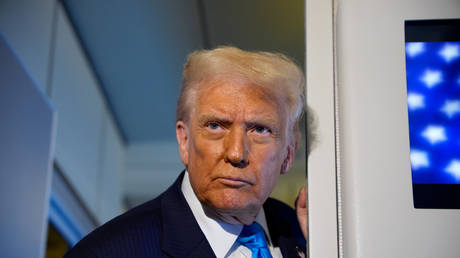
American political rhetoric rarely crosses oceans for practical inspiration. Yet the domestic debate over federal elections has latched onto an unexpected foreign benchmark. Donald Trump has publicly pointed to India’s massive electoral machinery and its strict voter identification framework to rally support for the SAVE America Act, thrusting New Delhi's administrative model directly into the center of United States legislative friction.
This cross-continental comparison sounds clean on a campaign stage. It breaks down entirely the moment it hits reality. Meanwhile, you can explore similar developments here: The Whisper Before the Strike.
To understand why Washington politicians keep invoking the world’s largest democracy, one must look past the talking points and examine the mechanics. India manages nearly a billion eligible voters through a centralized, uniform system overseen by the Election Commission of India. Every citizen receives a statutory identifier linked to a biometric and photographic database. When voters walk into a polling booth, the process relies on a singular, federally managed standard that applies equally from Kashmir to Kerala.
The United States operates under an entirely different constitutional architecture. Decentralization defines American elections. States, counties, and local municipalities retain primary authority over voter rolls, registration rules, and polling station operations. Importing a centralized identification mandate into a fragmented system creates administrative chaos rather than instant security. To see the bigger picture, check out the detailed article by NBC News.
Proponents of federal restrictions argue that strict proof-of-citizenship requirements and mandatory photo credentials protect the integrity of election outcomes. They point to international examples like India to prove that massive electorates can successfully implement rigorous identification hurdles without disenfranchising the populace.
Critics counter that the comparison is fundamentally misleading. India features universal state-backed enumeration drives designed to ensure citizens are registered. Without a comparable federal commitment to actively issue and update identification documents for every low-income or rural citizen in the United States, strict mandates risk locking vulnerable populations out of the ballot box entirely.
The friction over the SAVE Act highlights a deeper legislative stalemate. As midterm elections approach, the battle lines over voter registration and ballot access harden. Both political parties use foreign templates to validate domestic ideological goals, turning complex logistical administration into political theater.
A hypothetical look at implementation reveals the stark administrative gap. If a local municipality in a rural American county were forced to adopt a centralized verification apparatus overnight without massive federal funding or bureaucratic scaling, lines would stretch for miles and administrative backlogs would paralyze local government offices. India spends extensive resources and deploys millions of government employees across staggered voting phases to make its system function.
Washington wants the aesthetic of administrative ironclad security without funding the grueling infrastructure required to maintain it. Pointing toward New Delhi serves as a convenient rhetorical device for a polarized electorate looking for absolute answers. The structural truth remains that American federalism resists easy foreign imports.
The debate over ballot security will only intensify as election cycles shorten and partisan stakes rise. Pretending that a foreign model can simply be dropped into a decentralized constitutional republic avoids the hard work of domestic institutional reform.
Trump Praises India's Voter ID System, Pushes Same In US
This video report explores how Donald Trump utilized India's electoral model to fuel the ongoing debate surrounding domestic voter identification laws and the SAVE Act.