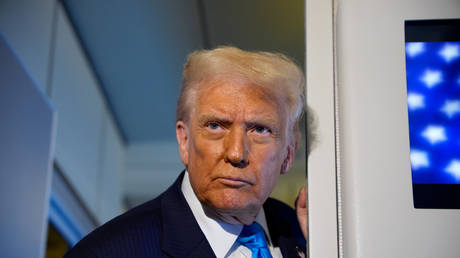
The sixty-day window has slammed shut. President Donald Trump confirmed Tuesday that all lines of communication with Tehran have gone dark, marking a definitive end to the fragile memorandum of understanding signed earlier this summer at the Palace of Versailles. With no talks scheduled and the naval blockade of the Strait of Hormuz solidified, the conflict has shifted from a phase of tentative maneuvering into a period of acute, potentially long-term military friction.
The failure of this latest diplomatic effort highlights a recurring pattern in the current administration’s approach to global crises: the reliance on rigid, ultimatum-driven negotiations. When the clock expired this week, the primary sticking point remained unchanged. Washington demands a total cessation of nuclear development, while Tehran continues to leverage its geographic control over the world’s most sensitive maritime chokepoint. The result is a stalemate that has pushed global oil markets to levels not seen in decades and forced major economies to reconsider their reliance on traditional energy corridors.
To understand why these talks collapsed, one must look past the public rhetoric. During the summer months, whispers of progress fueled speculative markets. Envoys spoke of "robust" channels and emerging arrangements with regional mediators like Oman. Yet, these discussions were never truly anchored in common ground. Instead, they functioned as a tactical pause—a way for both sides to assess military readiness while publicly signaling an openness to peace that neither side felt compelled to honor.
The White House position is starkly transactional. President Trump has framed the situation as a binary choice: either Iran abdicates its nuclear aspirations completely, or the economic and military pressure will continue to mount. This approach assumes that a regime under extreme duress will eventually accept a disadvantageous deal to survive. However, historical precedent in the region suggests otherwise. Tehran has long demonstrated an ability to weather sanctions and asymmetric naval engagements, using the Strait of Hormuz not merely as a waterway, but as a strategic bargaining chip to force the international community to the table.
Consider the role of the Strait of Hormuz itself. It is no longer just a shipping lane; it has become the central object of a territorial dispute. By declaring the strait a focus of U.S. naval operations and rejecting Iranian management, the administration has elevated the stakes from a nuclear non-proliferation issue to a direct challenge of Iranian sovereignty. This is a gamble of historic proportions. If the blockade fails to compel Tehran to surrender, the United States faces the prospect of a permanent, high-cost military presence in a theater where the risk of unintended escalation is constant.
The collapse of this agreement also exposes deep fissures among international partners. While the administration seeks a unified front, nations like Turkey have pushed for continued diplomatic channels, concerned that a total military standoff will destabilize the entire region for a generation. These dissenting voices are often dismissed by the current White House as secondary, yet they represent a significant obstacle to a long-term resolution. Without a cohesive coalition, the United States is essentially acting alone, shouldering the entire burden of enforcement and the inevitable economic fallout.
What follows is an era of heightened uncertainty. With the cessation of trade and financial transactions by regional neighbors like the United Arab Emirates, the diplomatic space available for de-escalation is vanishing. The administration now faces the reality that its maximum pressure campaign has reached a point of diminishing returns. Military strikes, blockade enforcement, and public threats of "big trouble" have been the hallmarks of this policy, but none have succeeded in changing the fundamental calculus of the leadership in Tehran.
We are witnessing the limits of a strategy built solely on coercion. When the only available tool is a hammer, every problem begins to resemble a nail, yet some problems are made of much harder material. The nuclear issue, deeply entwined with national identity and regime survival in Iran, will not be solved through the simple expiration of a memo or the enforcement of a maritime perimeter. It requires a level of diplomatic sophistication that is currently absent from the dialogue.
The situation remains volatile. Recent reports of ballistic missile activity and the targeting of shipping underscore how quickly this cold standoff can turn into a regional conflagration. As the naval blockade tightens, the focus will undoubtedly shift toward whether the administration can maintain this stance without triggering the very conflict it claims to be preventing. The transition from negotiation to confrontation is rarely clean, and the exit ramp from the current path is becoming increasingly narrow.
The reality of the current stalemate is that there is no plan for what happens tomorrow. The policy is the pressure itself. If the objective is to maintain the status quo until the adversary breaks, the question is how much global stability the international market is willing to sacrifice in the process. The silence from the White House regarding future outreach is telling. It implies that for the current administration, the policy of isolation is not a precursor to a new round of talks, but the final, intended state of the relationship.
History will judge whether this approach was a necessary display of strength or a profound miscalculation. For now, the ships continue to navigate a strait that is nominally open but functionally captured by the gravity of a war that neither side has officially declared, yet both are actively fueling. The window for a graceful solution has closed. What remains is a high-stakes standoff with no clear mechanism for resolution, leaving the world to manage the consequences of a diplomatic failure that was arguably inevitable from the day the first ultimatum was issued.
The strategic landscape has shifted beneath our feet. We have moved from a world of managed risk to a world of active, constant friction. The administration is betting that they can control the intensity of this friction, but in the volatile waters of the Middle East, the ability to control an escalation is an illusion. As the blockade holds and the rhetoric intensifies, the true cost of this policy will be tallied not in declarations, but in the rising price of inaction. The path forward is not through further isolation, but that is the only direction current policy is pointed. The inevitable consequence of such a rigid stance is an equally rigid response from the adversary, locking both nations in a cycle that leaves no room for the diplomacy required to actually change the outcome.