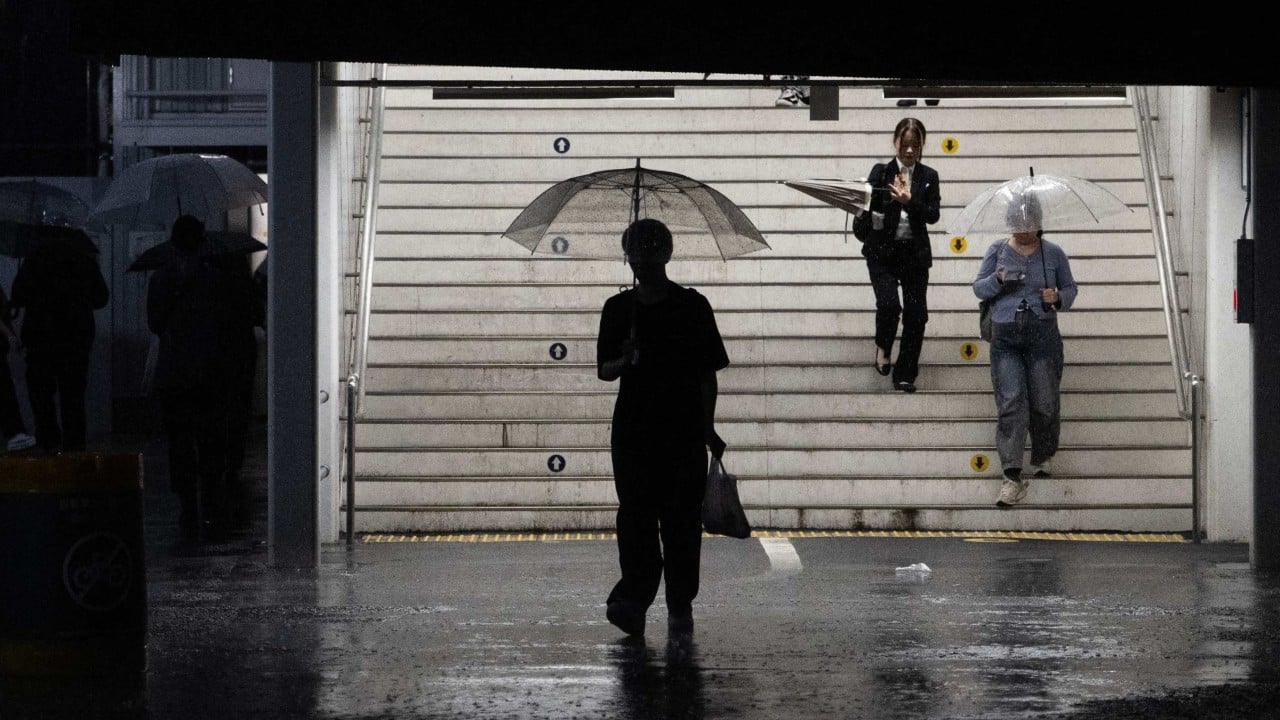
Record rainfall events trigger predictable urban hydrological failures. When precipitation rates exceed municipal drainage capacity, low-lying infrastructure, particularly underpasses and subterranean roadways, transforms into hydraulic traps. The recent recovery of a fatality from a submerged vehicle in Japan highlights a recurring structural vulnerability in disaster response and personal survival mechanics during extreme weather.
Understanding this class of incident requires deconstructing the physical, mechanical, and psychological variables that govern vehicular survival in rapidly rising water. Survival is not a matter of chance; it is a function of time, pressure differentials, and immediate execution of specific exit protocols before the vehicle loses buoyancy or electrical integrity.
The Three Phases of Vehicular Submersion
A sinking car transitions through three distinct physical phases. Each phase narrows the window of survivability and alters the operational mechanics required to escape.
Phase One: The Floating State
Upon entering standing water, a standard passenger vehicle floats temporarily because the cabin contains a volume of trapped air. During this phase, which typically lasts from thirty seconds to two minutes depending on water ingress rates, the doors remain operable.
The primary barrier to escape in phase one is psychological paralysis rather than physical resistance. Occupants often hesitate, assuming the vehicle will maintain position or that external assistance will arrive. This delay is fatal. Once water reaches the bottom of the window frame, the pressure dynamics shift irreversibly.
Phase Two: The Equalization Window
As water fills the engine compartment and cabin floorwells, the internal air volume compresses and escapes. The water level inside rises until it matches the external water level.
During this transition, hydrostatic pressure against the exterior of the doors makes them impossible to open. The force required to push open a door submerged by even one foot of water translates to hundreds of pounds of resistance against the occupant's leverage capacity. Physical strength becomes irrelevant against hydrostatic loads.
Phase Three: The Full Submersion State
When the cabin is entirely flooded, the internal and external water pressure equalizes. The force holding the doors shut disappears. However, by this point, the vehicle has settled on the substrate, visibility is near zero, and occupants must hold their breath while manually operating release mechanisms in an inverted or cramped spatial orientation.
The Mechanical Variables of Escape
The failure to escape a submerged vehicle stems from a fundamental misunderstanding of vehicle engineering and fluid dynamics. Standard operational assumptions fail entirely when aquatic immersion occurs.
Electrical System Failure
Modern vehicles rely on electronic window controls powered by secondary battery circuits that short-circuit upon contact with water. When a vehicle enters deep water, electronic window mechanisms typically fail within seconds.
Relying on power windows after submersion begins is a critical error. Manual window cranks, standard in older models, bypass this failure mode, but their market share has declined significantly. Consequently, occupants must rely on specialized impact tools designed to shatter tempered or laminated side glass immediately upon entry into the water.
Glass Physics
Windshields are constructed from laminated glass designed to withstand high impact forces and prevent ejection; they cannot be kicked out or broken easily with standard objects. Side windows use tempered glass, which shatters into small granules under localized point pressure.
A spring-loaded center punch or dedicated window breaker applied to the corner of the side window is the only reliable method to create an immediate opening during phase one or phase three. Attempting to break the glass in the center yields poor results due to the flex of the material.
Hydrological Factors in Urban Infrastructure
Extreme rainfall events overload drainage matrices designed for historical precipitation baselines rather than modern climate volatility. Urban planning failures compound the risk profile for motorists.
Subterranean Road Geometry
Underpasses and depressed roadways act as natural retention basins. When municipal pumping stations fail or lack adequate capacity, these zones fill within minutes.
The velocity of water entering an underpass creates a localized current that can sweep a moving vehicle off the roadway, turning a transit route into a dynamic flume. Drivers often misjudge the depth of standing water because the reflective surface conceals the drop-off gradient of the approach ramp.
Hydroplaning to Immersion Transition
Loss of tire traction occurs long before total submersion. When a wedge of water builds beneath the tire contact patch, directional control is lost.
If the vehicle drifts off the elevated roadway into an adjacent canal, drainage ditch, or flooded basin, the transition from kinetic motion to vertical drop accelerates the crisis timeline, often resulting in disorientation upon impact with the water surface.
Behavioral and Operational Gaps in Disaster Response
Emergency management communications during extreme weather events frequently rely on generalized warnings rather than actionable kinetic instructions. Public messaging advises motorists to avoid flooded roads, but lacks granular tactical protocols for drivers already caught in a flash flood.
Furthermore, emergency dispatch systems experience extreme load during record rainfall events. Relying on rescue services during the initial minutes of a vehicular submersion is statistically unviable. The response time of municipal rescue units exceeds the critical survival window defined by the cabin's floatation phase.
Immediate self-rescue remains the sole variable within the occupant's control. Municipal infrastructure updates and improved meteorological warning systems address the macro level of risk, but micro-level survival depends entirely on preemptive equipment availability—specifically, mounting a window-breaking and seatbelt-cutting tool within reach of the driver seat before an event occurs.
Deploy immediate operational checks across municipal transit networks: implement automated physical barrier gates at all subterranean underpasses that close when water depth sensors cross the thirty-centimeter threshold, thereby eliminating driver discretion during rapid-onset flood events.