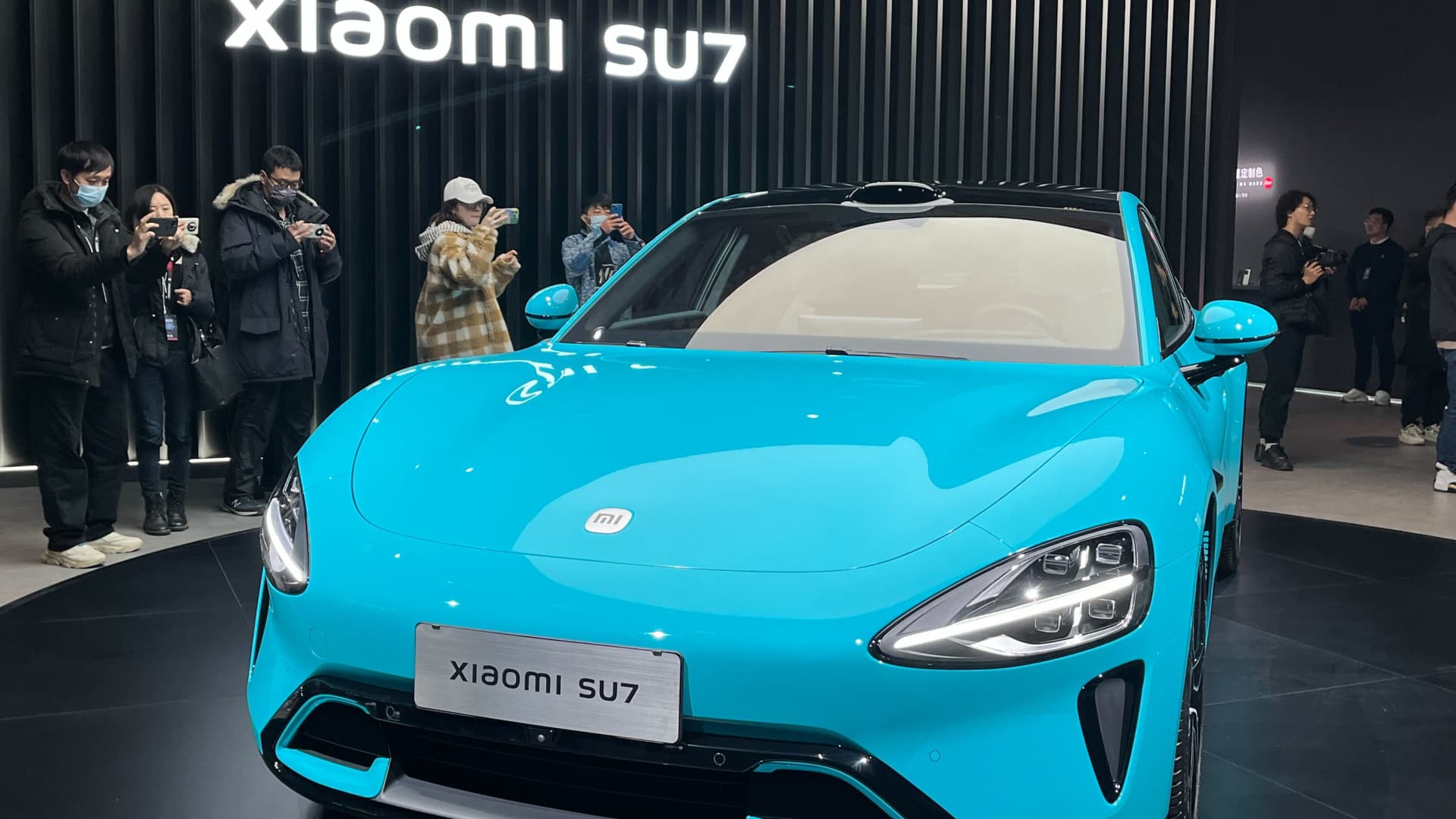
Xiaomi is no longer content with being the world’s third-largest smartphone maker. The Beijing-based giant is now pivoting its massive supply chain and software ecosystem to challenge Elon Musk’s dominance in the European electric vehicle market. By launching the SU7—a high-performance electric sedan—in select European markets, Xiaomi is betting that it can translate brand loyalty from the pocket to the driveway. This move isn't just about selling cars; it is a calculated attempt to integrate the vehicle into a broader "Human x Car x Home" digital ecosystem that Tesla currently cannot match.
The automotive world is witnessing a collision of two distinct philosophies. On one side stands Tesla, the pioneer that treated the car as a computer on wheels. On the other stands Xiaomi, a company that views the car as just another peripheral in a connected life. While the European automotive establishment struggles with software-defined vehicles, Xiaomi arrives with a decade of experience in building operating systems used by hundreds of millions.
The Manufacturing Miracle
Most tech companies that try to build cars fail. They underestimate the sheer brutality of automotive hardware. Apple spent ten years and billions of dollars before finally pulling the plug on its vehicle project. Xiaomi, however, went from a "green light" to mass production in just three years. This speed is terrifying to European legacy brands like Volkswagen and BMW.
The secret lies in the Beijing hyper-factory. Xiaomi utilized large-scale die-casting technology—similar to Tesla’s "Giga Press"—to reduce the number of components in the rear floor of the SU7 from 72 parts to a single piece. This cuts weight and improves manufacturing efficiency. But hardware is only half the story. The real threat to Tesla in Europe is Xiaomi’s ability to control costs while offering features that Musk often relegates to "Full Self-Driving" beta tiers or omits entirely to save on margins.
Europe is a difficult playground. It has strict safety ratings, complex charging infrastructure, and a consumer base that values build quality over raw acceleration. Xiaomi’s entry strategy involves positioning itself as a premium alternative that offers more "car" for less money, wrapped in a software package that feels as fluid as an iPhone.
Software as the Ultimate Differentiator
Tesla’s infotainment system is widely regarded as the industry gold standard. It is fast, intuitive, and integrated. However, it remains a closed loop. If you use a Xiaomi smartphone or any of the thousands of smart home devices in their ecosystem, the SU7 becomes an extension of your living room.
HyperOS, the company’s proprietary operating system, allows for near-instant synchronization between devices. Imagine a driver approaching their vehicle; the car recognizes the phone, adjusts the seat, loads the navigation from a previous search, and prepares the smart lights at home for the driver's eventual return. This level of cross-device integration is where the battle for the European buyer will be won.
Tesla owners often complain about the lack of Apple CarPlay or Android Auto. Musk wants you in his ecosystem. Xiaomi is offering a different kind of trap—one that is already in your pocket. If you already own a Xiaomi scooter, watch, and air purifier, the car is the logical final piece of the puzzle.
The European Protectionist Wall
Entering Europe is not a simple logistical hurdle. The European Commission has been increasingly vocal about the influx of Chinese EVs, citing concerns over state subsidies and "unfair" pricing. Tariffs are the primary weapon of choice for Brussels.
Xiaomi faces a steep climb. To avoid being sidelined by import duties, the company must prove that its value proposition isn't just "cheap Chinese manufacturing." It has to lead with innovation. This is why the SU7 is being marketed with specs that rival the Porsche Taycan rather than the budget-friendly MG or BYD models. They are aiming for the "tech-aspirational" demographic—the people who bought Teslas five years ago but are now looking for something more refined and better integrated with their digital lives.
There is also the matter of the service network. Tesla spent a decade building the Supercharger network, which remains its "moat." Xiaomi does not have this. In Europe, they will have to rely on third-party charging providers and build a service infrastructure from scratch. This is a massive capital expenditure that will test the company’s cash reserves, even with its highly profitable smartphone division footing the bill.
The Musk Factor
Elon Musk has a habit of dismissing competitors until they start eating his lunch. He famously laughed at BYD years ago; today, BYD is fighting Tesla for the global top spot in EV sales. Xiaomi represents a different kind of threat. Unlike traditional car companies, Xiaomi is comfortable with razor-thin hardware margins. They are used to making money on services, data, and ecosystem lock-in.
If Xiaomi can price the SU7 competitively in Europe despite tariffs, they break the price-to-performance ratio that Tesla has enjoyed for years. The SU7’s "V6" and "V8" electric motors (named to tweak the noses of internal combustion enthusiasts) offer performance metrics that force Tesla to either drop prices again or lose the spec war.
The Logistics of a Global Pivot
Shipping cars is harder than shipping phones. The sheer volume of an automotive supply chain requires deep-water ports, specialized car-carrier ships, and massive regional distribution centers. Xiaomi is currently scouting locations in Eastern Europe for potential assembly plants to circumvent trade barriers, a move that would mirror the strategies of other Chinese giants.
Building locally isn't just about avoiding taxes; it’s about optics. European consumers are increasingly wary of the carbon footprint of the products they buy. A car built in Hungary or Poland is more palatable to a German or French buyer than one shipped across the ocean from a factory in Yizhuang.
Engineering the Perception Shift
For decades, "Made in China" was shorthand for low-cost and derivative. Xiaomi is working to flip that narrative. The SU7 was designed by a team that includes former BMW and Mercedes-Benz veterans. The aesthetic is unashamedly European—sleek, aerodynamic, and minimalist.
They are also leaning heavily into battery technology. By partnering with CATL to use "Qilin" batteries, Xiaomi is claiming ranges that exceed 800 kilometers on a single charge. In the European market, where "range anxiety" is still a significant barrier to entry, these numbers matter more than 0-100 km/h times.
The struggle for Xiaomi will be convincing a loyal Mercedes or Audi driver to trust a "phone company" with their life at 130 km/h on the Autobahn. Reliability is a currency that takes decades to earn but seconds to lose. A single high-profile software glitch or a structural failure in a European crash test could end the brand's automotive ambitions before they truly begin.
The Invisible Battle for Data
The modern electric vehicle is a data vacuum. It tracks where you go, how you drive, and what you say. European GDPR laws are the strictest in the world regarding data privacy. Xiaomi will have to be transparent—or at least very clever—about how it handles the massive streams of data generated by the SU7’s sensors and cameras.
Tesla has already faced scrutiny over its camera privacy. Xiaomi, being a Chinese firm, will face ten times that level of investigation. The ability to localize data storage within European borders will be a non-negotiable requirement for success. If they fail to secure the trust of European regulators, the cars will never be allowed to operate their advanced autonomous driving features, neutering one of their strongest selling points.
The Price of Ambition
Xiaomi’s founder, Lei Jun, has described the EV project as his "last major entrepreneurship project." He is betting his reputation and a significant portion of the company’s $15 billion cash pile on this venture. The European market is the ultimate litmus test. If they can succeed in the home of the automobile, they can succeed anywhere.
Success in Europe requires a delicate balance of aggressive pricing, high-end engineering, and a seamless digital experience. Tesla proved that the market is hungry for change. Xiaomi is now betting that the market is ready for a change from the change.
The hardware war is largely over; the components are becoming commodities. The next era of the automotive industry will be defined by who controls the interface between the driver and the world around them. Xiaomi is already in the pocket of the consumer; now they are moving into the garage. The question is no longer whether a tech company can build a car, but whether a car company can survive a tech company.
Stop looking at the SU7 as a car and start looking at it as a four-wheeled computer with a 73-kWh battery. The battle for Europe isn't happening on the assembly line—it's happening in the code.