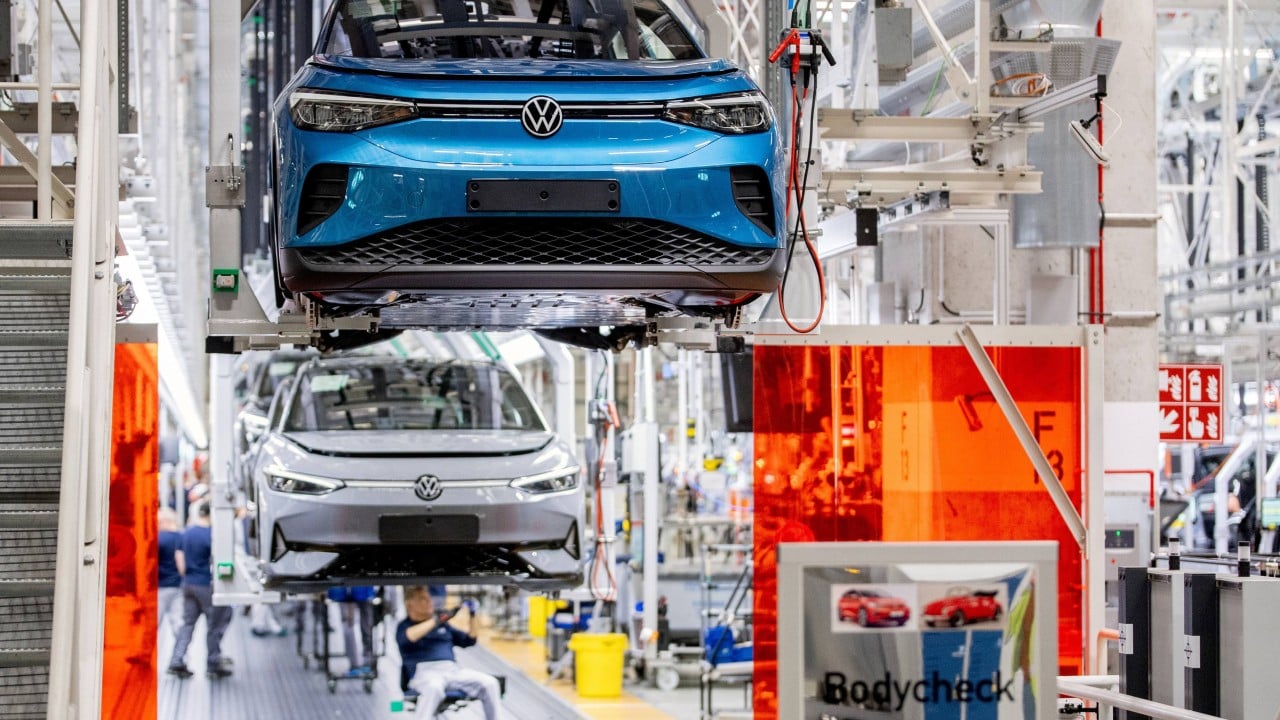
On a rainy Tuesday in Stuttgart, a mechanic named Thomas wipes grease from his knuckles and stares at an electric SUV. He is fifty-four. His father worked this same line, assembling the heavy, reassuring iron of combustion engines that defined the post-war German miracle. For decades, the math of Thomas’s life was simple. High-quality engineering equaled job security. Today, that math feels broken. He watches the digital diagnostic screen flash. The car is less a machine now and more a rolling computer encased in steel.
Across Europe, policymakers look at cars like the one Thomas works on and see a shadow stretching from the East. They see massive cargo ships leaving Shanghai, packed with cheap, subsidized electric vehicles ready to flood the continent. The fear is visceral. It smells like a dying industry. It looks like boarded-up factory towns.
But Europe is staring at the wrong ghost.
The dominant narrative coming out of Brussels and Frankfurt is one of unfair competition. The story goes like this: Beijing pours billions into its domestic battery and EV manufacturers, allowing them to underwrite their losses and dump underpriced vehicles onto the global market. The solution, we are told, is defensive. Tariffs. Walls. Protectionist trade barriers designed to keep Chinese imports at bay and save Thomas’s job.
It is a comforting story because it places the blame entirely outside of Europe's borders. It suggests that European industry is fundamentally healthy, just temporarily bullied.
It is also wrong.
To understand why, you have to leave the halls of parliament and look at how a modern electric vehicle is actually built. The competitive edge that Chinese manufacturers hold today is not merely a product of state subsidies, though those certainly exist. It is the result of a massive, decade-long structural bet on the entire supply chain.
Consider the battery. It is the heart of an electric vehicle, accounting for roughly forty percent of its total cost. While European legacy automakers were still tweaking the fuel injection systems of diesel engines in the 2010s, Chinese firms were buying up lithium mines in South America and cobalt processing plants in Africa. They built the refining capacity. They perfected the chemistry.
By the time Europe woke up to the electric transition, China had already built a vertical monopoly on the future.
Raising tariffs on finished Chinese cars does nothing to solve this foundational imbalance. It is like putting a padlock on your front door while the foundation of your house is actively sinking into the mud. If Europe slaps a twenty percent duty on an imported SUV, the Chinese manufacturer can often absorb the cost because their production expenses are already thirty to forty percent lower than their European counterparts.
Worse, those tariffs invite retaliation.
Europe’s automotive titans do not just compete with China on European soil. They rely on the Chinese market for survival. Volkswagen, BMW, and Mercedes-Benz sell millions of vehicles to China’s rising middle class every year. A trade war does not protect Thomas in Stuttgart. It puts a target on his back. If Beijing retaliates with its own duties or restricts the export of critical rare earth minerals, European production lines will grind to a halt before the cargo ships even leave port.
The real threat to Europe is not that China is playing dirty. The threat is that China is playing smarter.
Walk through a contemporary automotive plant in Shenzhen and the difference is stark. It does not look like the oily, mechanical world Thomas grew up in. It looks like a software development hub attached to a highly automated fulfillment center. The development cycle for a new vehicle in China is roughly one-third shorter than it is in Europe. They iterate at the speed of smartphones. If a digital dashboard interface feels clunky, it is rewritten and updated over-the-air in weeks, not during the next major vehicle redesign four years down the road.
European manufacturing has long prided itself on over-engineering. We love the solid thud of a well-fitted car door. We revere the mechanical perfection of a transmission. But in the digital age, consumers are shifting their priorities. The younger generation of drivers cares less about horsepower and more about connectivity, autonomous driving features, and seamless ecosystem integration.
In those categories, Europe is lagging. Not because of Chinese subsidies, but because of a cultural reluctance to cannibalize its own historical success.
There is a profound anxiety in acknowledging this. It means admitting that the skills that built the European economy over the last seventy years are not the skills that will sustain it for the next seventy. It means accepting that the continent is no longer the default center of the industrial universe.
True competitiveness cannot be legislated into existence through trade penalties. If Europe wants to secure its economic sovereignty, it must out-innovate, not out-protect. This requires an aggressive, domestic industrial strategy that looks forward rather than looking back.
It means building local battery mega-factories that are powered by cheap, renewable energy networks. It means rewriting the rigid regulations that prevent European tech startups from scaling across fragmented national borders. It means investing heavily in the re-skilling of workers like Thomas, transforming mechanical assembly lines into hubs of advanced software integration.
Protectionism is an addictive drug. It offers an immediate, politically satisfying high. It allows politicians to stand in front of cameras and claim they are fighting for the working class. But the comedown is brutal. Shielded from international competition, domestic industries grow sluggish. They become less efficient, less innovative, and ultimately less viable on the global stage. Consumers end up paying higher prices for inferior products, while the structural rot continues unabated beneath the surface.
The global economy is undergoing its most violent pivot since the introduction of the assembly line. The anxiety gripping Europe's industrial heartland is real, justifiable, and deeply human. But hiding behind tariff walls will not stop the future from arriving.
Back in Stuttgart, the rain stops, leaving a gray reflection on the hood of the electric SUV. Thomas closes the diagnostic panel. The car sits silent, waiting for a command from a line of code written thousands of miles away. The factory around him is quiet, save for the rhythmic, mechanical hum of a world that is changing whether Europe is ready or not.