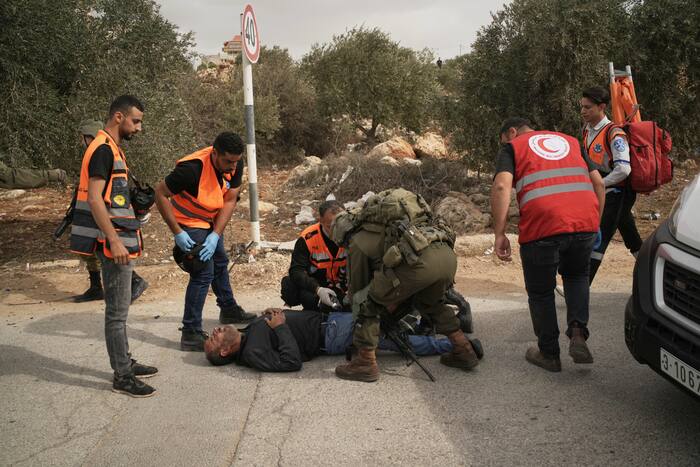
Dust hangs heavy in the afternoon light along a dirt track outside a West Bank village, thick enough to coat the tongue and turn every dry olive leaf a pale, chalky gray. Somewhere nearby, a camera clicks, a phone records, and a reporter checks the battery percentage on a device that has become both shield and lightning rod. No one in a quiet embassy office miles away hears the crunch of gravel under hurried boots until the clip reaches a screen. By then, the moment has already fractured into competing accounts, official statements, and a question that refuses to stay inside a press briefing: what happens when the person holding the notebook becomes the story itself?
Reporters.
When an American journalist is attacked by settlers in the West Bank and the United States ambassador to Israel steps forward to condemn the assault alongside other regional dispatches, wire services treat the item as one entry in a crowded daily ledger. Condemnation. Reaction. Another Middle East roundup before dinner. Yet a diplomatic rebuke rarely lands on neutral ground. In a region where every gesture is weighed for subtext, a sharp word from an envoy carries weight—and exposes just how fragile physical safety has grown for those trying to witness events firsthand.
To understand why a single scuffle or assault on a reporter reverberates far past the immediate scene, consider a hypothetical character—let us call her Nora, a freelance correspondent who has spent years moving between Jerusalem, Ramallah, and rural hillsides with a press pass clipped to a lanyard and a notebook worn soft at the corners. Nora is not a symbol on a diplomatic cable; she is someone who knows which checkpoints bottleneck at dawn, which bakeries still have warm bread at noon, and how fast a calm hillside lane can turn tense when shouting starts. When violence erupts near contested land, journalists often stand in the narrow strip between armed patrols, angry crowds, and residents trying to protect homes or groves. Standing in that middle ground does not grant immunity. Often, it makes a person visible to everyone at once.
Metaphorically, a reporter in a conflict zone is like a seismograph needle pressed against shifting tectonic plates. The needle does not cause the fault line to slip, nor does it choose the direction of the tremor; it simply records the oscillation. When someone smashes the instrument or shoves the operator, people often argue over whether the needle was standing on the right side of the line. Meanwhile, the ground underneath keeps moving.
Diplomacy operates on a different rhythm entirely. Ambassadors speak in measured sentences calibrated for capitals, allies, domestic audiences, and adversaries alike. When a U.S. ambassador condemns a settler attack on an American citizen and journalist, that statement signals that Washington is watching—or at least wants to be seen watching—at a moment when tensions across the West Bank, Gaza, Israel, and neighboring states are already stretched taut. Supporters of press freedom may hear a necessary boundary being drawn. Critics may ask whether words alone deter future assaults when accountability on the ground feels sporadic or slow. And residents living under daily friction may wonder why an attack on a foreign reporter draws immediate headlines while everyday clashes fade into background noise.
The Fragile Line Between Witness and Target
Field reporting in contested territory rarely looks like a cinematic standoff. More often, it begins with mundane logistics. Arranging a ride. Checking signal strength. Deciding whether to wear a helmet or keep a low profile so you do not draw attention from a distance.
In the West Bank, friction points are woven into everyday geography. Winding roads connect settlements, military outposts, and Palestinian towns in close proximity, where disputes over land, grazing rights, road access, and security collide without warning. A routine afternoon walk to document property damage or interview farmers can shift in seconds if groups converge, tempers flare, or stones and pushes replace arguments. For a journalist, the danger is rarely just one blow; it is the sudden collapse of predictability. One minute you are asking a question in English or Arabic; the next, you are backing up with your lens lowered, calculating how quickly you can reach a car without turning your back on people whose motives you cannot read.
I have stood beside colleagues in tense places where the air felt charged before a single voice was raised, watching the subtle shift in posture when a camera comes up. People who feel cornered or righteous often view a lens not as a neutral eye, but as an adversary that will frame their actions unkindly for an unseen audience. That perception can turn a journalist into a proxy target for broader grievances.
Even when an attacker faces arrest or official pushback, the chilling effect lingers. A bruised rib heals in weeks. A cracked camera can be replaced. The hesitation that creeps into a reporter's chest the next time a crowd gathers—wondering whether stepping closer is bravery or recklessness—takes much longer to mend.
Why Diplomatic Condemnation Cuts Two Ways
When an ambassador issues a condemnation over an attack on an American journalist, the statement enters a hall of mirrors. Every phrase is parsed. Was the language strong enough? Did it name the perpetrators clearly? Did it pair concern for the reporter with broader warnings about rule of law and civilian safety?
Diplomatic language is built for leverage and restraint, which can make it feel unsatisfying to people nursing real bruises or demanding firm consequences. An envoy represents an administration's policy, not a personal crusade, and must balance bilateral ties, regional security calculations, and domestic politics. Still, public condemnation matters because silence normalizes impunity. When high-level officials call out violence against reporters—especially fellow citizens—it reminds local authorities and armed actors that such incidents carry reputational costs beyond the local ridge.
Yet there is an uncomfortable truth that seasoned observers recognize: statements do not police a dusty road at dusk. If enforcement on the ground remains uneven, or if political rhetoric in any quarter treats journalists as partisan troublemakers rather than essential witnesses, a diplomatic rebuke can sound like thunder without rain. Worse, in a polarized environment, an ambassador's remarks can quickly become ammunition in domestic debates back home, pulling attention away from the reporter's actual reporting and turning a safety issue into a culture-war talking point.
The Wider Mideast Current Behind Every Headline
A single incident involving a journalist never sits in a vacuum, especially in Middle East news where threads connect across borders like copper wire. What happens on a hillside near Nablus or Hebron echoes in Jerusalem, resonates in capitals across the Levant and the Gulf, and shapes how audiences in Washington and around the world read the next bulletin.
Consider how regional news cycles feed one another. A security operation here, a diplomatic outreach there, a stalled negotiation, a flare-up along a northern border—each development alters the mood on the streets miles away. When frustration builds across the region, restraint thins. People on every side feel their own pain acutely and view the other side's actions through years of accumulated distrust.
Let us return to Nora in our hypothetical scenario. Suppose she files her story after the scuffle—detailing what she saw, who intervened, what officials said, and how local villagers reacted. Within hours, two readers on opposite sides of the globe can read the exact same paragraphs and come away convinced of opposite conclusions. One sees proof of unchecked aggression and insufficient deterrence. Another sees a one-sided snapshot that ignores provocation, history, or the dangers faced by ordinary families trying to stay safe.
That split reaction is one of the hardest parts of covering the Middle East today. Facts themselves are contested before the ink even dries. If a journalist is physically assaulted while trying to gather those facts, the public loses even the shared baseline of eyewitness observation. Without reliable reporting from the ground, rumor fills the vacuum—and rumor is far more flammable than verified detail.
What Readers Often Miss Between the Lines
People scanning a regional news roundup often ask practical questions that rarely get a neat, one-line answer in a short dispatch. Why do reporters keep going back into volatile areas if the risks keep rising? Why does an attack on a U.S. citizen draw particular diplomatic attention? And how should an ordinary reader tell solid reporting apart from noise when emotions run high?
Reporters return because distance breeds distortion. Watching a conflict strictly through official press releases or filtered social media clips leaves huge blind spots. Being there—smelling the smoke, hearing the cadence of local conversation, seeing who is actually present when trouble starts—gives context that no remote summary can match. Most journalists are not thrill-seekers; many are deeply cautious professionals who weigh risk every single day and pull back when a line is crossed.
As for why a U.S. ambassador speaks out when an American journalist is targeted, governments have a long-standing duty to protect their citizens abroad and defend press access where their interests and values are engaged. At the same time, press advocates consistently argue that protection should not depend on which passport a reporter carries. Local journalists—Palestinian, Israeli, Lebanese, Syrian, and others—often bear the heaviest daily risks with the fewest diplomatic safety nets, and their safety is just as vital to an honest record.
For readers, the most useful habit is slowing down when a headline triggers an instant rush of anger or triumph. Look for specific details rather than sweeping labels. Notice who is quoted, what was directly witnessed versus reported secondhand, and whether the piece acknowledges complexity without surrendering basic facts.
I admit something that can feel awkward for someone who cares deeply about clear, accountable journalism: even after years of following regional affairs, the sheer density of grief and grievance in the Middle East can feel overwhelming. Sometimes the news moves so fast that one outrage blurs into the next before anyone has processed the last. When everything feels urgent all the time, readers can grow numb—and numbness is dangerous when real people are getting hurt.
Accountability Beyond the Press Release
Condemnation is a starting point, never a finish line. If attacks on journalists—whether by settlers, militants, security forces, or unruly crowds—are to decline, accountability has to be tangible, consistent, and visible on the ground. That means clear rules of engagement, genuine investigations when reporters are assaulted or equipment is destroyed, and political leadership across the board that treats press safety as non-negotiable rather than convenient.
It also requires honest self-examination from media organizations and audiences alike. Journalists have to remain disciplined, fair, and transparent about their methods so they do not hand bad-faith actors an excuse to treat the press as an enemy. Audiences, in turn, have to resist treating every reporter as a cheerleader or a villain simply because their reporting complicates a preferred narrative.
When a diplomat condemns an attack on a journalist, it shines a brief, bright beam onto a dark corner of the conflict. The real test is whether the light stays on after the cameras pack up and the statement is archived.
Out on that dusty track outside the village, the late afternoon sun dips lower, stretching long shadows across the stones. Somewhere a reporter backs up their notes, checks the lock on a car door, and listens to the quiet settling back over the hills—knowing tomorrow will bring another road, another crowd, and another test of whether the world still values the person willing to look closely.