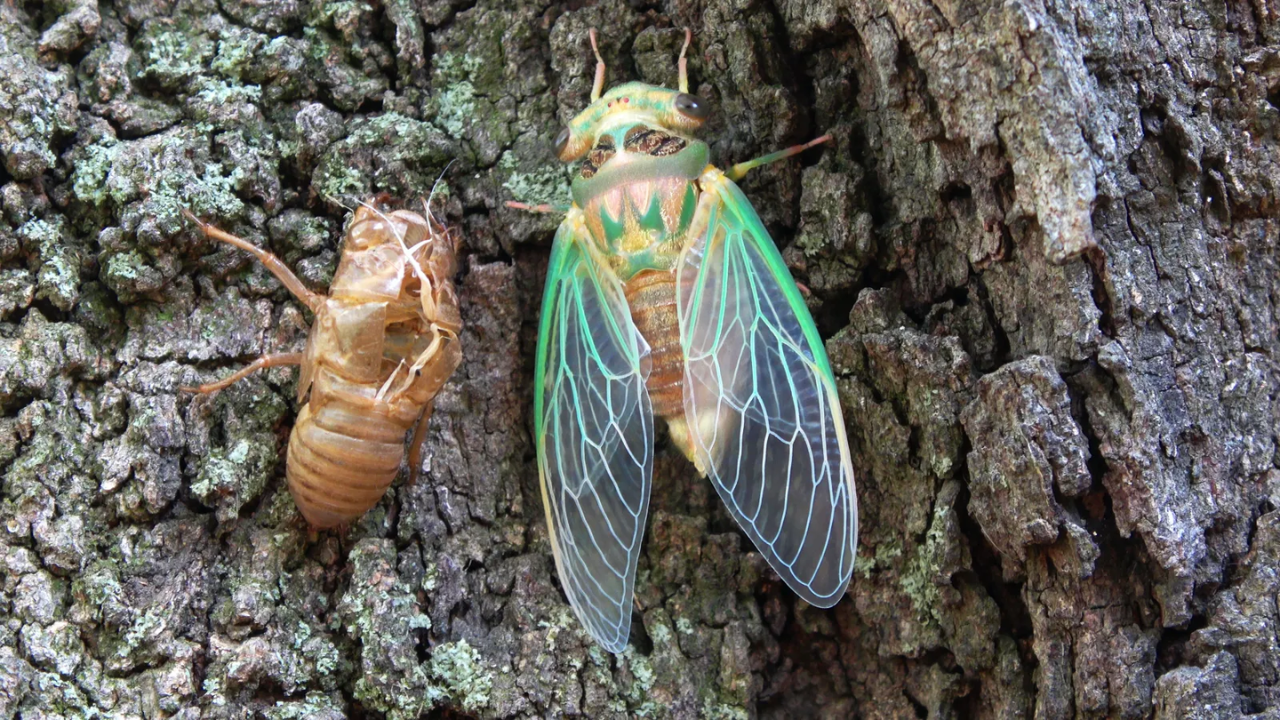
Dr. Elena Vance stared at a dead bug.
It was an ordinary periodical cicada, collected months prior from the damp soil of an eastern forest. To anyone else, it was a discarded husk of summer, brittle and brown. To Elena, holding the specimen with ultra-fine titanium tweezers under the glare of a halogen microscope lamp, it was a library of unread blueprints.
She wasn't looking at the eyes. She wasn't looking at the segmented body. She was staring at the wings.
Transparent. Delicate as blown glass. Fragile enough to fracture under a stray breath. Yet, hidden within that gossamer membrane lay a microscopic architecture honed by millions of years of evolutionary pressure—a pattern of tiny pillars and nanostructures designed to shed water, kill bacteria, and catch light in ways human engineers could only envy.
Elena leaned in closer. Her breath hitched.
For years, her lab had chased ghosts. They wanted to listen to the universe at its absolute quietest. They wanted to hear the single molecule of a rogue protein whispering a warning before a tumor bloomed in human tissue. They wanted to detect the chemical ghost of a disease before symptoms ever appeared. But our instruments were too loud. The background noise of the world drowned out the small stuff. Amplifiers distorted the signals. Gold coatings were too thick, swallowing the very data they were meant to capture.
Science needed a microphone for the molecular scale.
Instead of building one from scratch, Elena looked back at the cicada.
The Silence Before the Storm
Imagine standing in an empty cathedral. You drop a pin. The sound bounces off the stone walls, echoing outward, growing faint until it vanishes.
Molecular detection works much the same way, except the cathedral is a laser beam and the pin is a tiny chemical vibration. This is the realm of Raman spectroscopy, a technique where scientists fire laser light at a sample and listen to how the light bounces back. Every molecule has a unique fingerprint, a distinct vibrational pitch that shifts the wavelength of the scattered light.
The catch? Most molecular fingerprints are painfully faint.
To hear them, researchers rely on a phenomenon called Surface-Enhanced Raman Scattering, or SERS. By roughening a metal surface—usually with microscopic bumps of gold or silver—they can trap light in tiny spaces called hot spots. When a molecule wanders into one of these hot spots, its signal gets amplified a millionfold. Suddenly, a whisper becomes a shout.
For decades, the standard recipe for SERS substrates sounded like industrial alchemy. Take a silicon wafer. Etch it with harsh chemicals. Deposit expensive metal nanoparticles using high-vacuum chambers that cost more than a suburban home.
The results were impressive, but flawed. The synthetic metal bumps were jagged, unpredictable, and uneven. One batch would scream a molecular signal loud and clear; the next batch would stay dead silent. Consistency was a myth. Cost was a barrier.
Elena was tired of fighting chaos with chaos.
One afternoon, over lukewarm coffee and a pile of discarded microscope slides, a doctoral student named Marcus dropped a paper onto her desk. It was a study on natural nanostructures.
"Look at the wings," Marcus said, tapping a finger on a micrograph of a cicada wing. "Nature already solved the spacing problem."
Elena looked. The surface of the wing wasn't smooth. It was paved with billions of pillars, uniformly spaced, standing like microscopic columns in an ancient temple. No chemical etching. No multi-million-dollar cleanroom. Just biology, doing what it had done for millennia.
The Silver Touch
The experiment started as a desperate hunch.
They needed to turn the organic wing into a metallic conductor without destroying the delicate pillars. If the silver coat was too thick, it would flood the valleys, smoothing over the architecture and ruining the traps. If it was too thin, it wouldn't capture the light.
Elena remember the night they finally got the balance right.
They used a gentle vapor-deposition technique, coaxing silver atoms to drift down onto the cicada wing in a vacuum chamber, atom by atom, building a film so thin it was measured in nanometers.
Marcus placed the treated wing under the Raman microscope. He dropped a tiny, dilute solution of a chemical marker onto the surface—a concentration so low it should have been completely invisible, a needle hidden inside an ocean of water.
He fired the laser.
On the monitor, a spectral line spiked upward. Sharp. Tall. Unmistakable.
"Look at that enhancement factor," Marcus whispered, his voice trembling slightly.
The silver-coated cicada wing hadn't just amplified the signal. It had magnified it by orders of magnitude. The natural pillar array of the insect had acted as an organic scaffold, forcing the silver to form a uniform, highly structured landscape of nano-antennas. Light pooled in the valleys between the silver-plated pillars, creating a dense forest of hot spots.
It worked. Nature had provided the chassis, and human engineering had provided the spark.
What Comes Next
The implications stretched far beyond a single glowing monitor in a university lab.
Consider what happens when you scale this up. Think about a patient walking into a clinic for a routine checkup. Instead of waiting weeks for lab results, a drop of blood or saliva is placed on a bio-sensor lined with these silver-infused biological templates. The sensor doesn't just check for general markers; it listens for the specific molecular signature of early-stage pancreatic cancer, or a mutating pathogen, or trace amounts of environmental toxins in drinking water.
The materials are cheap. Cicadas are abundant. The architecture is already written into the DNA of the insect world.
We spent centuries trying to conquer nature, bulldozing ecosystems to build our own artificial precision instruments from scratch. We built cleanrooms. We engineered silicon. Yet, sometimes the most advanced technology in the room is the one that sat quietly in the summer trees, waiting for someone to finally pay attention.
Elena turned off the microscope. The lab grew dark, save for the green glow of a computer standby light.
On the specimen stage, under a glass cover, lay the tiny silver wing. Silent. Still. Ready to speak.