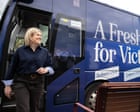
Paint. Vinyl wrap, to be precise. That is what a campaign bus actually is beneath the slogans, the smiling portraits, and the carefully chosen shades of blue. It is a heavy diesel engine wrapped in a promise that things are finally moving forward.
In Victorian politics, where the opposition has spent years trying to find traction against an entrenched Labor government, a newly branded coach rolling down the highway is supposed to project momentum. According to reporting on the Victorian Liberals’ recent campaign swing, the vehicle was meant to signal a fresh start—a clean visual break from internal friction and a pivot toward everyday voters in the suburbs and regions.
Instead, the bus became the defining image of a difficult week.
To understand why a piece of campaign transport can hijack an entire political message, you have to step away from the press releases and stand on the asphalt of a regional high street at seven in the morning. I have spent enough damp mornings waiting alongside local reporters and party staffers outside regional bakeries to know how fragile political theater really is. The coffee is usually lukewarm. The wind carries diesel exhaust across the footpath. Everyone is watching the door of the bus, waiting to see whether the reality inside matches the confidence painted on the outside.
The Anatomy of a Symbol
Political campaigns rely on shorthand because voters rarely have the time or patience to read forty-page policy documents over breakfast. A bus is the oldest shorthand in modern democracy. It says: We are showing up. We are listening. We are taking our message directly to you.
Consider a hypothetical voter—let’s call her Sarah, a small business owner in outer-suburban Melbourne watching her energy bills climb while she tries to keep two apprentices on the books. Sarah does not follow daily factional maneuvering on Spring Street. She does not track internal party room ballots or shadow cabinet reshuffles. What she notices, glancing up from her phone during a lunch break, is whether an alternative government looks organized enough to run a state.
When the Victorian Liberals rolled out their campaign bus, the strategic goal was straightforward. Party strategists wanted a disciplined week focused on cost-of-living pressures, crime, and government accountability. They needed a unifying backdrop that kept the leader and the message front and center, away from the distractions of Parliament House.
Yet politics rarely obeys the itinerary printed on a media schedule.
As coverage of the week unfolded, media outlets and political observers noted that the tour was repeatedly overshadowed by internal party distractions, awkward optics, and questions that had nothing to do with the slogans plastered across the side of the coach. Rather than projecting forward motion, the bus became a rolling magnet for scrutiny. Every stop invited questions about unity, discipline, and whether the party had truly moved past the internal turbulence that has plagued its recent years in opposition.
Why Optics Matter More Than Strategists Admit
There is a tempting cynicism in modern commentary that dismisses political optics as shallow—mere theater for the press gallery while real issues go ignored. That view misunderstands how trust actually works.
Trust is cumulative. And fragile.
Think of a campaign like a commercial airline flight. Passengers do not inspect the hydraulic lines or audit the pilot’s training log before takeoff. They look at the small things. Is the cabin clean? Is the crew calm? Does the boarding process run on time? If the overhead bins are broken and the crew is arguing in the galley, passengers start wondering about the engines.
Voters apply that exact same intuition to political parties. When an opposition asks the public to hand over the keys to a multi-billion-dollar state budget, voters look for basic operational competence first. If a party struggles to keep a single week on the road free of self-inflicted headlines, skeptics ask a blunt question: If they cannot manage a bus tour, how will they manage Victoria?
According to political analysts cited in coverage of Victorian opposition dynamics, overcoming a long-term incumbent government requires more than dissatisfaction with the status quo. Voters may feel frustrated with rising taxes, infrastructure delays, or healthcare pressures, yet still hesitate to switch sides if the alternative appears divided or reactive. In Australian state politics—from Victoria in the 1990s to New South Wales in 2011—oppositions only break through when they convince the middle ground that they are cohesive, disciplined, and ready to govern from day one.
Without that foundation, every well-intentioned stunt risks turning into a mirror.
The Invisible Weight Inside the Cabin
Step inside any campaign bus during a rough news cycle and the atmosphere changes instantly. The air feels heavier. Phones buzz constantly in the back rows where media advisers sit hunched over laptops, refreshing news feeds and fielding calls from producers who want to talk about yesterday’s controversy rather than today’s policy announcement.
Down the aisle, the candidate has to walk off those steps into bright sunlight, shake hands at a local hardware store, and smile as though the morning headlines do not exist.
That is the human toll rarely captured in dry political summaries. Campaigning is exhausting even when the wind is at your back. When the narrative turns sour, every handshake feels slightly stiffer, every press conference turns into an exercise in damage control, and every kilometer between towns stretches out like a marathon. Local candidates who hoped a visit from the leader would boost their own community profile suddenly find themselves standing behind a podium while reporters ask about internal party disputes hundreds of kilometers away.
Let’s return to our hypothetical suburban business owner, Sarah, watching the six o'clock news that evening. She hears a thirty-second grab about cost-of-living relief, followed immediately by commentary dissecting the opposition’s rough week on the road. The policy evaporates. The dysfunction lingers.
What does a voter do with that impression? Usually, nothing dramatic. They do not write angry letters or join a protest. They simply file away a quiet doubt—and carry it with them into the polling booth months later.
The Trap of the "Reset"
Part of the problem lies in the very idea of a political reset.
In corporate boardrooms and campaign war rooms alike, leaders love the word because it implies that past mistakes can be wiped clean with a fresh launch, a new slogan, or a freshly wrapped vehicle. Human memory does not work like a spreadsheet. You cannot highlight a difficult year and hit delete.
Historical patterns across Australian elections show that genuine political resets happen quietly, over months of consistent behavior, long before a campaign bus ever leaves the depot. They happen when internal grievances stay behind closed doors, when policy positions remain steady under pressure, and when shadow ministers speak with one recognizable voice.
When a party treats a bus tour as the mechanism of renewal rather than the reward for hard internal work, the vehicle ends up carrying weight it was never built to bear. Every pothole on the highway becomes a metaphor. Every detour becomes a headline.
To be fair to those on board, governing parties enjoy structural advantages that oppositions can never match. An incumbent premier travels with the full machinery of the state—official announcements, infrastructure openings, and institutional authority. An opposition leader travels mostly on persuasion and symbolism. When you have fewer levers to pull, the symbols you choose carry outsized risk.
A Diesel Engine on a Country Road
By the end of the week, the news cycle inevitably moves on to the next debate in Melbourne, the next budget figure, the next press conference. The vinyl wrap stays intact. The tires keep turning.
Yet out on a quiet stretch of regional highway at dusk, long after the cameras have packed up and the press pack has filed its stories, a campaign bus is just a large vehicle heading home through the dark—its headlights cutting a narrow beam across the asphalt, illuminating only a few meters of road at a time.