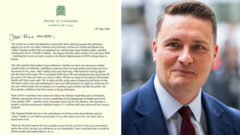
The political earthquake many expected finally hit Westminster on Thursday. Wes Streeting is out. The Health Secretary didn't just resign; he delivered a calculated, multi-page indictment of Keir Starmer’s premiership that reads more like a manifesto than a goodbye note. While the headlines focus on the drama of a Cabinet minister jumping ship, the actual text of his letter reveals a much more complex play for the future of the Labour Party.
Streeting’s departure isn't a surprise to anyone who’s been watching the internal temperature of the party since the disastrous local election results on May 7. Labour took a beating from Reform UK and the Greens, leaving the backbenches in a state of near-panic. By resigning now, Streeting isn't just leaving a sinking ship; he's trying to build the lifeboat.
If you want to understand where the British government is heading, you have to look at what he actually said—and what he pointedly didn't.
The vision versus vacuum argument
The most devastating line in the entire letter is a direct hit on Starmer’s perceived lack of ideological core. Streeting wrote, “Where we need vision, we have a vacuum. Where we need direction, we have drift.”
It’s a brutal assessment. For months, critics have argued that the government has been reactive rather than proactive. Streeting has now given those critics a high-profile voice from within the inner circle. He's effectively saying that the "steady as she goes" approach that won the 2024 election is no longer enough to govern in 2026.
He didn't stop at vague metaphors about vacuums. He specifically called out policy failures that he believes have alienated the public. He mentioned the "island of strangers" speech and the controversial decision to cut the winter fuel allowance. By listing these, Streeting is distancing himself from the most unpopular parts of the Starmer era, framing them as "individual mistakes" made at the top rather than collective Cabinet failures.
Claiming the NHS victory before walking away
Politicians rarely resign when things are going well, but Streeting made sure to frame his exit as a "mission accomplished" moment for his department. He used the letter to cement his legacy as Health Secretary, citing fresh data that shows NHS waiting lists have fallen for the fifth straight month.
- NHS Productivity: He claimed the service hit a 2.8% productivity target, smashing the initial 2% goal.
- Wait Times: He noted that ambulance response times for heart attacks and strokes are at a five-year low.
- A&E Performance: He highlighted that four-hour waiting figures are the best the country has seen in half a decade.
This is a clever move. If he eventually runs for the leadership, he can point to these numbers as proof that he’s a "delivery" politician. He’s telling the party and the public, "I fixed what I was given, but I can't fix the man at the top." It’s a way of saying he isn't quitting because the job was too hard, but because the leadership was too weak.
The war in Iran and the statesmanship trap
Interestingly, Streeting wasn't entirely negative. He praised Starmer for "courage and statesmanship" regarding the conflict in Iran, specifically for keeping Britain out of a direct war. This might seem like a olive branch, but in reality, it's a "statesmanship trap."
By praising Starmer’s performance on the world stage, Streeting is subtly suggesting that the Prime Minister is better suited for international diplomacy than the gritty, day-to-day management of a fractured country. It’s the ultimate backhanded compliment. He's basically saying, "You're a great diplomat, Keir, but a terrible domestic leader."
Why he didn't launch a bid immediately
The biggest shock in the letter wasn't the resignation itself, but the fact that Streeting stopped short of triggering a formal leadership contest. Under current Labour rules, he needs 81 MPs to back him to force a vote.
The reality? He probably doesn't have the numbers yet.
The letter calls for a "broad field of candidates" and a "battle of ideas." This is coded language. Streeting knows that if he had launched a solo bid today, it might have looked like a naked power grab. By calling for a "broad field," he’s inviting others—like Angela Rayner or David Lammy—to join the fray. It creates a sense of inevitability. He wants the transition to look like a party-wide movement for change rather than a personal vendetta.
What this means for Keir Starmer
Starmer’s response was characteristically measured, expressing "true sorrow" and ignoring the scathing criticisms entirely. But don't let the polite tone fool you. The Prime Minister is now in a fight for his political life. With four junior ministers already gone and the Health Secretary now leading the charge from the backbenches, the "drift" Streeting mentioned has turned into a full-blown crisis.
Streeting’s letter has set the terms for the coming weeks. It’s no longer about whether Starmer should lead, but who is best placed to replace him. By framing the argument around "vision" and "ideas," Streeting has shifted the focus away from administrative competence and toward the soul of the party.
If you’re looking for the next steps, keep an eye on the backbenchers. The magic number is 81. Streeting has laid the groundwork; now he just needs the signatures. Honestly, it’s not a matter of if the challenge comes, but how many more letters are currently being drafted in Westminster offices tonight.
The National Health Service remains the "embodiment of all that is best about Britain," as Streeting put it. He's betting that the public will remember him as the man who started to fix it, rather than the man who helped break the government.
NHS England performance data on waiting lists is a good place to verify the numbers Streeting is using to build his case for the future.
This video provides an immediate look at the scenes outside Downing Street and the initial reaction from political analysts on the ground.