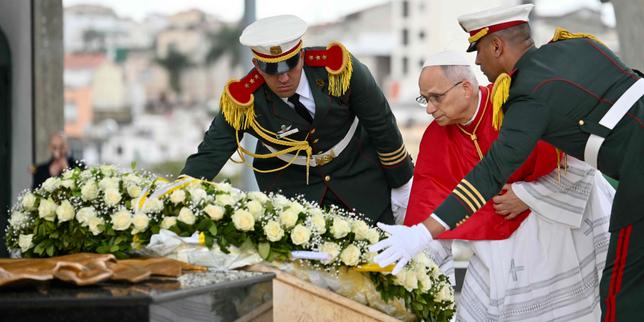
The sun over Algiers does not merely shine; it interrogates. It bounces off the white-washed hills of the Casbah and glares against the Mediterranean with a ferocity that makes the eyes ache. On this particular morning, the heat carried the scent of salt and the faint, metallic tang of history. Thousands of eyes were fixed on a small, solitary figure draped in white, standing at the base of the Maqam Echahid.
Pope Leo XIV looked fragile against the concrete brutalism of the Martyr’s Memorial. The three giant palm leaves of the monument soar ninety-two meters into the sky, a stone scream dedicated to those who died during Algeria's struggle for independence. To stand here is to stand in the epicenter of a nation’s collective trauma.
Memory is a heavy thing. In Algeria, it is not kept in textbooks; it is etched into the architecture and the very soil. For a Roman Pontiff to set foot on this ground is more than a diplomatic formality. It is an admission.
The Silence of the Stones
Imagine a young Algerian woman standing in the crowd. We can call her Amel. She grew up hearing stories of the "Guerre d'Algérie" not as a historical event, but as a map of her own family tree—the branches that were cut, the roots that remained scarred. To her, the arrival of a Pope isn't about theology. It’s about the acknowledgment of a wound that hasn't quite closed, even after sixty years.
When the Pope bowed his head, the silence was absolute.
Peace is often sold as a grand, sweeping gesture, a signature on a treaty or a handshake between giants. But standing there, watching the wind catch the hem of his robes, it became clear that peace is actually much quieter. It is the uncomfortable, gritty work of looking at a graveyard and refusing to look away.
Leo XIV did not come with a checklist of policy demands. He came to speak the word that political leaders usually choke on: Pardon.
The Anatomy of an Apology
The complexity of this visit lies in the layers of the past. Algeria’s relationship with the West, and specifically with the religious institutions of the North, is a tangled web of colonial ghost stories. The Church, for centuries, was seen by many in the Maghreb not as a sanctuary, but as the spiritual vanguard of empire.
To ask for forgiveness at the Memorial of the Martyr is to navigate a minefield of sensitivities. How do you apologize for the pain of a million deaths without it sounding like a hollow PR exercise?
The Pope chose the path of vulnerability. He didn't speak from a position of moral superiority. Instead, he spoke of "the common memory of suffering." He used the Arabic word for peace—Salam—not as a gimmick, but as a bridge.
Consider the mechanics of a bridge. It must be anchored on both sides of a divide, or it collapses. By acknowledging the "legitimate aspirations" of the Algerian people during their revolution, the Pope anchored his side of the bridge in the reality of their pain. He didn't try to sanitize the violence of the past. He sat with it.
A Dialogue in the Dust
The air in Algiers is thick with more than just heat; it is thick with ghosts. Every corner of the city has a story of a barricade, a protest, or a fallen brother. When the Pope moved from the memorial to meet with local imams and youth leaders, the atmosphere shifted from the monumental to the personal.
This is where the real work happens.
In a small, shaded courtyard, the scent of jasmine fought against the midday dust. Here, the grand narratives of "East vs. West" or "Islam vs. Christianity" began to dissolve. They were replaced by the concerns of a generation that is tired of inheriting their grandfathers' wars.
The youth in Algeria are navigating a unique crossroads. They are fiercely proud of the revolution that built their country, yet they are hungry for a world where their identity isn't defined solely by resistance. They watched the Pope—a man representing an institution older than their nation—and they looked for sincerity.
One young man, his hands calloused from work, asked a question that hung in the air: "How can we forgive when the scars are still visible on our streets?"
The Pope didn't offer a platitude. He didn't say that time heals all wounds. He said that forgiveness is a choice made by the brave, not the weak. It is the act of deciding that the future is worth more than the satisfaction of a grudge.
The Invisible Stakes
Why does a religious leader’s visit to a North African monument matter to someone sitting in London, New York, or Tokyo?
Because the world is currently a tinderbox of historical grievances. We are living in an era where "identity" is frequently used as a weapon, and the past is mined for reasons to hate the neighbor. Algeria is a microcosm of this global struggle.
If a Pope can stand at the memorial of a revolution that ousted a Catholic power and speak of brotherhood, it challenges the cynical assumption that we are trapped in an endless cycle of retribution. It suggests that history is not a prison.
The stakes are high. Failure here would mean a regression into the old rhetoric of "Clash of Civilizations." Success, however, looks like a quiet conversation over mint tea. It looks like a shared moment of grief that transcends liturgy.
The Long Walk Back
As the afternoon shadows lengthened, the papal motorcade began its slow crawl back through the city. People lined the streets. Some cheered; others watched with a wary, quiet respect.
Amel, the woman from the crowd, watched the white car disappear around a bend in the road. She didn't feel like the world had changed overnight. The economic struggles remained. The political tensions hadn't vanished. But something felt different in the air, a slight cooling of the atmospheric pressure.
The Pope’s visit was a performance of humility in a world that prizes ego. He showed that you can be the head of a global power and still bow your head to the martyrs of a different faith.
Forgiveness isn't a destination you reach and then stay at forever. It is a path you have to keep walking, even when the stones are sharp and the sun is blinding.
As the sun finally dipped below the horizon, turning the Mediterranean into a sheet of hammered gold, the Maqam Echahid remained standing—tall, silent, and now, perhaps, a little less lonely. The white figure was gone, but the echo of the word "pardon" seemed to vibrate in the concrete, a low frequency of hope in a world that usually prefers the sound of a drum.