Some objects are built to build. Hammers shape hot iron into plows, drive nails into roof timbers, and steady the shaking foundations of a home against the winter wind. Other objects are built solely to erase.
A sledgehammer belongs to the latter family. It carries a heavy, iron-weighted head and a long handle designed to leverage human fury against inanimate resistance. When swung with intention, it does not negotiate. It shatters.
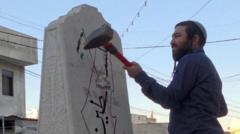
On a dusty roadside, concrete does not bleed. Granite does not cry out. But when a heavy iron head impacts a stone memorial dedicated to the lives lost in a long, grinding conflict, something intangible splinters alongside the masonry.
Consider the morning air in a contested land. It rarely arrives quiet. Usually, it carries the distant hum of traffic, the sharp bark of stray dogs, and the heavy undercurrent of a tension older than most of the people breathing it. Into this routine landscape steps a man holding a tool meant for demolition.
He is not a nameless vandal working under the cover of a moonless night. He is an elected official. His name is Almog Cohen, a member of Israel's parliament, stepping forward in broad daylight to physically dismantle a monument erected in memory of Palestinian victims.
To understand why a lawmaker would trade a pen for a demolition tool, we have to look past the immediate flash of cameras and examine the architecture of political performance. In modern political theater, symbols carry more weight than laws. A monument is never just a collection of carved letters and poured concrete. It is a physical manifestation of grief, a designated space where a community gathers to whisper names that official histories might otherwise scrub clean. When you strike that stone with steel, you are not merely damaging public property. You are declaring that the grief of the other side has no right to occupy space under the sun.
I remember standing near roadside shrines in zones of protracted conflict, places where families tie faded ribbons to guardrails or pile small cairns of stones to mark where a life ended abruptly. There is an unspoken contract in these places. Even enemies, locked in bitter cycles of retaliation, usually leave the dead alone. Corpses cannot vote, and monuments cannot strike back. They are the fragile truce of memory.
When that truce is broken by a lawmaker swinging a sledgehammer, the shockwave travels far beyond the shattered rubble.
Let us be entirely clear about the mechanics of this event, utilizing the verified reporting surrounding the incident. Almog Cohen, associated with the far-right faction of Israeli politics, targeted a memorial structure dedicated to Palestinian casualties. This was not a chaotic riot or an uncoordinated outburst from a fringe extremist in a mask. This was a state representative utilizing his political immunity and physical presence to make a statement carved in destruction.
Why do this? What is the political dividend of smashing concrete?
The answer lies in the currency of outrage. In systems where moderation is frequently punished by primary challengers and media algorithms reward spectacle, escalation becomes the primary mode of communication. By attacking a memorial, the actor signals absolute defiance to a specific domestic constituency. The message is raw, visceral, and intentionally offensive: We will not allow you to mourn.
But human memory is stubbornly resilient. You can crack a granite slab, but you cannot pulverize the stories carried inside the heads of the people who built it.
Think of a hypothetical mother living a few miles from that demolished site. Let us call her Miriam, though her exact name matters less than the rhythm of her days. Miriam wakes up, pours tea into a chipped glass, and looks out at a horizon defined by checkpoints, concrete walls, and armed patrols. Her world is already narrow, hemmed in by invisible lines and explicit prohibitions.
When she hears that the memorial down the road has been smashed by a member of the Knesset, she does not gasp in surprise. Instead, a familiar, heavy exhaustion settles into her shoulders. The destruction confirms what she has suspected for years: that the very existence of her people's sorrow is viewed as an existential threat by those holding power.
Yet, the next morning, Miriam and her neighbors do not riot. They do something quieter and far more dangerous to the architects of erasure. They gather up the broken pieces of stone. They sweep the dust. And they begin to rebuild, not with heavy concrete this time, but with photographs, handwritten notes, and whispered stories passed down to children who were too young to remember the original loss.
This is the fundamental failure of the sledgehammer strategy. It assumes that history is written on walls. It is not. History is written in the nervous system of a population that refuses to forget.
When we observe these clashes from a distance, safely tucked behind glowing screens in peaceful cities thousands of miles away, it is easy to view them as distant theater. We consume headlines like sports scores, keeping a mental tally of who struck first and who retaliated last. We intellectualize the geography of hatred.
We forget the sensory reality. The smell of pulverized limestone hanging in the hot air. The sharp, metallic tang of adrenaline. The hollow echoing sound of iron striking rock, a sound that announces to everyone within earshot that dialogue has officially been abandoned.
We must admit how deeply uncomfortable this subject is. It forces us to confront the limits of diplomacy and the terrifying ease with which civilization slips back into tribalism. When lawmakers become vandals, the social contract does not just fray; it snaps entirely. It creates a vacuum where compromise is treated as treason and cruelty is rebranded as strength.
Consider what happens next in a cycle like this. The video of the lawmaker swings across social media platforms within minutes. On one side, it is cheered as a display of patriotic resolve. On the other, it is archived as unarguable proof of systemic dehumanization. Both sides retreat further into their respective bunkers, sharpening their arguments, hardening their hearts, and waiting for the next provocation.
The memorial was repaired, as memorials often are. The dust was cleared away. But the psychological architecture of the region remains fractured.
Every time a politician picks up a tool of destruction instead of a tool of construction, they leave a permanent hairline fracture in the possibility of a shared future. Concrete can be poured in a matter of hours. Walls can be rebuilt. But trust, once pulverized into powder, requires generations of agonizing, invisible labor to restore.
The iron head of the hammer eventually cools down. The cameras pack up and move on to the next crisis. But the stone remembers the blow, and the people remember the hand that swung it.