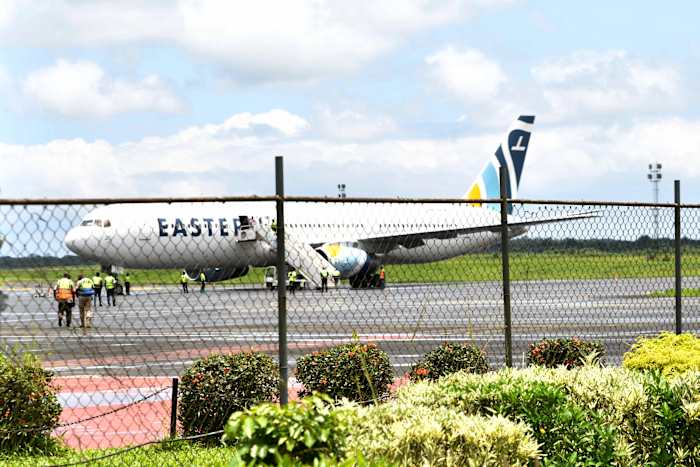
The tarmac at Roberts International Airport holds the heat long after the sun goes down. Standing there, waiting for the stairs to roll up to the belly of a charter plane, you can smell the sharp tang of jet fuel mixed with the heavy, red dust of the Liberian rainy season. It is a familiar scent. It smells like departure, and it smells like return.
Twenty people walked down those steps into the humid night air.
To a statistician sitting in a sterile office in Washington, they are a line item. They are twenty units of a larger, freshly negotiated agreement—a quiet, bureaucratic understanding that will eventually funnel twelve hundred souls back to this West African soil. But numbers do not sweat. Numbers do not carry the accumulated weight of decades spent building a life in the quiet suburbs of Ohio or the crowded neighborhoods of New York, only to see it evaporate behind the frosted glass of an immigration holding facility.
I remember the first time I watched someone unpack a single plastic bag containing all they had left in the world. It was years ago, but the posture never changes. It is a distinct slouch—the shoulders rolled inward, as if trying to shield a chest that has grown too hollow.
Let us step into a hypothetical scenario, rooted entirely in the documented reality of this new bilateral framework. Imagine a man named Emmanuel. (For the sake of illustration, let us call him Emmanuel, though his face belongs to any of the twenty who disembarked that night.) Emmanuel left Monrovia twenty-two years ago. He was twenty-one then, full of the fierce, unyielding optimism that only youth and desperation can forge. He went to America, found work in warehouses, learned how to navigate the bone-chilling winters of the Midwest, paid his taxes, fell in love, and raised children who only knew how to say "ma" and "pa" with an American accent.
He thought he was safe. Most of them do.
Then came the knock. Not the dramatic, cinematic kick-to-the-door, but the quiet, administrative tap of an enforcement officer handing over a manila folder. A decades-old deportation order, dusted off and reactivated under a fresh diplomatic push.
When the plane doors closed on him, Emmanuel left behind a mortgage, a beat-up sedan with a leaking radiator, and a teenage daughter who was supposed to start college in the fall. He arrived in Liberia with a pocketful of foreign currency he could not spend, a phone with no signal, and memories of a country that had transformed utterly since he was a boy.
The agreement between Washington and Monrovia is framed in the polite, bloodless language of international relations. It speaks of orderly processes, compliance, and migration management. Governments must manage their borders; sovereignty demands order. That is the argument from the top down. It is clean, rational, and entirely detached from the sensory shock of stepping off a wide-body jet into a reality you spent half a lifetime trying to leave behind.
Look closer at the mechanics of this deal. Twelve hundred people. Twelve hundred stories of disrupted families, sudden goodbyes, and forced adaptation.
Infrastructure in Monrovia does not bend easily to sudden influxes. The city breathes with a resilient, chaotic rhythm, but housing is tight, electricity is a luxury measured in hours rather than days, and the job market offers few berths for middle-aged men whose primary work history is tied to American logistics hubs or construction sites. When a deportee arrives, the reintegration process is not a smooth, cushioned slide. It is a hard collision.
Consider what happens next for someone like Emmanuel. He is a stranger in his own birthplace. The slang on the street has shifted. The landmarks of his youth are swallowed by new construction or worn away by decades of neglect. He is too American for Liberia, yet not American enough to stay. This is the invisible purgatory of modern repatriation. It is a state of perpetual in-betweenness.
We talk endlessly about immigration policy as if it were a math problem. We argue over percentages, detention bed counts, and diplomatic leverage. We treat human beings like cargo shipped across oceans on a ledger sheet. But every time a charter flight touches down on that sweltering tarmac, a dozen individual worlds are violently unmade and hastily reassembled.
The twenty people who stepped off that plane are now navigating the labyrinth of a city that feels both hauntingly familiar and deeply alien. They are looking for cousins who may have moved, trying to find a bed in a compound that is already crowded, and wondering how to explain to their children back stateside why dad is suddenly a continent away, trapped in a geographic error of bureaucratic timing.
The deal is signed. The flights are scheduled. The machinery of the state grinds forward, indifferent to the tears drying on the runway. And out in the humid Liberian night, a man who thought his American story was permanent begins the slow, agonizing task of writing a second prologue in a country he thought he had left behind forever.