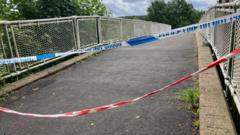
The siren did not startle the birds. It was too low for that, a heavy, rhythmic thrumming that vibrated through the mud banks and into the roots of the weeping willows. On a standard Tuesday afternoon, the riverbank is a place of soft, predictable sounds. The slap of current against rotting wood docks. The chatter of mallards. The occasional distant hum of a lawnmower.
Then, the first blue flash cut through the low-hanging branches.
When an eleven-year-old boy goes missing near a river, the world shifts on its axis, dividing instantly into two distinct groups. There are those who look at the water and see a scenic backdrop, a place for weekend kayaking or skipped stones. And there are those who know the truth. The river is not a postcard. It is a conveyor belt of immense, indifferent hydraulic force.
To understand what happens in the minutes and hours after a child vanishes into a current, you have to look past the sterile headlines that read River search under way for missing boy, 11. Those words are a placeholder for terror. They tell you nothing about the mud that ruins a paramedic’s boots within thirty seconds of arrival. They tell you nothing about the specific, agonizing silence that settles over a neighborhood when the realization hits: he hasn't hidden in a backyard treehouse. He went toward the sound of the rushing water.
The Illusion of the Shallows
Imagine a boy on the brink of adolescence. Let us call him Leo. At eleven, a boy is a strange mix of bravado and fragile geometry. His limbs are suddenly too long for his torso. He moves with a jerky, uncoordinated energy, convinced of his own immortality because he has never yet broken a bone or lost something he couldn't find by turning over his couch cushions.
On a warm afternoon, the river looks small.
This is the first trap. From the bank, the surface of a river often looks like glass. It glides. We are conditioned by swimming pools and backyard ponds to believe that water is static unless stirred. But a river is an engine. Even a modest current moving at just four miles per hour exerts roughly sixty-six pounds of force against a person's legs. For an eleven-year-old boy weighing eighty pounds, that isn't just a push. It is a tackle.
The danger begins with the geology of the riverbed. Unlike the concrete slope of a public pool, a river bottom changes by the hour. A deep pool forms where a log jammed three days ago. A shelf of loose gravel gives way under the weight of a sneaker.
Consider what happens next. A foot slips. The water is cold—perhaps fifty-five degrees, even in the late spring. The human body reacts to sudden cold immersion with an involuntary physiological reflex known as the gasp response. It is a primal, uncontrollable inhalation. If your head is above water, you survive the gasp. If a swirl of current has pulled you under for just a fraction of a second, that single, deep breath fills the lungs with silt and river water instead of air.
From that moment, the clock does not just tick. It sprints.
The Geometry of the Search
When the emergency call rings through to the county dispatcher, a highly choreographed, terrifying machine roars to life. It is a race against both time and geometry.
A river search is not a standard missing-person hunt. You cannot track footprints. You cannot deploy bloodhounds across a surface that refreshes itself every second. Instead, search and rescue teams rely on fluid dynamics and grim probability mathematics.
       [Point of Entry]
              |
              v
     +-----------------+
     |  Scour Zone     | <-- Heavy diving teams, sonar
     +-----------------+
              |
              v
     +-----------------+
     |  Debris Fields  | <-- Snag points, fallen trees
     +-----------------+
              |
              v
     +-----------------+
     |  Downstream Fan | <-- Boat patrols, shore spotters
     +-----------------+
The search area expands exponentially with every passing minute. If the current is moving at five feet per second, the search perimeter widens by three hundred feet every single minute. By the time the first volunteer fire truck arrives and sets its brakes, the potential location of the boy has stretched over a mile downstream.
The deployment happens in layers.
- The Hasty Search: First responders run down the banks, ignoring the briars that tear at their uniforms, screaming a name into the wind. They look for the markers of a child’s afternoon—a dropped bicycle, a single neon sneaker stuck in the shoreline clay, a discarded bag of chips.
- The Dive Teams: These are volunteers, mostly. Men and women who leave their day jobs at mechanic shops and law firms to pull on thick neoprene suits and heavy air tanks. They don't dive in the crystal-clear water of television dramas. They dive in liquid mud. They navigate by touch, crawling along the river bottom through submerged shopping carts, sharp rebar, and tangled fishing line, feeling through the darkness with gloved hands.
- The Air Support: Helicopters or drones hover low, their rotors flattening the tall river grass. From the air, the water looks different. Polarized lenses cut through the glare, searching for a shape, a color, anything that doesn't belong to the natural architecture of the river.
The atmosphere on the bank during these early hours is thick with a particular kind of static electricity. Neighbors gather at the yellow police tape. They speak in whispers, as if a loud voice might disrupt the concentration of the men in the boats. Everyone looks at the water. They look at it with a newfound, visceral hatred. The same river they drove past this morning without a second thought has suddenly become a vault, locking away a secret it refuses to yield.
The Human Cost of the Unseen
We live in an era obsessed with certainty. We expect our packages to arrive on a tracked map in real-time. We expect our phones to tell us exactly when the rain will stop. But standing on a muddy bank while a dive boat circles a deep eddy is a brutal education in the limits of human technology.
Side-scan sonar can map the contours of the riverbed, highlighting logs and boulders with eerie, digital precision. But it cannot distinguish between a waterlogged log and the soft silhouette of a child. That determination still requires a human being to submerge themselves into the cold and the dark.
The emotional weight of this work leaves scars that no one talks about. The divers who go under do not do so with a sense of adventure. They do so with a grim, heavy obligation. They know that every minute that passes changes the nature of their mission from a rescue to something far more somber. Yet, they continue to dive until their air tanks hiss empty and their fingers are too numb to feel the difference between stone and cloth.
And then there is the family.
To watch a parent on a riverbank during a search is to witness a human being stripped of every defense mechanism. They do not pace. They stand frozen, eyes locked on the spot where the dive boat's wake breaks against the shore. Every time a diver surfaces, the parent’s chest heaves with a terrible, desperate hope. Every time the diver shakes their head and submerges again, that hope is systematically crushed, only to rebuild itself over the next three minutes.
They remember the mundane things. The argument over breakfast about unfinished homework. The way the boy forgot his jacket. The sound of the screen door slamming as he ran out into the sunshine. The sheer unfairness of a world where a life can be altered permanently between the time a clock strikes three and the time it strikes four.
The Lessons Left in the Mud
The water does not care about our grief. It keeps moving, pulling the soil from the banks, carrying leaves and debris toward the sea.
When the sun begins to dip below the tree line, the nature of the search changes again. The helicopters depart as the light fades, their shadows stretching long and thin across the valley. The boats turn on their searchlights, long fingers of white glare cutting through the rising mist. The river looks different at night. It looks wider. It looks deeper.
We treat these events as anomalies, sudden tragedies that flash across our screens before being replaced by the next headline. But they are a constant, quiet subtext to our relationship with the natural world. We build our towns near rivers for commerce and beauty, forgetting that these waterways are ancient, wild corridors that owe no allegiance to our fences or our safety signs.
An eleven-year-old boy is old enough to navigate the internet, to understand complex video games, to ride a bike across town alone. But he is not old enough to calculate the fluid mechanics of a hidden undercurrent. He does not know that the water moving around a bend travels faster on the outside curve than the inside, creating a natural vacuum that pulls everything toward the deepest channel.
The search continues because giving up is an admission of defeat that the human spirit cannot tolerate. The men and women in the mud will stay until their flashlights flicker and die. They will return at dawn.
On the bank, a small pile of discarded items sits near the command post. A bicycle with a rusted chain. A blue baseball cap with a bent brim. The river rolls past them, making the same soft, rhythmic sound it made yesterday, entirely indifferent to the fact that everything has changed.