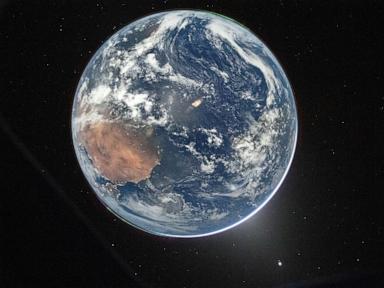
Space is crowded. You probably don't think about it while you're stuck in traffic or deciding what to have for dinner, but right now, thousands of rocks are screaming through the vacuum at speeds that would make a fighter jet look like it's standing still. One of those rocks, a newly discovered asteroid, is about to make a "close" approach to Earth. If you see a headline claiming we're all doomed, take a breath. It's not happening.
The asteroid, recently flagged by automated survey telescopes, will pass within a distance that sounds terrifying on paper but is actually a massive gap in cosmic terms. We're talking about a flyby that stays well outside the orbit of the Moon. To put that in perspective, the Moon is about 238,855 miles away. This rock isn't even coming close enough to tickle our satellite.
Why We Keep Finding These Rocks at the Last Minute
You might wonder why we only seem to hear about these asteroids a few days before they zip past us. It feels a bit like realizing a semi-truck is barreling toward your living room only when it's already in the driveway. But space isn't a driveway. It’s huge. It's dark.
Asteroids are essentially dark lumps of coal floating in a sea of blackness. We only see them when they reflect enough sunlight for our telescopes to pick up a tiny, moving dot. Most of the "newly discovered" ones are small—roughly the size of a city bus or a small house. These aren't the "planet-killers" that wiped out the dinosaurs. Those big ones, the ones over a kilometer wide, are mostly accounted for. NASA’s Center for Near-Earth Object Studies (CNEOS) keeps a very tight watch on about 95% of them.
Small rocks are different. They're sneaky. They often come from the direction of the sun, where the glare makes it nearly impossible to spot them until they’ve already swung around and started their exit. It's not a failure of science. It's just a reality of physics.
The Difference Between Close and Dangerous
When astronomers say "close encounter," they aren't using the word the way you do. If a friend tells you they had a close encounter with a deer while driving, they mean they almost hit it. When an astronomer says it, they mean the object passed within a few million miles.
The jargon can be misleading. Here’s how the experts actually categorize these things.
Near Earth Objects or NEOs
An NEO is basically any asteroid or comet that comes within 1.3 astronomical units (AU) of the Sun. Since Earth is at 1 AU, these are the neighbors. Just because someone lives on your street doesn't mean they're breaking into your house. Most NEOs are perfectly harmless neighbors who just happen to be passing by on their way to somewhere else.
Potentially Hazardous Asteroids or PHAs
This is the one that gets the clicks. To be "potentially hazardous," an asteroid needs to meet two criteria. First, it has to be big enough to cause significant regional damage (roughly 140 meters or larger). Second, its orbit has to bring it within 4.6 million miles of Earth.
The asteroid making news right now? It doesn't even fit the size requirement. It’s a cosmic pebble. Even if it did hit our atmosphere—which it won't—it would likely burn up or explode high in the sky, creating a spectacular fireball rather than a crater.
What Happens if a Real Threat Shows Up
Let's talk about the "what if" because that's what everyone actually cares about. If we found a rock that was actually on a collision course, we aren't as helpless as we used to be. We've moved past the era of just watching and praying.
In 2022, NASA conducted the DART (Double Asteroid Redirection Test) mission. They intentionally crashed a spacecraft into a small asteroid called Dimorphos. The goal wasn't to blow it up—that’s a bad idea that just creates more debris. The goal was to nudge it. By hitting it at high speed, they successfully changed its orbital period.
We proved that if we have enough lead time, we can play a game of cosmic billiards to keep Earth safe. The trick is the lead time. That’s why these "last-minute" discoveries are actually good news. Every time we find one, we're refining our detection systems. We’re getting better at seeing the dark spots in the dark.
How to Track These Objects Yourself
Don't take a journalist's word for it. You can see the data yourself. NASA’s "Eyes on Asteroids" is a real-time 3D visualization tool that shows every known NEO. You can zoom in, see the orbits, and realize just how much empty space there really is.
If you have a decent backyard telescope, you might even be able to spot some of these flybys. You won't see a giant flaming ball. You’ll see a tiny point of light moving slightly faster than the stars behind it. It’s subtle, but there’s something grounding about seeing a rock that’s been traveling through the void for four billion years just doing its thing.
The Odds Are Actually in Your Favor
Statistically, the chance of a significant asteroid impact during your lifetime is incredibly low. You're much more likely to be hit by lightning while winning the lottery. We live in a shooting gallery, sure, but the targets are tiny and the room is the size of the ocean.
Stop worrying about the "newly discovered" headlines. They're a sign that our "radar" is working. Every time a telescope at the Pan-STARRS or the Catalina Sky Survey flags a new object, it means we’re more aware of our surroundings than we were yesterday.
The next time you see a report about a "safe encounter," don't look for a bunker. Look up. It's a reminder that we live on a small, fragile marble in a very busy neighborhood. If you want to stay informed without the hype, follow the Minor Planet Center or the CNEOS Twitter feeds. They provide the raw numbers without the sensationalism. Check the distance, check the size, and then go back to your coffee. We're doing just fine.
Download a sky tracking app like SkySafari or Stellarium. These apps often update with the coordinates of passing NEOs. If a pass is bright enough, the app will show you exactly where to point your binoculars. Seeing it for yourself is the best cure for "asteroid anxiety."