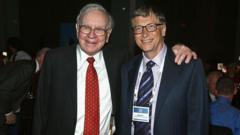
The financial press is clutching its collective pearls over Warren Buffett’s decision to cut off the Bill & Melinda Gates Foundation.
Mainstream commentators are treating this like a tragic divorce, a sudden bout of billionaire petulance, or the end of an era of effective altruism. They look at the sheer volume of cash—tens of billions diverted away from the world’s largest private charitable trust—and assume global progress just took a massive hit.
They are completely wrong.
The lazy consensus views mega-philanthropy through a lens of pure math: more money equals more good. But anyone who has actually managed large-scale capital deployment knows that hyper-concentrated wealth creates its own toxic gravity well. Having spent years analyzing institutional asset allocation and the failure modes of corporate governance, I know that Buffett’s exit isn't a crisis. It is a desperately needed market correction for the charity industry.
Buffett is doing what he has always done best: cutting losses on an inefficient vehicle and reallocating capital to where it faces actual accountability.
The Myth of the Monolithic Super-Charity
For nearly two decades, the Gates Foundation operated as an unchallenged superpower. It dictated global health agendas, shaped education policies, and functioned with the bureaucratic density of a G7 nation.
When Buffett pledged the bulk of his Berkshire Hathaway fortune to Gates in 2006, the logic seemed sound. Why build a competing infrastructure when you can plug into an existing, highly efficient machine?
But efficiency degrades with scale.
The mainstream media asks: How will the Gates Foundation survive without Buffett's billions?
The real question we should ask: Why should a single private entity control that much global policy in the first place?
When a charitable organization grows too large, it stops being an agile problem-solver and starts acting like a government agency, minus the voters. It becomes risk-averse. It funds safe, incremental projects that look good in annual glossy reports but fail to move the needle on systemic issues.
By pulling his funding, Buffett is exposed a fundamental truth that the industry refuses to admit: Monopolies are just as destructive in the non-profit sector as they are in the corporate world.
The Accountability Vacuum of Institutional Giving
Let's look at the mechanics of how the Gates Foundation actually operates.
| Feature | The Corporate World | The Mega-Charity World |
|---|---|---|
| Feedback Loop | Quarterly earnings, stock price, bankruptcy risk. | Self-generated metrics, subjective praise. |
| Governance | Activist investors, hostile takeovers, regulatory audits. | Insular board of directors, often close friends or family. |
| Capital Discipline | High. Inefficiency results in liquidation. | Low. Failure often justifies asking for more funding. |
In business, if you burn through five billion dollars on a failed strategy, the market punishes you. Your stock crashes, the board fires you, and competitors eat your market share.
In mega-philanthropy, if you spend five billion dollars on a flawed initiative, you write a white paper about "lessons learned," host a panel discussion at Davos, and continue as if nothing happened. There is no short-selling a charity. There is no activist investor forcing a turnaround.
Buffett, a man who built his entire empire on strict capital discipline and razor-sharp governance, clearly saw the limits of this model. The Gates Foundation became a sprawling bureaucracy. The decision to step away is a tactical rejection of top-heavy, institutionalized giving that answers to no one.
The Illusion of "Effective Altruism"
People also ask whether this move signals that Buffett is souring on philanthropy altogether. Not at all. He is souring on bad governance.
The standard defense of these massive foundations is the concept of "strategic philanthropy"—applying business metrics to social ills. It sounds brilliant on paper. You treat malaria eradication like a supply chain problem. You treat poverty like a market inefficiency.
But society's deepest problems do not adhere to a spreadsheet.
When you inject billions of dollars into a complex ecosystem, you create massive unintended distortions. Local governments step back from their own responsibilities because foreign billionaires are picking up the tab. Local NGOs alter their entire missions just to chase the specific grant criteria laid out by bureaucrats in Seattle.
I have watched organizations abandon highly successful, community-led programs because a major foundation changed its funding priorities for the upcoming fiscal year. That isn't effective altruism; it's philanthropic colonialism.
Buffett’s pivot to his children’s three smaller, more targeted foundations—the Sherwood Foundation, the Howard G. Buffett Foundation, and the NoVo Foundation—is a deliberate shift toward localized, responsive capital. It acknowledges that smaller pools of money, managed by people on the ground with skin in the game, outperform a distant, monolithic mega-fund every single time.
The Three-Generation Rule: Where the Money is Really Going
The mechanics of Buffett's new plan are brutal, elegant, and entirely counter to how modern billionaires manage their legacies.
Instead of leaving his wealth to perpetuate an eternal institution, Buffett is putting his remaining fortune into a new charitable trust managed by his three children. The catch? The money must be spent down entirely within their lifetimes.
This is a direct attack on the concept of the perpetual foundation.
Most massive charities exist primarily to sustain themselves. They hoard principal capital, investing it in the markets, and distribute only the bare minimum required by tax laws (usually around five percent annually). The primary goal becomes preserving the endowment, not solving the problem. The foundation transforms into a asset management firm with a marketing arm that happens to do charity work.
Buffett's spend-down mandate changes the game entirely. It introduces an artificial time horizon that forces immediate, high-stakes action.
- It eliminates the temptation to build a multi-generational bureaucracy.
- It prevents future trustees from drifting away from the original intent.
- It forces the capital into the economy right now, where it can actually work, rather than sitting in a tax-sheltered investment portfolio for the next century.
The downside to this contrarian approach? It requires intense operational focus. Spending tens of billions of dollars effectively in a few decades without causing massive inflation in the non-profit sector is incredibly difficult. His children will have to be ruthlessly disciplined, and they will undoubtedly make mistakes. But the alternative—letting the money sit in a perpetual institutional vault—is worse.
Stop Funding Institutions. Start Funding Execution.
If you want to take a page out of Buffett's playbook, stop looking at charity as a way to build a legacy. Stop writing checks to massive university endowments or multi-billion-dollar global trusts that treat your donation like a drop in an ocean of capital.
Redefine your approach to giving by asking the hard questions the Gates Foundation ignored:
- What is the wind-down plan? If an organization doesn't have a strategy to put itself out of business by solving the problem, it is incentivized to keep the problem alive.
- Where is the negative feedback loop? Look for charities that openly publish their failures, their misallocated funds, and their abandoned projects. If their reporting is 100% positive, their data is 100% curated.
- Is the capital decentralized? Fund execution, not administration. If more than twenty percent of a budget goes to overhead, marketing, and executive salaries, you are funding a lifestyle, not a cause.
Buffett didn't abandon Bill Gates because of a personal rift. He abandoned a broken, bloated philosophy of giving that prioritizes the institution over the impact. The era of the untouchable mega-charity is dead, and Warren Buffett just drove the stake through its heart. Good riddance.


