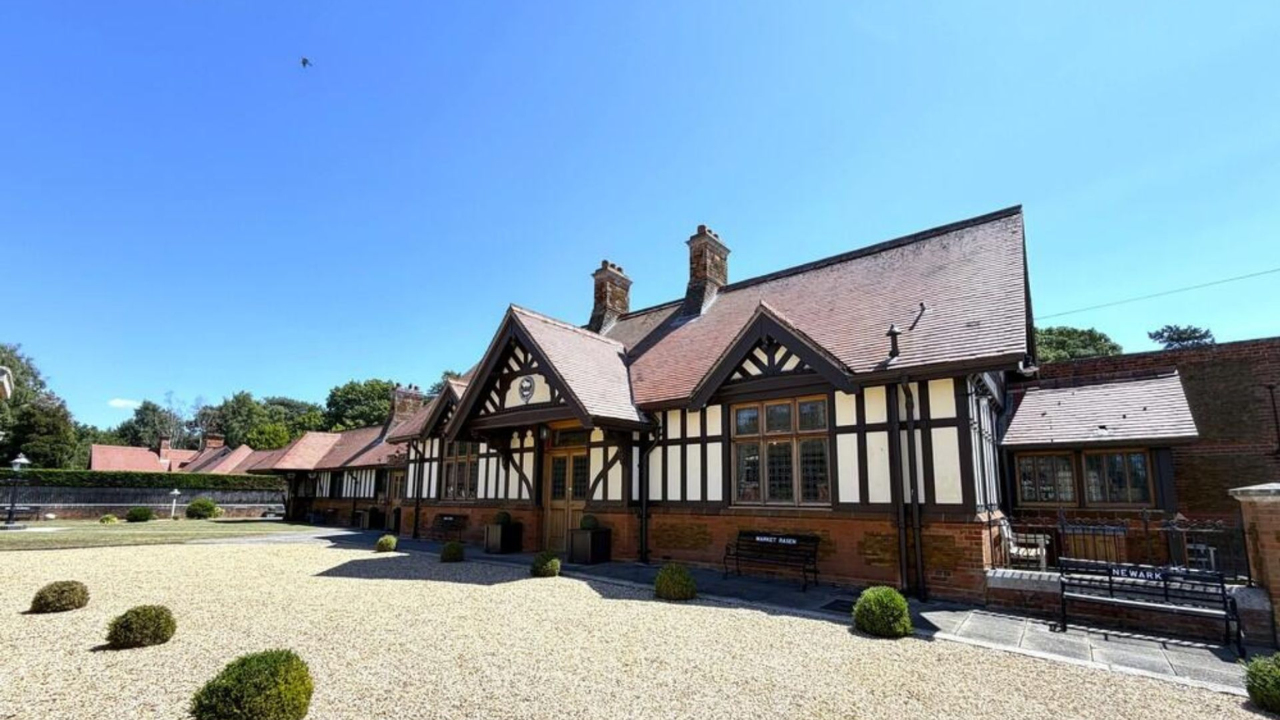
The market pricing of idiosyncratic real estate relies on scarcity, historical weight, and structural conversion costs rather than standard square-foot comparables. When the former Wolferton Royal Station in Norfolk hit the market for 1.25 million pounds, it provided a live clinical case study in asset repurposing. Built in 1862 to service the Sandringham Estate, this Grade II*-listed property represents an intersection of Victorian infrastructure, architectural preservation, and modern residential economics. Evaluating this asset requires stripping away the novelty of its royal pedigree to examine the fundamental economics governing historic conversions.
The Cost Function of Heritage Conversions
Acquiring a historic property involves an inverse relationship between initial purchase friction and long-term capital expenditure. Assets carrying statutory protection status, such as Grade II* listings, impose strict constraints on structural modifications. The economic profile of such a property is defined by three primary variables:
- The initial acquisition price per square foot or acre.
- The regulatory compliance burden of maintaining historic fabric.
- The technological integration cost required to bring 19th-century utility up to 21st-century habitability standards.
In the case of Wolferton, the asset spans approximately half an acre and includes a three-bedroom main residence derived from the former royal suite and public waiting rooms, alongside a completely rebuilt signal box functioning as a standalone annex. The valuation of 1.25 million pounds does not reflect raw spatial utility. Standard residential properties in rural Norfolk of equivalent square footage trade at lower capital thresholds. The delta represents a premium for historical monopoly—the absolute non-fungibility of the asset class. There is only one station built specifically to receive Queen Victoria and subsequent monarchs traveling from London St Pancras or King's Cross.
The Capital Expenditure Amortization Timeline
A critical error in evaluating heritage real estate is treating historical restoration as an immediate value-add rather than a prolonged capital sink. Private owners who treat these assets as multi-decade projects face steep opportunity costs.
The structural evolution of Wolferton Station followed a distinct path of private interventions. Following its closure in 1969 under post-war rail rationalization policies, the property faced near-demolition before being rescued by railway preservationists. The subsequent multi-decade timeline of interventions demonstrates the economic reality of such projects:
- Phase one stabilization prevented structural decay and secured basic residential functionality.
- Phase two optimization introduced modern climate systems, including heat exchangers, partial underfloor heating, and electrical grid upgrades, without violating conservation laws.
- Phase three involved the granular restoration of operational mechanics, such as the 40-lever signal frame and gate wheel.
The economic return on these inputs is non-linear. The capital deployed over twenty-five years of stewardship rarely translates into a direct dollar-for-dollar recovery upon exit. Instead, the financial return is heavily dependent on macroeconomic shifts in lifestyle preferences, specifically the post-urban migration trends toward rural properties with high narrative value.
Spatial Efficiency and Adaptive Reuse Constraints
Transforming a commercial or industrial transit hub into a domestic dwelling creates severe architectural inefficiencies. Railway stations are designed for high-throughput passenger movement, featuring exaggerated ceiling heights, massive fenestration, and expansive open circulation areas.
At Wolferton, the former Royal Suite features ceilings standing twelve feet three inches high, dominated by intricate Tudoresque lattice molding and heavy oak wainscot paneling. While these features maximize aesthetic distinction, they impose structural penalties on thermal dynamics. Heating large-volume rooms with historic, single-glazed or specialized leaded windows creates high thermal loss coefficients.
To counteract this, modern interventions must rely on concealed mechanical engineering. The integration of closed-loop heat recovery systems, basement-level plant rooms housing ventilation controls, and targeted thermal zoning represents the hidden cost baseline required to render a Victorian railway station habitable. The layout forces a compromise between preserving the integrity of the original passenger processing flow—where royal parties moved directly from carriages to private waiting rooms—and establishing modern domestic compartmentalization.
Micro-Location Dynamics and Neighborhood Externalities
Real estate pricing is permanently tethered to spatial externalities. Wolferton Station sits within the immediate orbit of the 20,000-acre Sandringham Estate. Proximity to an active royal residence introduces a unique set of micro-economic variables.
Security perimeters, local infrastructural investments, and regional tourism patterns directly influence liquidity. Furthermore, localized high-profile residency changes within the estate boundary create localized volatility in buyer sentiment and neighborhood desirability profiles. Assets adjacent to royal holdings carry a distinct liquidity profile: they attract a narrow band of buyers driven by status association or niche architectural interests, which inherently extends days-on-market metrics compared to standard suburban stock.
Strategic Market Placement
The pricing ceiling for properties of this classification is dictated by the intersection of maintenance liability and utility caps. A three-bedroom configuration on half an acre, regardless of provenance, remains functionally a niche lifestyle asset rather than a scalable residential investment.
Future valuation growth for Wolferton Station will not be driven by broader regional housing market appreciation. It will depend entirely on matching the asset with a specialized buyer for whom the preservation of railway heritage and architectural exclusivity outweighs the ongoing structural maintenance liabilities of a Grade II*-listed building. The transaction mechanics require recognizing that historical preservation is a consumption good disguised as real estate equity.