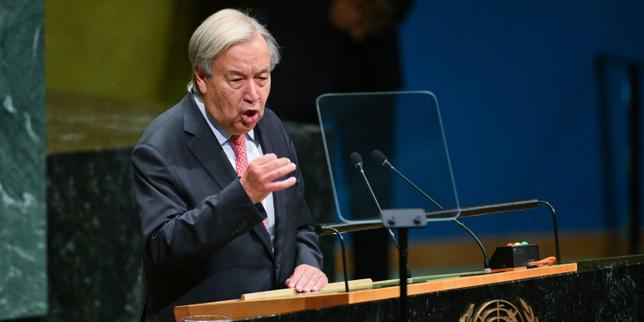
Every time Antonio Guterres steps up to a podium at the General Assembly and invokes the darkest ghosts of human history, the diplomatic press corps swoops in like vultures smelling fresh carrion. When he warns of the spectre of ethnic cleansing in the occupied West Bank, the commentary machine grinds into gear, churning out the exact same predictable binary arguments we have heard for decades. Half the world nods sagely, praising moral clarity. The other half screams bias, citing institutional bad faith. Both sides are playing a script written by bureaucrats whose survival depends on the persistence of the very crises they pretend to solve.
Let us stop pretending that verbal escalation equals strategic intervention. For an alternative look, see: this related article.
I have watched international organizations burn billions of dollars on high-altitude rhetoric while ground realities calcify into permanent apartheid. When the Secretary-General uses loaded historical nomenclature, he is not sounding an alarm to wake up sleeping giants. He is engaging in a ritualized performance of concern designed to absorb moral pressure, vent steam from a boiling pot, and change absolutely nothing. The lazy consensus says that words matter, that naming and shaming shifts state behavior, and that diplomatic condemnation is a step toward justice. That consensus is a comforting fairy tale invented by people who have never had to live under the boot of a military checkpoint or watch their olive groves bulldozed by administrative decree.
The uncomfortable truth is that international institutions do not want permanent resolution. Permanent resolution means shrinking budgets, diminished staffing, redundant committees, and the loss of institutional relevance. Endless crisis is the business model. Similar coverage on the subject has been provided by Associated Press.
The Economics of Performative Despair
To understand why high-level UN pronouncements accomplish precisely zero, you have to look at the structural incentives governing modern international relations. Diplomacy is an industry. It employs tens of thousands of functionaries, special envoys, rapporteurs, and peacebuilders whose career trajectories depend on the continuation of low-intensity conflict.
When Guterres talks about demographic engineering, creeping annexation, or forced displacement in the West Bank, he is describing processes that have been accelerating for fifty years. Everyone knows the mechanics. The settler movement is not an accidental byproduct of rogue actors; it is a state-sponsored colonization project backed by legal structures, financial subsidies, and military protection. It operates in broad daylight. There is no mystery to solve. There are no missing facts to uncover.
Yet the response from global governance bodies is perpetually stuck in the diagnostic phase. We get committees of inquiry. We get resolution drafts vetoed in the Security Council. We get strongly worded statements expressing deep concern. This is not diplomacy. This is political theater designed to give the illusion of motion while keeping the treadmill spinning at top speed.
Imagine a scenario where a corporate board watched a factory burn down every single day for thirty years, and instead of calling the fire department or redesigning the wiring, they simply issued a strongly worded annual report decrying the presence of fire. You would call them insane, or corrupt, or both. Yet when the United Nations does this on a geopolitical scale, we applaud their persistence.
Dismantling the Myth of Neutrality
The foundational myth of the international system is that neutral observers can referee a structural imbalance of power through moral equivalence. This approach collapses the moment it hits concrete reality.
In the West Bank, the power dynamic is utterly asymmetrical. On one side stands a nuclear-armed state with an advanced industrial economy, total air superiority, absolute control over water, borders, telecommunications, and the population registry. On the other side stands a fractured, occupied population living under military law, fragmented into non-contiguous bantustans, and subjected to daily administrative violence.
When leaders like Guterres use diplomatic euphemisms or balance their condemnations to satisfy donor states, they reinforce this asymmetry. They treat occupier and occupied as political agents sitting across a normal bargaining table, waiting only for the right mediator to whisper magic words into their ears. This is a deliberate delusion.
You cannot mediate a master-servant relationship. You cannot negotiate the gradual dismantling of a colonization apparatus using the rules set by the colonizer. By framing the situation as a conflict between two equal parties who simply lack communication skills, the UN shields the structural driver of the violence from real, punitive consequences.
I have seen career diplomats spend decades drafting reports on zoning laws in Area C while thousands of homes were demolished. They treat the symptoms with econometric precision while ignoring the disease. They measure the height of the separation wall with micrometers while pretending they cannot see the land theft it exists to lock in.
The Weaponization of Historical Trauma
One of the most insidious tactics used in contemporary rhetoric is the casual invocation of historical atrocities to describe ongoing political violence. When high-ranking officials throw around phrases like ethnic cleansing or genocide without attaching immediate, mandatory enforcement mechanisms, they dilute the gravity of those terms.
Words like ethnic cleansing carry specific legal and historical weight. They denote an intentional, systematic campaign to remove an unwanted population from a given territory through terror, forced displacement, and violence. In the West Bank, the displacement is methodical, bureaucratic, and legalistic. It relies on military orders, retroactive land seizures, zoning restrictions, and the tacit greenlight given to armed vigilantes.
Calling it by its scariest name without backing it up with economic sanctions, arms embargoes, or diplomatic isolation reduces human suffering to a rhetorical soundbite. It allows Western governments to perform empathy on television while continuing to sign billion-dollar trade and defense deals with the perpetrator. It is a cynical transaction: the UN provides the moral theater, and member states provide the weapons and diplomatic cover.
If Guterres actually believed his own rhetoric about the spectre of displacement, his next move would not be another speech in New York. It would be an immediate call to suspend all cooperation, strip away diplomatic immunities, and implement severe financial penalties against the entities executing the displacement. But he will not do that, because he cannot. The machinery of the organization is tethered to the geopolitical interests of the very powers underwriting the status quo.
Why the Standard Playbook is Dead
For decades, the standard prescription for the West Bank has been the two-state solution. Politicians, op-ed columnists, and international mediators repeat this phrase like a secular prayer.
Let us be brutally honest: the two-state solution is dead. It has been dead for at least a decade. The facts on the ground have buried it. With over seven hundred thousand settlers entrenched across the West Bank and East Jerusalem, with an irreversible matrix of highways, military bases, tunnels, and infrastructure cutting the territory into unviable shreds, a sovereign Palestinian state is a physical impossibility.
Everyone who works in foreign policy knows this. The ambassadors know it. The intelligence analysts know it. Even the politicians repeating the mantra in public know it. Yet they cling to the corpse of the peace process because admitting its death forces them to confront the alternative: a single, apartheid-like reality where one group enjoys full democratic citizenship and the other lives under permanent military subjugation.
By continuing to harp on negotiations, peace summits, and confidence-building measures, international bodies act as accessories to this reality. They provide the anesthesia while the amputation is being completed.
What Real Accountability Looks Like
If we are going to talk about the West Bank without the suffocating stench of diplomatic hypocrisy, we have to throw out the entire playbook of polite condemnation.
First, we must stop treating settlements as a political disagreement and start treating them for what they are: war crimes under the Fourth Geneva Convention. The individuals, corporations, and international charities financing, building, and supplying these settlements should be treated as transnational criminals. If international law had teeth, their bank accounts would be frozen, their leadership would be barred from international travel, and their assets would be seized.
Second, we must dismantle the fiction of the peace process. As long as the occupier knows that time is on their side, that land can be stolen incrementally with zero material consequences, and that western capitals will shield them at every turn, there is zero incentive to change course. Diplomacy without leverage is just a conversation between accomplices.
Third, the institutions charged with maintaining international order must either find the courage to enforce their own resolutions or disband. An organization that can issue spine-chilling warnings about crimes against humanity from the comfort of a Manhattan skyscraper while doing nothing to stop them is worse than useless. It is an alibi for impunity.
The next time a high-ranking official stands at a podium and laments the tragedy unfolding in the Jordan Valley or the South Hebron Hills, do not listen to the adjectives they choose. Look at their hands. Look at what they are withholding. Look at the contracts they are signing behind closed doors.
The tragedy is not that the international community does not know what is happening. The tragedy is that they know exactly what is happening, and they have calculated that managing the catastrophe is cheaper, safer, and more profitable than actually stopping it. Stop buying the theater. Start demanding the ledger.