The air inside the terminal was thick, not with the usual frenetic hum of departures, but with a heavy, stifling stagnation. I watched a young man in a rumpled suit drop his suitcase. He didn't swear. He just stared at the departure board, where the word CANCELLED sat like an indictment next to every London-bound train. His hands were shaking. He had a flight to catch, a wedding to attend, a life to return to, and the tracks—the iron arteries connecting him to the rest of the world—had simply stopped beating.
Fire.
It sounds primitive, doesn't it? In an age of high-speed digital signaling and billion-pound infrastructure, the simple, ancient hunger of flame is what brought the line to its knees.
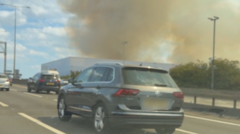
Multiple trackside fires broke out along the route between London and Stansted Airport, turning a routine journey into a logistical nightmare. For the thousands of us stranded on the platform, it wasn't just a delay. It was the sudden, jarring realization of how fragile our movement really is. When the power goes, when the cables melt, when the earth itself catches, we are no longer modern commuters. We are ghosts in a machine that has forgotten how to run.
I stood there for an hour, listening to the static crackle over the intercom. The staff looked exhausted. Their uniforms were neat, but their eyes held the truth: they had no idea when the line would breathe again. This is the invisible cost of our transit systems. We treat them like background noise, like the weather or the sunrise. We step onto a train, bury our faces in our screens, and expect to arrive. We don't think about the cables buried under the ballast. We don't think about the dry brush lining the tracks, waiting for a stray spark.
Consider the reality of these fires. They are not grand, cinematic explosions. They are ugly, creeping things. A bit of debris, a technical fault, the dry tinder of a hot afternoon, and suddenly, the safety systems—the very things designed to protect us—do their job too well. They shut everything down. They cut the power to prevent a catastrophe, and in doing so, they create a different kind of chaos.
A woman stood next to me, clutching her toddler. The child was crying. The mother looked at her watch, then at the empty tracks, her face a mask of quiet, desperate arithmetic. How much is a taxi? Can I afford the surge pricing? If I miss this flight, does my ticket hold any value?
This is where the story lives. It isn't in the train schedules or the official apologies issued by the rail operators. It is in the arithmetic of the stranded.
The rail network is a nervous system. When a fire breaks out trackside, it acts like a localized stroke. The signals fail. The trains, heavy and metallic and utterly dependent on the flow of electricity, lose their way. They become hulking statues, trapping passengers in carriage-side purgatory.
I remember a similar morning years ago, sitting in a halted carriage in the middle of a field. The silence inside was absolute. No one spoke. The AC had hummed off, and the temperature began to climb, slow and steady. You start to notice things then. The way the sunlight catches the dust motes. The way the person across from you looks just as tired and defeated as you feel. You realize that you are all essentially cargo, waiting for a signal from an invisible hand that the path ahead is clear.
The authorities speak of "investigations" and "damage assessments." They use words like infrastructure integrity and mitigation. It is necessary language, I suppose. It provides a veneer of control over a situation that is inherently chaotic. But out here, on the platform, we don't care about the integrity of the cable. We care about the missed meeting. We care about the goodbye we didn't get to say.
What is truly unsettling is the frequency of these disruptions. We are building faster trains, smarter systems, more efficient grids, yet we are still held hostage by the vulnerability of the tracks themselves. A fire in the undergrowth shouldn't be a systemic collapse. And yet, here we are. Again.
As the afternoon dragged on, the terminal began to resemble a makeshift refugee camp. People were sprawled on the floor, charging phones against pillars, their faces illuminated by the harsh blue glow of social media feeds. There was a weird, distorted sense of community. We were all sharing the same burden. We were all trapped in the same temporal void.
I thought about the engineers scrambling to reach those remote stretches of line. I imagined them in their high-visibility vests, walking through the charred remnants of the scrub, fighting the heat and the urgency of a clock that didn't stop ticking just because the trains did. It is a thankless, grueling task. They are the ones who put the pulse back into the wires. They are the ones who confront the fire so that we can eventually return to our screens, our meetings, and our lives.
The incident is a reminder, harsh and cold, that our mobility is a miracle we have turned into an expectation. We have forgotten that for the rail to move, the earth beneath it must be tended. We have forgotten the labor, the risk, and the fragility of the path.
When the first train finally rumbled back into the station, the reaction wasn't cheers. It was a collective, weary sigh. The doors hissed open, and we flowed toward them like water, desperate to be moving again.
I found a seat and watched the station drift away. The fire was still there, somewhere behind us, a small, dark chapter in the story of the line. But as we gained speed, the landscape blurred into a streak of green and grey. The fear of being stuck faded into the background, replaced by the crushing anxiety of being late.
We are so quick to forget. We are so quick to assume that the world will always be waiting to carry us where we need to go. But every so often, the track goes quiet. The fires burn. And we are left standing on the platform, suddenly and painfully aware of just how far away we really are.
The sun began to set, casting long, bruised shadows over the fields, and for a few miles, the train felt less like a machine and more like a fragile, glowing needle threading its way through the dark. We are always just one spark away from standing still.