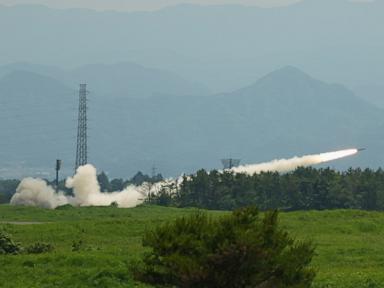
A cloud of dust kicks up on the slopes of Japan’s most iconic peak, and within seconds, the launcher is gone. It’s called "shoot and scoot." It’s fast. It’s loud. It’s exactly what the U.S. Marines want their enemies to see. The recent deployment of the M142 High Mobility Artillery Rocket System (HIMARS) near Mount Fuji wasn’t just a routine training exercise. It was a loud, clear message sent across the East China Sea.
The U.S. military just finished testing these mobile rocket systems in a rapid-fire drill designed to prove one thing. They can land, fire, and vanish before a counter-battery strike even leaves the tube. If you've been following the tension in the Indo-Pacific, you know this isn't just about practicing with big toys. It's about a fundamental shift in how the U.S. and Japan plan to defend a string of islands that are increasingly under pressure.
Why the Mount Fuji Drills Are Different This Time
Most people think of military drills as static events. A bunch of tanks sit in a field and fire at targets. That’s old-school thinking. The "shoot and scoot" tactics practiced at the East Fuji Maneuver Area are the backbone of modern island warfare. The goal isn't to hold a single piece of ground until the end of time. It's to be a ghost.
The Marines brought in the HIMARS because it’s light enough to be shoved onto a C-130 transport plane and dropped onto a dirt strip or a civilian road. During this specific exercise, the crews demonstrated they could receive targeting data, set up, and fire long-range precision rockets in a window so small it would make an interceptor’s head spin. They don't stay to watch the impact. By the time the rocket hits, the truck is already miles away, hidden in a forest or a garage.
Japan’s Ground Self-Defense Force (JGSDF) wasn't just watching from the sidelines. They were integrated. This is part of a larger strategy to turn the "First Island Chain"—the series of islands stretching from Japan down to the Philippines—into a lethal barrier. If you can move mobile launchers quickly between these islands, you make it nearly impossible for an opposing navy to operate safely in those waters.
The Reality of Shoot and Scoot Tactics
Let’s talk about why this actually works. In the past, if you wanted to destroy a ship from the shore, you needed massive, permanent coastal batteries. Those are easy to find and easier to blow up. HIMARS changes the math. It’s a five-ton truck that can carry six Guided Multiple Launch Rocket System (GMLRS) rockets or one Army Tactical Missile System (ATACMS) missile.
The "scoot" part is the most vital bit of the equation. Modern radar can track a rocket's trajectory back to its source almost instantly. If you stay put for more than ten minutes, you're dead. The crews at Mount Fuji are getting their displacement times down to under three minutes. That’s a terrifyingly small window for an enemy to react.
Intelligence is the Real Weapon
You can have the fastest truck in the world, but it’s useless if you don't know where to aim. The Fuji drills focused heavily on the "kill web." This isn't just about the Marines. It’s about using Japanese sensors, U.S. Navy drones, and even F-35s to pass data to the rocket launcher.
I’ve seen how these systems operate in high-pressure environments. The stress on the crews is immense. They aren't just pushing buttons. They’re managing data links in a "denied environment" where GPS might be jammed and radio comms are sketchy. Success at Fuji means they can do this while the world is falling apart around them.
Misconceptions About Mobile Rockets in Japan
A lot of folks assume these tests are just a show of force against North Korea. While Pyongyang is always on the radar, the real target of this posture is the maritime expansion in the South and East China Seas. The geography around Mount Fuji offers a mix of terrain that mimics the larger islands in the Ryukyu chain.
People also get hung up on the "test" label. These aren't tests of the technology—HIMARS is proven tech. These are tests of the logistics. Can we get the fuel there? Can the Japanese roads handle the weight? Can we talk to each other without a translator in the middle of a fire mission? That’s the stuff that actually wins or loses a conflict.
The Strategic Weight of the First Island Chain
If you look at a map, Japan is essentially a giant unsinkable aircraft carrier. But it’s also a series of bottlenecks. The Miyako Strait and the Bashi Channel are narrow corridors that any fleet must pass through to reach the open Pacific. By mastering mobile rocket drills at the base of Mount Fuji, the U.S. and Japan are perfecting the art of "bottlenecking" an adversary.
- Mobility: The ability to fly a launcher from Okinawa to a remote northern island in hours.
- Precision: Hitting a moving ship at sea from a hidden position on land.
- Interoperability: Japanese officers calling in strikes for U.S. launchers and vice-versa.
This isn't about aggression. It’s about deterrence. The idea is to make the "cost of entry" into these waters so high that no one wants to pay it. When you see a HIMARS firing near Fuji, you're seeing a defensive wall being built out of speed and data.
What This Means for Regional Stability
Critics often argue that these drills provoke more than they protect. It’s a fair point to debate, but the reality on the ground is that Japan has been rapidly shifting its defense posture for a reason. They’ve moved from a purely "homeland defense" mindset to one of "active deterrence."
We’re seeing more of these drills every year. The frequency is increasing because the window of technological superiority is closing. The U.S. can’t rely on having better tech forever, so they have to rely on being faster and more unpredictable. The Mount Fuji exercise proved that the integration between the U.S. Marines and the JGSDF is tighter than it’s ever been.
Tactical Takeaways for the Near Future
If you’re watching this space, keep your eyes on how these units move. The next step won't just be bigger rockets. It’ll be smaller, more autonomous launchers. We’re already seeing talk of "unmanned" HIMARS variants that can be dropped onto an island and operated remotely.
The Fuji drills are the baseline. They prove the human element is ready. The next phase is scaling this so that an enemy doesn't just have to worry about ten trucks, but a hundred distributed platforms hidden across thousands of miles of coastline.
If you want to understand the future of security in the Pacific, stop looking at the aircraft carriers. Start looking at the trucks. They’re harder to find, cheaper to lose, and—as the Mount Fuji drills showed—deadly accurate.
Watch for the next round of "Resolute Dragon" exercises. That’s where the lessons from Fuji will be put to the test on an even larger scale. The Marines aren't just training; they're rewriting the manual on how to win a war before it even starts. Pay attention to the displacement times. Speed is the only currency that matters in the "shoot and scoot" world.