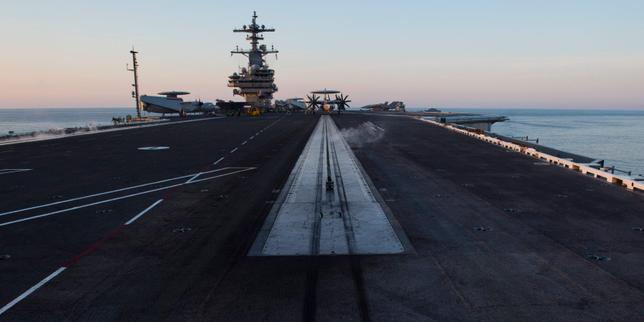
The defense punditry loves a shiny new toy. Hand them a multi-billion-dollar electronic launch system, and they will write glowing essays about the march of progress. They did it with the Ford-class carrier program. They swallowed the narrative that electromagnetic aircraft launch systems, known as EMALS, represent an inevitable, superior future because digital always beats mechanical.
They were wrong.
When political rhetoric targets the Electromagnetic Aircraft Launch System and pushes for a return to steam catapults, the media rolls its eyes. They frame it as nostalgia. They paint it as a political gimmick from a leader obsessed with retro aesthetics.
That framing is pure laziness.
Strip away the political theater, look past the headlines, and examine the raw mechanics of naval aviation engineering. The push to bring back steam is not about looking backward. It is a brutal acknowledgment of operational reality, redundancy limits, and thermodynamic facts that digital enthusiasts prefer to ignore.
The Myth of Perpetual Technological Linearism
We suffer from a cultural delusion that technology only moves in one direction. Newer is assumed to be better. Solid state is assumed to always trump kinetic. Silicon is assumed to be more reliable than boiling water.
Physics does not care about your Silicon Valley marketing brochures.
A modern supercarrier is not a floating tech startup. It is a nuclear-powered floating airbase designed to function in the middle of an ocean while taking direct kinetic damage, absorbing massive EMP shocks, and operating under conditions where maintenance cycles are measured in hours, not fiscal quarters.
The core argument for EMALS is efficiency and precise control. Electromagnetic coils linear induction motors fling a thirty-ton fighter jet off a deck with smooth acceleration profiles that supposedly reduce stress on the airframe. On paper, it is a triumph of electrical engineering.
In practice, it is a maintenance nightmare wrapped in a closed-loop software dependency.
I have watched defense contractors burn through millions of dollars trying to debug complex power spikes on bleeding-edge systems while sailors bleed time trying to isolate faults in solid-state inverter panels. When an electromagnetic drive system faults out, you do not grab a wrench and a welding torch. You call a specialized technician, wait for diagnostic subroutines to run, and pray the spare parts manifest isn't backordered six months.
Steam is loud, dirty, heavy, and delightfully stupid. And that is precisely why it works.
Breaking Down the Thermodynamic Reality
Let us look at the engineering trade-offs that the mainstream defense press refuses to touch.
Steam catapults draw their energy directly from the nuclear reactors or auxiliary boilers via massive accumulator flasks. You boil water. You store high-pressure steam. You dump that pressure into a cylinder to drive a piston connected to the shuttle.
It is violent. It is crude. It is mechanical.
When a component fails on a steam system, a ship's company machinist mate with a basic tool kit and standard metallurgy knowledge can often fabricate a fix, repack a seal, or weld a pipe. You can troubleshoot with a pressure gauge and human senses. You can smell a leak, hear a drop in pressure, and see a mechanical failure.
EMALS relies on high-density electrical storage and complex power conversion modules. It requires drawing massive, instantaneous current surges from the ship's integrated power grid. If the software glitches, or if a thermal management subsystem hiccups while dumping gigajoules of energy into a linear stator, the entire launch cycle stalls.
The mainstream argument claims steam takes up too much freshwater and too much space. True. It weighs a ton and requires complex piping throughout the hull. But weight and space are precisely what aircraft carriers have in abundance. What they do not have in abundance is time during a contested peer-to-peer conflict.
The Survivability Paradox
Imagine a scenario where a carrier group takes a hit from a hypersonic anti-ship missile or suffers a severe cyber-electronic attack.
In a degraded environment where shipboard data networks are compromised, power distribution nodes are fragmented, and automated diagnostics are fried, which system do you want powering your sortie generation rate?
The system controlled by millions of lines of proprietary code running on sensitive digital architecture? Or the system driven by high-pressure fluid dynamics that can be manually operated via bypass valves if necessary?
The defense establishment loves to talk about network-centric warfare until the network goes dark. When the physical infrastructure of a ship is compromised, mechanical simplicity is the ultimate survivability metric.
Critics call steam outdated. I call it resilient.
The Cost of Progress Addiction
We need to talk about the sunk cost fallacy. The Ford-class carrier program has been plagued by delays, cost overruns, and persistent reliability issues with its advanced weapons elevators and EMALS. Every time the system breaks down at sea, readiness plummets.
The institutional response has been to double down. More software patches, more contractor oversight, more complex diagnostic tools. It is an infinite loop of treating symptoms of over-engineering with more engineering.
Sometimes, the smartest pivot is admitting when an innovation has crossed the line from clever to fragile.
Reintroducing steam-driven launch technology, or at least maintaining a hybrid industrial base capable of producing heavy mechanical marine hardware, is not a retreat into the past. It is an insurance policy against technological hubris.
The next time you read a pundit mocking mechanical retrofits as a sign of declining vision, ask yourself one question: would you rather bet national security on a pristine line of digital code that requires a team of civilian contractors to debug, or a massive pipe full of boiling water that has launched jets reliably for half a century?
Stop chasing theoretical efficiency at the expense of tactical reliability.