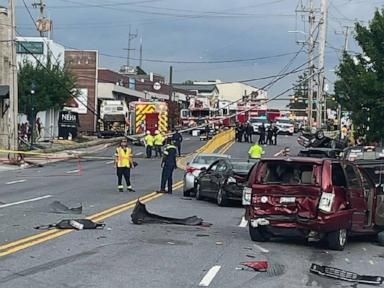
A devastating multi-vehicle collision in Pikesville, Maryland, left 28 people injured on Wednesday evening when a Maryland Transit Administration bus plowed through multiple cars before smashing into a commercial building. The crash occurred around 5:48 p.m. along the heavily trafficked 1500 block of Reisterstown Road, triggering a second-alarm mass casualty response that gridlocked the northwest Baltimore suburb. Emergency crews worked under intense pressure to extricate two trapped victims, including one in critical condition who required immediate transport via shock trauma units. While investigators sift through the mechanical and situational wreckage, the incident exposes a deep, structural vulnerability in how regional mass transit interacts with aging suburban infrastructure.
This was not a simple case of driver error or sudden brake failure. It represents a predictable failure point where high-velocity arterial roads, dense commercial zoning, and heavy public transit vehicles collide.
The Reisterstown Road Bottleneck and Suburban Design Flaws
The 1500 block of Reisterstown Road is a notorious stretch of asphalt. It serves as a primary commercial artery, lined with strip malls, office parks, and fast-food outlets, all feeding into a multi-lane roadway that demands high speeds while simultaneously requiring frequent stops. When a forty-foot transit bus weighing upwards of 30,000 pounds enters this environment, the margin for error drops to zero.
Suburban corridors like this one were originally designed to move automobiles quickly from outer residential zones to urban centers. Over the decades, intensive commercial development has forced these same roads to function as local business streets. Cars constantly slow down to turn into parking lots, others merge blindly from narrow driveways, and delivery trucks block outer lanes.
This creates a phenomenon traffic engineers call arterial friction. The constant disruption of traffic flow forces sudden braking and erratic lane changes. For a standard passenger vehicle, an unexpected stop is a minor inconvenience. For an MTA transit bus carrying dozens of standing or loosely seated passengers, a sudden swerve to avoid a turning vehicle can initiate a catastrophic chain reaction.
Witness accounts and initial footage from the Pikesville scene indicate that at least eight vehicles were caught in the wake of the bus, with one vehicle completely overturned. This level of kinetic destruction suggests that the bus was either moving at a significant speed matching the corridor's design or was unable to shed momentum due to a compounding mechanical or situational crisis.
The Brutal Physics of Heavy Transit Encroachment
To understand why 28 people were injured in a matter of seconds, one must look at the sheer physics of mass transit operations on mixed-use roadways. A fully loaded transit bus possesses an immense amount of momentum.
$$E_k = \frac{1}{2}mv^2$$
Because kinetic energy increases with the square of velocity, even moderate suburban speeds of 40 miles per hour transform a transit bus into an unstoppable force if braking mechanisms fail or are delayed by perception lag. When that mass hits smaller passenger vehicles, the energy transfer is violent.
In the Pikesville crash, the bus did not merely hit one car; it cascaded through seven other vehicles before hitting a building structure. The overturned vehicle points to an underride or T-bone dynamic where the sheer mass of the bus lifted or flipped smaller consumer cars.
When a heavy vehicle undergoes a sequence of impacts, the driver frequently loses steering control entirely after the initial contact. The front wheels can be knocked out of alignment, air lines supplying the brakes can rupture, or the driver can be thrown from their seat due to the force of the first impact. Once steering control is lost, the vehicle follows the path of least resistance, which in dense commercial corridors often leads straight into storefronts or apartment complexes.
The Structural Threat to Commercial Retailing Zones
The final resting place of the MTA bus was against the facade of a local building. This marks the second time in recent years that an MTA vehicle has breached a structural facade in the greater Baltimore region, echoing a 2023 incident where an unguided transit bus impacted an apartment building downtown.
The Pikesville crash forced building inspectors and special rescue operations teams to evaluate whether the four-story structure was at risk of immediate collapse. While initial assessments suggest the core support columns survived the impact, the first floor sustained severe structural compromise.
Most commercial buildings along arterial roads are built using light-frame construction or unreinforced masonry facades. They are designed to withstand wind loads and vertical gravity loads, not the concentrated lateral impact of a multi-ton vehicle. The lack of heavy infrastructure protection, such as crash-rated bollards or reinforced concrete retaining barriers, means that buildings sit completely exposed to the roadway.
Municipalities have historically resisted installing crash barriers along commercial corridors due to aesthetics and cost. Yet, as transit fleets grow and traffic density intensifies, the absence of physical separation between 50-mile-per-hour traffic lanes and pedestrian-heavy commercial properties becomes a liability that cities can no longer afford to ignore.
The Operator Environment and Systemic Strain
No investigation into a mass transit incident is complete without examining the human element and the operational environment imposed by transit authorities. Regional transit bus operators face an increasingly hostile working environment defined by tight schedules, aggressive passenger interactions, and intense traffic congestion.
While the specific medical and professional status of the Pikesville operator remains under investigation, industry-wide trends reveal severe labor shortages that force existing drivers into extended overtime shifts. Fatigue alters perception reaction time. A delay of even half a second in recognizing a hazard down the road translates to dozens of feet of unbraked travel for a massive transit vehicle.
Furthermore, defensive driving protocols taught to transit operators emphasize holding the lane during an emergency rather than swerving. Swerving risks tripping the bus, striking pedestrians, or steering into oncoming traffic. However, when faced with an immediate, life-threatening obstacle, human instinct often overrides training, leading to sudden evasive maneuvers that expose the long sides of the bus to secondary impacts or send it careening off the roadway entirely.
Anatomy of a Level One Mass Casualty Response
The scale of the Pikesville incident pushed local emergency resources to their absolute limits. Managing 28 patients simultaneously requires an intricate, pre-planned triage network. Within minutes of the 5:48 p.m. call, dispatchers elevated the scene to a mass casualty event, summoning fifteen ambulances, a medevac helicopter, and specialized heavy rescue squads to Reisterstown Road.
Triage at a bus crash is a brutal exercise in logistical efficiency. First responders utilize the START method (Simple Triage and Rapid Treatment) to categorize victims into color-coded priority levels based on respiration, perfusion, and mental status:
- Red (Immediate): Patients with life-threatening injuries who cannot wait for transport, such as the individual critically trapped inside the wreckage.
- Yellow (Delayed): Victims with significant injuries, like fractures or closed-head trauma, who are stable for the moment.
- Green (Minor): The walking wounded, often transit passengers who suffered lacerations and contusions from being thrown against interior handrails.
The logistical challenge is not just sorting patients on the asphalt; it is distributing them across regional hospitals without overwhelming a single emergency room. In this instance, critical patients were routed to the University of Maryland Shock Trauma Center in Baltimore, a facility designed for extreme blunt-force trauma, while minor injuries were distributed to community hospitals throughout Baltimore County.
The extraction of the trapped occupants required heavy hydraulic tools, including the Jaws of Life, to cut away crushed metal from both the transit bus and the crumpled passenger cars. The fact that rescuers did not clear the final trapped patient until nearly an hour after the initial crash underscores the complexity of stabilization when multiple vehicles are fused together against a structurally damaged building facade.
The Flawed Metrics of Transit Safety
Following an event of this magnitude, public officials routinely issue statements promising thorough investigations and renewed commitments to safety. These promises rarely address the underlying metrics that govern transit operations.
Transit agencies are judged primarily on two metrics: ridership numbers and on-time performance. Security and structural safety are treated as baseline assumptions rather than actively funded priorities. Drivers are constantly pressured to maintain schedules on roads that are fundamentally unsuited for the safe, rapid movement of mass transit vehicles.
If a route requires a bus to navigate a corridor filled with unregulated turning points, narrow lanes, and high speed limits, the system itself is incentivizing high-risk behavior. To truly prevent events like the Pikesville mass casualty incident, regional planning commissions must fundamentally alter their approach to mixed-use transit corridors.
This means reducing the number of access points where private vehicles can cut across transit lanes, implementing dedicated bus lanes separated by physical barriers, and restructuring speed limits on arterial roads to account for the stopping capabilities of the heaviest vehicles on the layout. Until these infrastructural changes are prioritized over commercial convenience, public transit buses will continue to operate on a razor-thin margin between standard transit operations and catastrophic multi-vehicle failures.