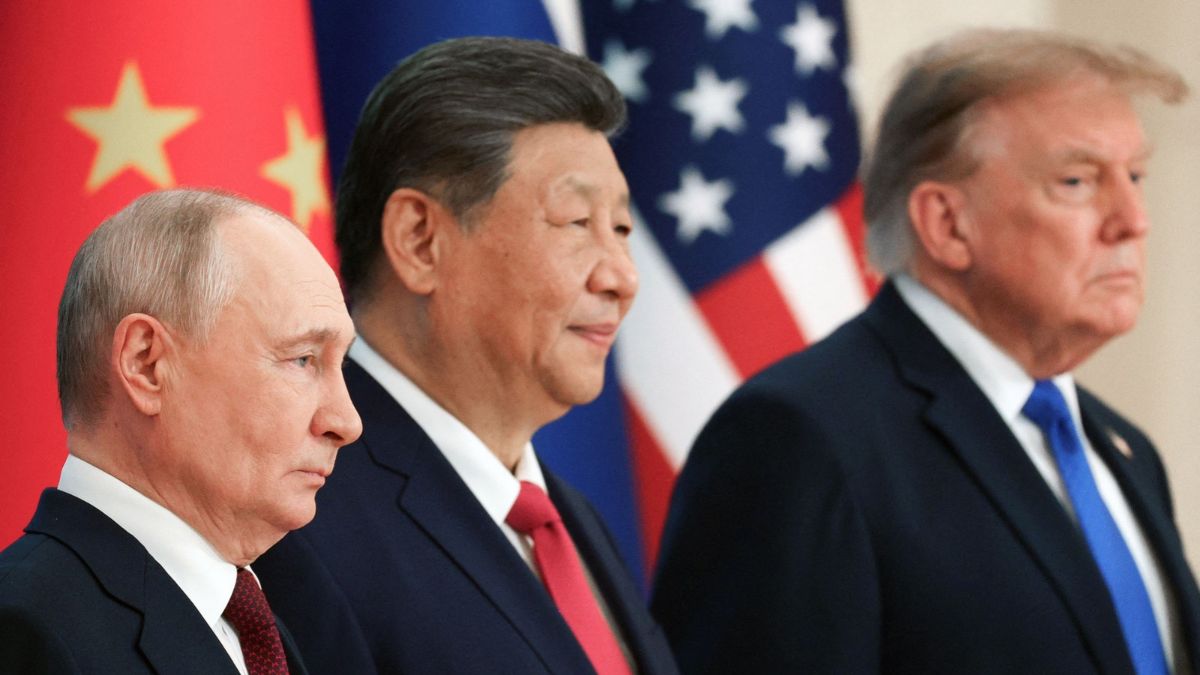
The reported joint commitment by Donald Trump, Xi Jinping, and Vladimir Putin at the 2026 Asia-Pacific Economic Cooperation (APEC) summit represents a structural shift from unilateral economic containment to managed trilateral interdependence. By linking commitments on stable energy flows with renewed nuclear arms control negotiations under a broad peace declaration, the three leaders are attempting to decouple existential security threats from ongoing commercial and industrial competition. Analyzing this diplomatic alignment requires stripping away the ceremonial language of summit communiqués to examine the underlying game-theoretic incentives, supply chain vulnerabilities, and deterrence mechanics driving each actor.
The Structural Logic of the Tripolar Bargain
Traditional international relations theory often frames multipolar competition as a zero-sum struggle for regional hegemony. However, when three nuclear-armed powers with deeply intertwined commodity and manufacturing supply chains face simultaneous domestic economic pressures, the payoff matrix shifts toward tactical stabilization.
The Trilemma of Great Power Competition
Each of the three leaders enters the 2026 summit constrained by a strategic trilemma. A nation cannot simultaneously maximize unilateral military escalation, enforce total economic decoupling, and maintain domestic macroeconomic stability.
- The United States: Pursuing aggressive tariff regimes alongside high defense expenditures creates inflationary pressure and strains industrial input costs. Stabilizing global energy prices reduces domestic consumer friction and lowers manufacturing overhead, creating fiscal space for targeted industrial policy.
- China: Export-led growth models depend on predictable maritime transit routes and stable demand from Western markets, paired with discounted, uninterrupted energy imports from overland Eurasian pipelines. Escalating regional conflict threatens both import security and export revenue.
- Russia: Sustaining state revenue requires continuous monetization of hydrocarbon and mineral reserves, while prolonged military mobilization depletes human capital and high-tech industrial capacity. Re-entering formal diplomatic frameworks provides sanction relief leverage and legitimizes its role as a primary Eurasian energy broker.
The 2026 APEC declaration functions as a release valve for this trilemma. Rather than resolving underlying ideological or territorial disputes, the agreement establishes a floor beneath bilateral and trilateral relations, preventing accidental escalation while preserving each state's freedom to compete in non-restricted domains.
Deconstructing the Stable Energy Flows Mechanism
A commitment to stable energy flows is not an altruistic pledge to global market harmony; it is a coordinated intervention in commodity risk premiums. Energy markets price in geopolitical risk well before physical supply disruptions occur. When major producers and consumers signal alignment, the volatility premium embedded in crude oil, liquefied natural gas (LNG), and refined product futures contracts compresses.
Chokepoint Security and Supply Route Diversification
Global energy stability relies on the uninterrupted operation of physical infrastructure—specifically maritime chokepoints like the Strait of Malacca and the Strait of Hormuz, alongside overland pipeline networks crossing Central Asia and Siberia.
- Maritime De-escalation: Joint assurances reduce the probability of naval blockades, gray-zone interdictions, or insurance rate spikes for commercial tankers transiting the Indo-Pacific. Lower maritime insurance premiums directly reduce the landed cost of energy for net importers across the APEC bloc.
- Overland Corridor Integration: Russia and China have spent years expanding overland pipeline capacity, such as the Power of Siberia network, to insulate bilateral energy trade from naval interdiction. Integrating these flows into a broader stability framework reduces the friction caused by secondary sanctions on shipping, banking, and energy infrastructure.
- Strategic Reserve Coordination: While formal cartelization between Washington, Beijing, and Moscow is politically impossible, synchronized signaling regarding Strategic Petroleum Reserve (SPR) releases and production quotas dampens speculative price spikes.
The Price-Band Equilibrium
The operational goal of this energy commitment is to maintain hydrocarbon prices within a goldilocks band—high enough to sustain capital expenditure and state budgets for producers like the United States and Russia, yet low enough to prevent industrial margin compression and stagflation in major consuming economies like the United States and China.
This equilibrium faces severe structural limitations. Physical infrastructure remains vulnerable to non-state actors, technical failures, and localized regional conflicts outside the direct control of the three capitals. Furthermore, private energy majors and state-owned enterprises operate on distinct capital allocation timelines; political declarations do not immediately translate into upstream drilling rigs or LNG liquefaction terminals.
The Architecture of Renewed Nuclear Talks
Pairing energy security with nuclear arms control talks introduces issue linkage—a classic diplomatic strategy where cooperation in an area of mutual economic benefit is used to incentivize concessions in a high-stakes security domain.
Overcoming the Strategic Stability Deficit
Following the expiration or suspension of legacy Cold War arms control treaties—most notably the Intermediate-Range Nuclear Forces (INF) Treaty and New START—strategic deterrence entered an unregulated phase. Without verification protocols, data exchanges, or warhead ceilings, military planners in Washington, Beijing, and Moscow must model worst-case scenarios, triggering an expensive, destabilizing arms race.
- Bilateral to Trilateral Complexity: Historically, nuclear arms control was a bilateral arithmetic problem between Washington and Moscow. China's rapid modernization and expansion of its nuclear arsenal rendered bilateral caps obsolete from the American perspective, while Beijing previously refused to join talks until its arsenal reached parity with the other two powers.
- The Cost Function of Modernization: Maintaining, upgrading, and expanding nuclear triads—intercontinental ballistic missiles (ICBMs), submarine-launched ballistic missiles (SLBMs), and strategic bombers—consumes vast capital and engineering talent. Entering formal talks allows all three governments to cap long-term capital outlays on delivery systems without appearing unilaterally weak to domestic audiences.
Verification Bottlenecks and Asymmetric Arsenals
Initiating nuclear talks at APEC is a low-cost political signal; achieving a binding treaty is an immense technical challenge. Several structural barriers impede rapid progress:
- Asymmetric Force Structures: The United States and Russia possess large, roughly comparable deployed strategic arsenals, whereas China maintains a smaller, rapidly growing force alongside a substantial inventory of regional, intermediate-range conventional and dual-capable missiles. Designing a single metric that equates tactical warheads, strategic delivery vehicles, and missile defense interceptors requires complex weighting formulas.
- Verification Intrusiveness: Effective arms control requires on-site inspections, telemetry sharing, and satellite monitoring protocols. States deeply protective of military opacity—particularly regarding mobile launcher locations and underground facilities—resist intrusive verification regimes that could expose conventional vulnerabilities.
- Emerging Technology Integration: Modern deterrence is no longer confined to kinetic nuclear warheads. Hypersonic glide vehicles, anti-satellite (ASAT) weapons, cyber capabilities targeting nuclear command-and-control (NC3) networks, and artificial intelligence in early-warning systems blur the line between conventional and nuclear escalation. Any durable framework must define boundaries for these non-traditional domains.
Evaluating the Peace Declaration Through Game Theory
In diplomatic practice, a peace declaration lacking binding enforcement mechanisms functions as a non-binding coordination game rather than an enforceable contract. Its immediate value lies in altering expectations and establishing focal points for future crisis management.
Signaling vs. Binding Commitment
To assess whether the 2026 declaration represents a genuine strategic pivot or a tactical pause, analysts must distinguish between cheap talk and costly signals.
- Cheap Talk: Joint communiqués, photo opportunities, and broad pledges to pursue peace carry zero immediate implementation cost. Leaders frequently use them to project statesmanship ahead of domestic elections, party congresses, or economic downturns.
- Costly Signals: Credible commitment requires observable, irreversible actions that reduce a state's ability to defect later. Examples include the physical dismantling of missile silos, the lifting of specific statutory tariffs or export controls, the establishment of permanent military-to-military hotlines with strict response protocols, or long-term infrastructure co-investment.
Without accompanying costly signals in the months following the summit, the declaration operates purely as a temporary shock absorber. Each actor retains the option to defect the moment domestic political incentives or regional tactical opportunities shift.
Impact on Middle Powers and Regional Alliances
A trilateral understanding among Washington, Beijing, and Moscow immediately alters the strategic calculus for middle powers across the Indo-Pacific and Europe, including Japan, South Korea, Australia, India, and European Union member states.
- Abandonment vs. Entrapment: Allied nations constantly balance the fear of entrapment (being dragged into a superpower conflict) against the fear of abandonment (having their core security interests traded away in a grand bargain between great powers). A unilateral or trilateral peace declaration negotiated without formal input from regional allies triggers anxiety in capitals like Tokyo, Seoul, and Taipei, potentially accelerating their own independent defense spending and hedging strategies.
- Supply Chain Realignment: Businesses that spent years executing "China Plus One" or friend-shoring strategies to insulate themselves from geopolitical crossfire must reassess their capital expenditure models. If tariffs stabilize and energy flows normalize, the economic penalty for maintaining integrated global supply chains decreases, though few corporate boards will fully reverse diversification efforts given the history of sudden policy reversals.
Operationalizing the Post-Summit Environment
For institutional investors, multinational supply chain executives, and policy planners, reacting to high-level diplomatic declarations requires disciplined risk management rather than headline-driven repositioning.
Step-by-Step Risk Assessment Protocol
Organizations exposed to Indo-Pacific trade, global energy markets, or defense-industrial supply chains should execute a four-stage verification process before altering baseline operational strategies:
- Audit Statutory and Regulatory Implementation: Track concrete administrative actions—such as Office of Foreign Assets Control (OFAC) license issuances, tariff schedule modifications, and export control entity list adjustments—rather than relying on summit press releases. Policy shifts only become operationally real when codified in federal registers and customs directives.
- Monitor Physical Commodity Spreads: Observe Brent-WTI crude spreads, Asian LNG spot prices (JKM), and maritime freight rates across key transit corridors. Genuine energy stabilization will manifest as sustained compression in implied volatility across 6-to-12-month futures curves.
- Track Military-to-Military Institutionalization: Look for the resumption of working-level arms control working groups, scheduled inspection exchanges, and formal incident-at-sea protocols. Diplomatic momentum without bureaucratic institutionalization rarely survives a localized military accident.
- Maintain Structural Redundancy: Retain dual-sourcing agreements for critical minerals, semiconductors, and energy inputs. The structural drivers of great power competition—technological supremacy, industrial market share, and regional sphere-of-influence contests—remain intact beneath the surface of trilateral stabilization.
Strategic Forecast and Positioning
The 2026 APEC agreement marks the onset of an era of compartmentalized competition. Washington, Beijing, and Moscow have recognized that unrestrained escalation in nuclear posture and energy warfare imposes unacceptable macroeconomic and existential costs on all three regimes. Consequently, the three powers are ring-fencing existential risks—nuclear exchange and global energy shocks—while preserving the arena for intense competition in artificial intelligence, advanced manufacturing, critical mineral processing, and regional diplomatic influence.
Decision-makers must treat the resulting reduction in geopolitical volatility as a tactical window rather than a permanent return to pre-2016 globalization. Capital allocators and corporate strategists should use this period of compressed risk premiums to lock in long-term energy hedges, refinance debt under stabilized inflation expectations, and finalize supply chain redundancies before the next cyclical friction tests the durability of the trilateral truce.