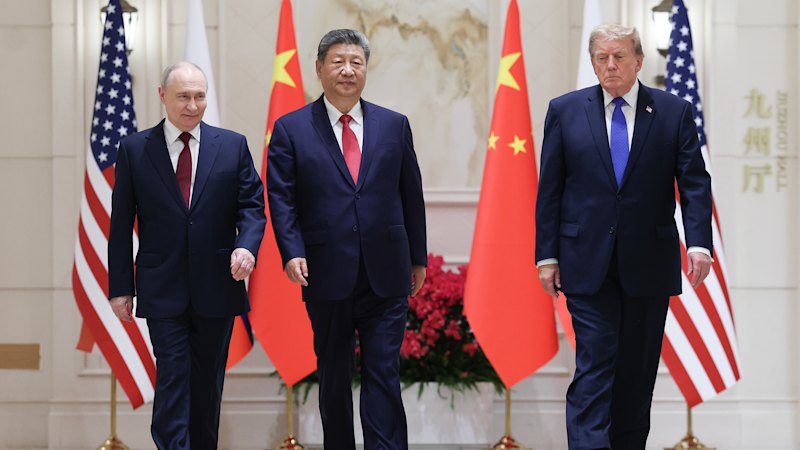
Diplomacy involving Donald Trump, Vladimir Putin, and Xi Jinping over nuclear arms control and the war in Ukraine operates as a nested two-level bargaining game rather than a conventional bilateral negotiation. Standard political reporting treats these interactions as isolated summits or personality-driven dealmaking. That framing misses the structural mechanics. When the executives of the United States, Russia, and China engage simultaneously on strategic nuclear arsenals and European territorial security, they are attempting to price and trade fundamentally asymmetric assets across two distinct theaters.
To analyze this interaction rigorously, observers must separate the public signaling from the underlying strategic equilibrium. The core mechanism at work is cross-domain linkage: using concessions or escalation threats in a conventional regional conflict (Ukraine) to extract structural advantages in strategic nuclear stability (arms control treaties and force posture), and vice versa.
The Structural Shift from Bipolar to Tripolar Deterrence
For five decades, strategic nuclear stability rested on a bilateral mathematical foundation between Washington and Moscow. Under treaties such as the Strategic Arms Reduction Treaty (START) and later New START, parity was measurable through verifiable ceilings on deployed warheads and delivery vehicles. The logic was straightforward: mutual vulnerability ensured restraint, and bilateral verification prevented breakout scenarios.
The entry of Beijing as a peer-level nuclear competitor breaks that bilateral architecture. China's rapid expansion of its silo-based intercontinental ballistic missile (ICBM) fields, road-mobile launchers, and submarine-launched capabilities introduces the three-body deterrence problem.
In a bilateral system, increasing warhead counts yields diminishing marginal returns once assured destruction is achieved. In a tripolar system, the United States faces a dual-deterrence requirement: maintaining sufficient survivable second-strike capability to deter Russia and China simultaneously, without triggering an unrestrained arms race where Moscow and Beijing combine their arsenals to achieve numerical superiority.
- The US Dilemma: Washington cannot accept bilateral parity with Moscow if Beijing remains unconstrained, because combined Sino-Russian strategic forces would exceed US deployed limits under New START caps (1,550 deployed strategic warheads).
- The Russian Calculus: Moscow relies heavily on its nuclear arsenal—both strategic and non-strategic (tactical)—to compensate for the degradation of its conventional military forces in Ukraine. For the Kremlin, nuclear weapons are the primary instrument preserving its great-power status.
- The Chinese Incentive: Beijing benefits from strategic ambiguity and numerical expansion. Entering formal trilateral arms control talks locks China into an inferior ceiling before it achieves parity, making participation irrational unless Washington offers substantial non-nuclear concessions, such as halting missile defense deployments in the Indo-Pacific or altering its posture regarding Taiwan.
When Trump, Putin, and Xi discuss nuclear weapons, they are not negotiating a simple renewal of expired treaties. They are contesting the baseline rules of a tripolar nuclear order where verification regimes have collapsed and missile defense technologies blur the line between offensive and defensive capabilities.
Deconstructing the Bargaining Assets
Effective negotiation analysis requires mapping what each actor actually holds, what they value, and what they can credibly trade. A common analytical error is assuming all three leaders share a preference for stability. In practice, controlled instability often serves as a primary source of bargaining power.
United States Executive Posture
The American position under Trump centers on transactional linkage and cost-shifting. The primary objective is reducing direct US financial and military expenditure in Europe while forcing European NATO allies to assume primary responsibility for conventional deterrence against Russia. Simultaneously, Washington seeks to pull Beijing into arms control frameworks to cap Chinese nuclear modernization before the early 2030s, when Pentagon projections indicate China could field over 1,000 operational warheads.
The US holds three primary bargaining chips:
- Military Aid and Intelligence Flows to Kyiv: The volume, velocity, and targeting restrictions of American weapons systems directly dictate Ukraine's operational capacity to hold territory or strike Russian logistics.
- Sanctions and Financial Architecture: Control over secondary sanctions, dollar-clearing mechanisms, and energy price enforcement gives Washington direct pressure over Moscow's war economy and Beijing's export-dependent financial sector.
- Alliance Guarantees and Force Posture: The deployment of US strategic bombers, nuclear-capable dual-use aircraft in Europe, and regional missile defense systems (such as Aegis Ashore) serve as direct pressure points on both Russian and Chinese security perimeters.
Russian Strategic Objectives
Putin operates from a position of high conventional attrition paired with high nuclear escalation dominance. Russia's economy has transitioned to a wartime footing, sustaining immediate industrial output at the cost of long-term structural inflation, labor shortages, and technological isolation.
Moscow's core demands in Ukraine—permanent territorial recognition of annexed oblasts, Ukrainian neutrality outside NATO, and strict limits on the size and weaponry of the Ukrainian Armed Forces—are designed to render Ukraine indefensible against future coercion. In the nuclear domain, Putin uses calibrated nuclear signaling, doctrinal revisions lowering the threshold for nuclear use, and the suspension of New START inspection protocols to deter deeper Western intervention in Ukraine. By tying strategic nuclear talks to European security architecture, Putin attempts to force Washington to trade away Ukrainian sovereignty in exchange for predictable nuclear risk reduction.
Chinese Geostrategic Mediation
Xi Jinping occupies the pivot position in this triangle. China maintains a "no-limits" strategic partnership with Russia, providing dual-use microelectronics, machine tools, and energy purchases that keep the Russian defense industrial base functioning. However, Beijing avoids overt lethal aid to prevent catastrophic secondary sanctions from the US and the European Union, which remain China's largest export markets.
For Xi, the Ukraine war is a strategic buffer. As long as Washington and Moscow remain locked in a European proxy conflict, American diplomatic bandwidth, defense industrial capacity, and naval/air assets are diverted from the Indo-Pacific. Beijing's interest in a Ukraine settlement is strictly conditional: Xi will only exert decisive economic pressure on Putin to freeze the conflict if Washington offers reciprocal concessions on tariffs, technology export controls, or non-interference in the Taiwan Strait.
The Mechanics of Cross-Domain Linkage
The central flaw in conventional diplomatic commentary is treating the Ukraine negotiations and nuclear arms talks as parallel tracks. In reality, they operate as an interconnected system of hydraulic pressure. Applying force in one chamber immediately alters the equilibrium in the other.
Consider the Escalation-to-De-escalate Feedback Loop. When Ukrainian forces achieve tactical breakthroughs or strike deep inside Russian territory using Western-supplied long-range precision munitions, Moscow's conventional deterrence fails. To restore deterrence without mobilizing additional domestic manpower, the Kremlin elevates nuclear readiness or deploys non-strategic nuclear systems to forward bases in Belarus.
This nuclear signaling achieves two distinct outcomes for Moscow. First, it constrains Washington's willingness to lift targeting restrictions on Kyiv, effectively establishing an invisible sanctuary for Russian rear-area logistics. Second, it signals to Trump that strategic nuclear stability cannot be decoupled from the settlement terms in Eastern Europe.
Conversely, Trump's threat to drastically accelerate US nuclear modernization, expand missile defense architectures, or flood Ukraine with unrestricted offensive weaponry creates a Cost-Imposition Trap for both Putin and Xi. Neither Russia nor China desires an unconstrained nuclear arms race with the United States, whose capital markets and technological base remain superior when fully mobilized. By threatening an expensive arms race alongside an unpredictable escalation in Ukraine, Washington attempts to force Beijing to act as a restraining agent on Moscow.
Operational Friction and Verification Bottlenecks
Even if the three leaders reach a political framework linking a ceasefire in Ukraine to new nuclear limits, execution faces severe technical and operational bottlenecks. Diplomatic announcements frequently collapse during the technical implementation phase because political leaders ignore verification mechanics.
The Collapse of Arms Control Verification
New START relied on on-site inspections, telemetry exchanges, and notifications of missile movements. Following Russia's suspension of treaty implementation, bilateral visibility degraded to national technical means—primarily reconnaissance satellites and signals intelligence.
Bringing China into a trilateral agreement multiplies this verification problem exponentially:
- Co-mingling of Forces: China co-locates conventional and nuclear missile brigades (such as the DF-26 intermediate-range ballistic missile) under the People's Liberation Army Rocket Force. Verifying whether a launcher carries a conventional or nuclear warhead requires intrusive on-site inspection protocols that Beijing has historically rejected as espionage.
- Non-Strategic Nuclear Weapons: Russia holds an estimated 1,000 to 2,000 non-strategic nuclear warheads, which are not covered by any existing treaty. These weapons are stored in central facilities but can be mated rapidly to dual-capable delivery systems (artillery, short-range ballistic missiles, cruise missiles). Accounting for these warheads requires warhead-level chain-of-custody verification, a technology that has never been implemented operationally between nuclear powers.
- Breakout Timelines: Without continuous data exchanges, each side must plan for worst-case "upload" scenarios—the rapid installation of reserve warheads onto existing missiles (MIRVing). In a three-party system, distrust over upload capacity creates a hair-trigger hair-pulling dynamic where each state expands its reserve stockpile as a hedge against cheating by the other two.
The Unenforceability of Frozen Conflicts
A negotiated ceasefire in Ukraine faces a parallel verification and enforcement problem. A demilitarized zone (DMZ) stretching over 1,000 kilometers across contested terrain requires continuous, impartial monitoring and a credible rapid-reaction enforcement mechanism.
If Ukraine is denied NATO Article 5 collective defense guarantees as a condition of Russian withdrawal or ceasefire, Kyiv requires an alternative security guarantee to prevent Russia from using the pause to reconstitute its armored brigades and launch a third invasion in three to five years.
- The Bilateral Security Pact Limitation: Executive agreements signed by a US administration are not binding treaties ratified by the Senate. Moscow and Kyiv both recognize that a subsequent US president can alter or abandon executive commitments.
- The European Deterrence Deficit: European NATO members lack the independent strategic lift, intelligence-surveillance-reconnaissance (ISR) saturation, and deep-strike munitions stockpiles required to enforce a ceasefire against a reconstituted Russian military without American backing.
- The Porcupine Strategy: The only self-enforcing military equilibrium for Ukraine outside NATO involves transforming the country into an asymmetric fortress—deploying dense layers of integrated air defense, automated drone swarms, hardened subterranean fortifications, and domestic long-range strike capabilities. However, Putin's core objective in negotiations is explicitly to prohibit this exact militarization, creating a direct zero-sum impasse.
Separating Known Facts from Analytical Hypotheses
Rigorous strategy requires stripping away media speculation and isolating verified baseline realities from conditional projections.
Verified Baseline Realities:
- Nuclear Modernization is Active: All three powers are currently executing multi-decade nuclear modernization programs. The US is replacing its triad (Sentinel ICBMs, Columbia-class submarines, B-21 bombers); Russia has modernized over 90 percent of its strategic nuclear delivery systems; China is constructing hundreds of new solid-fuel ICBM silos in its western provinces.
- Attrition Limits Conventional Offense: Neither Russia nor Ukraine possesses the combined-arms breakthrough capacity to achieve rapid, decisive strategic victory across the entire front under current force ratios and drone-saturated battlefield transparency.
- Sino-Russian Trade is Structural: Bilateral trade between China and Russia exceeded $240 billion annually, insulating Moscow from Western financial sanctions while increasing Russian economic dependency on Chinese industrial goods and energy purchases.
Conditional Analytical Hypotheses:
- Hypothesis A (The Grand Bargain): Trump attempts to trade an immediate freeze of the Ukraine conflict along current lines of control—combined with a moratorium on NATO expansion—for Russian cooperation in pressuring Beijing into trilateral nuclear talks and reducing Moscow's alignment with Iran and North Korea. Failure Mode: Putin accepts the territorial freeze in Ukraine to rebuild his military, then refuses to deliver Chinese concessions or stalls arms control talks indefinitely, leaving Washington with degraded alliance credibility and zero strategic nuclear gains.
- Hypothesis B (Coercive Escalation): Facing Russian intransigence on Ukraine and Chinese refusal to enter nuclear negotiations, Washington removes all restrictions on Ukrainian deep strikes, accelerates defense spending, and deploys intermediate-range missiles to both Europe and the Indo-Pacific. Failure Mode: Moscow and Beijing formalize a mutual defense pact, synchronize regional crises in Eastern Europe and the South China Sea, and trigger an unconstrained three-way nuclear arms race.
- Hypothesis C (Managed Fragmentation): Negotiations yield no comprehensive treaty. Instead, the parties settle into an informal, tacitly managed cold peace: a brittle, heavily mined ceasefire line in Ukraine enforced by European peacekeepers and US weapons sales, paired with basic bilateral crisis-communication hotlines to prevent accidental nuclear escalation, while quantitative arms control remains dead.
Tactical Framework for Interpreting Summit Outcomes
When evaluating future diplomatic engagements between Washington, Moscow, and Beijing, analysts must ignore joint communiqués, diplomatic rhetoric, and nominal ceasefire declarations. Real strategic shifts are visible only through measurable operational indicators:
- Telemetry and Notification Resumption: Any genuine progress on nuclear stability will manifest first in the quiet restoration of pre-launch missile notifications and data exchanges, not in headline warhead reduction targets.
- Chinese Export Control Enforcement: If Xi Jinping genuinely commits to ending the war in Ukraine, the immediate indicator will be Chinese customs crackdowns on dual-use microelectronics, CNC machine tools, and nitrocellulose shipments to Russian defense entities. Without supply-chain interdiction, Chinese peace proposals are purely diplomatic theater.
- Force Posture Disengagement: A durable settlement in Ukraine requires verifiable withdrawal of heavy artillery, electronic warfare brigades, and tactical ballistic missile launchers beyond specific range thresholds from the line of contact, monitored by continuous overhead commercial and military satellite constellations.
The strategic reality governing the Trump-Putin-Xi triangle is straightforward: personal rapport between executives cannot override structural security dilemmas. Washington seeks to pivot resources toward containment of China without losing European stability; Moscow requires imperial subjugation of Ukraine to validate its regime and offset conventional weakness; Beijing uses the European conflict to bleed American power while completing its nuclear breakout. Unless one party alters its core survival calculus through severe economic shock or decisive battlefield defeat, talks between these three leaders will produce temporary tactical pauses rather than a stable geopolitical equilibrium.
To navigate this environment, Western defense planners and policymakers must decouple strategic nuclear deterrence from territorial negotiations in Eastern Europe—securing bilateral crisis-communication channels and funding domestic triad modernization independently, while conditioning any sanctions relief for Moscow or tariff reductions for Beijing strictly on verifiable, irreversible reductions in military-industrial output rather than reversible diplomatic signatures.