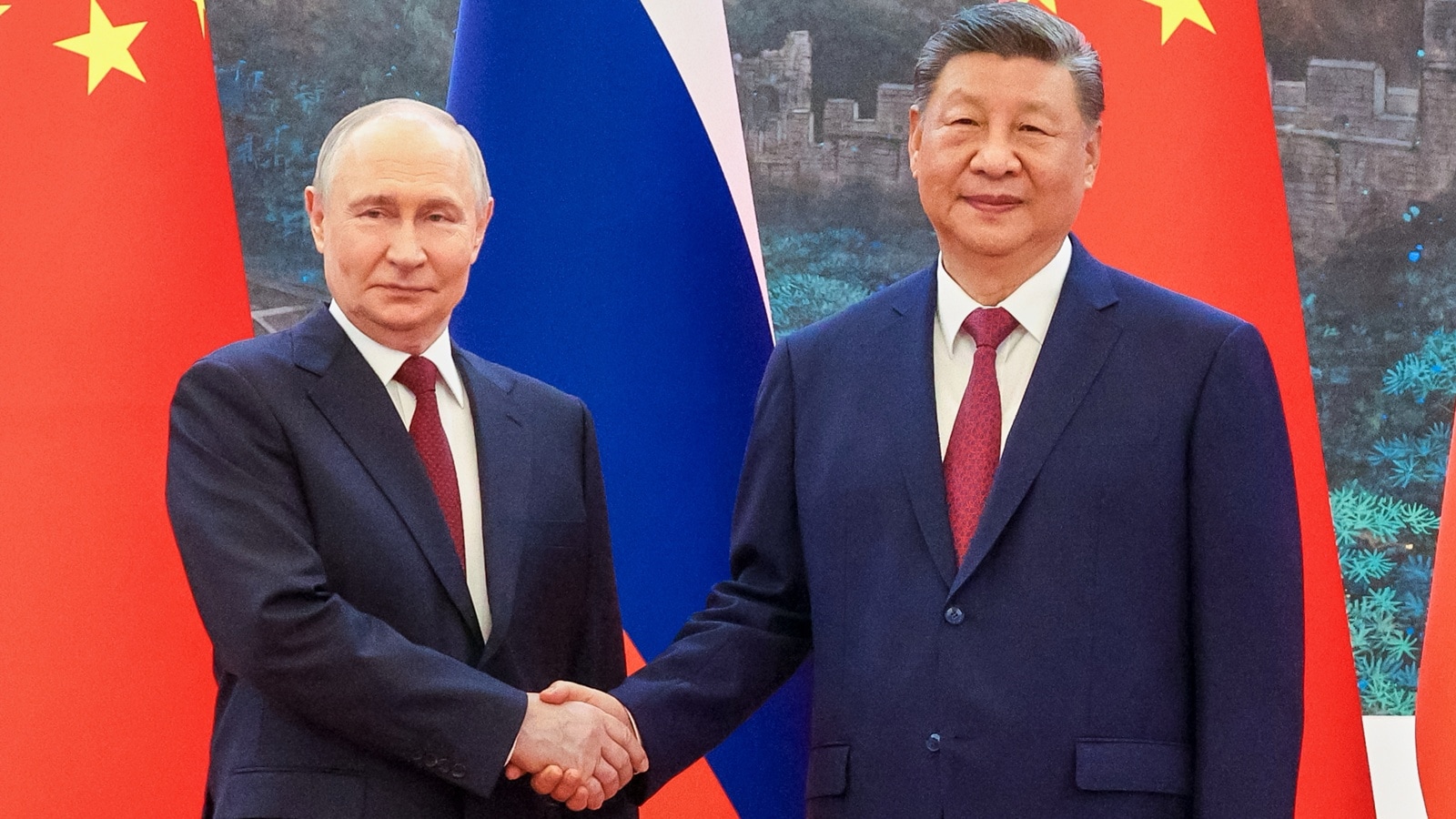
The timing of Vladimir Putin’s arrival in Beijing—occurring mere days after a high-stakes US presidential delegation visit—is not a diplomatic coincidence. It is a calculated exercise in strategic triangulation. While mainstream commentary frequently views these bilateral summits through the lens of performative diplomacy or vague notions of "axis alignment," a rigorous structural analysis reveals a highly transactional calculus. Beijing is actively balancing two competing economic and geopolitical variables: maintaining critical export access to Western G7 markets while simultaneously capitalizing on Russia's structural dependency to secure deeply discounted energy reserves and industrial leverage.
To understand the trajectory of Sino-Russian relations, analysts must look past the rhetorical veneer of a "no-limits partnership" and evaluate the operational constraints driving both regimes.
The Strategic Triangulation Framework
Beijing’s foreign policy operates on a three-body problem involving the United States, Russia, and the European Union. The structural relationship between these entities can be broken down into three distinct operational vectors.
1. The Asymmetric Dependency Vector
Russia's isolation from Western capital markets and the SWIFT banking system has fundamentally altered its terms of trade. Moscow has shifted from a peer partner to a junior supplier of raw commodities. This gives China unprecedented monopsony power—the leverage of being the dominant buyer in a market with limited alternative options.
2. The G7 Export Hedging Vector
Despite growing domestic consumption, China’s industrial apparatus remains structurally reliant on exporting manufactured goods to the US and Europe. A total pivot toward Russia cannot mathematically offset a systemic rupture with the West. Therefore, every diplomatic concession offered to Moscow is calibrated to stay just below the threshold that would trigger sweeping, secondary Western sanctions on major Chinese financial institutions.
3. The Eurasian Security Buffer
For Beijing, Russia represents a critical, contiguous landmass that secures its northern border. This allows the People's Liberation Army (PLA) to concentrate its naval and military resources toward the first island chain and the South China Sea, rather than policing a volatile land frontier.
The Energy Discount Function: Quantifying the Economic Arbitrage
The core economic driver of the Beijing-Moscow axis is not shared ideology; it is resource arbitrage. Since the imposition of Western price caps and embargoes on Russian crude, Moscow has been forced to re-route its Urals and ESPO blends to Asian markets.
[Standard Global Brent Pricing]
       │
       ▼ (Western Sanctions & Embargoes)
[Russian Urals / ESPO Crude]
       │
       ▼ (Monopsony Buyer Power)
[Sinopec / PetroChina Discounted Procurement]
This structural shift functions as a massive economic subsidy for China’s industrial base. By purchasing Russian oil and gas via non-dollar denominated channels—primarily the Renminbi (RMB)—China achieves a dual objective:
- Margin Expansion: Chinese refiners obtain feedstock at a significant discount relative to Brent crude, lowering the input costs for downstream chemical and manufacturing sectors.
- De-dollarization Infrastructure: Processing these transactions via the Cross-Border Interbank Payment System (CIPS) builds a functional alternative to Western financial architecture, insensitizing China to potential future asset freezes.
However, this mechanism has explicit limitations. The Power of Siberia 2 pipeline remains a point of friction. Beijing is leveraging its dominant position to demand price parity with heavily subsidized domestic Russian rates, alongside zero take-or-pay volume guarantees. Moscow desires long-term, fixed-volume commitments to replace its lost European market share. The gridlock over this infrastructure demonstrates that when national economic interests collide, the "no-limits" rhetoric yields to cold ledger arithmetic.
Industrial Substitution and Market Capture
The departure of Western automotive, industrial, and technology corporations from the Russian domestic market created a vacuum that Chinese enterprises have systematically monetized. This is not a temporary trading relationship; it is a permanent structural displacement.
Automotive and Heavy Machinery
Chinese brands now command over half of the Russian passenger vehicle market, transforming a region once dominated by European and Japanese automakers into a captive revenue stream. This provides a critical vent for China's industrial overcapacity.
Semiconductor and Dual-Use Component Flows
While Beijing officially denies providing lethal military assistance, the trade data reveals a massive surge in the export of CNC (computer numerical control) machine tools, optical components, and microelectronics. These items occupy a gray zone: they are essential for civilian manufacturing but are easily diverted into Russia’s military-industrial complex to sustain its defense production lines.
The strategic risk for Beijing lies in the enforcement threshold of US secondary sanctions. The Chinese banking sector is highly bifurcated. Tier-1 state banks with global clearing footprints are increasingly restricting RMB-denominated payments from Russian entities to avoid losing access to the US dollar clearing network. Instead, Beijing is shifting these transactional risks to localized, Tier-3 regional banks that have zero exposure to the Western financial system. This creates a firewall, protecting China’s primary financial engines while maintaining the economic lifeline to Moscow.
The Strategic Balance Sheet: Constraints on the Alliance
A rigorous assessment requires analyzing the structural vulnerabilities that prevent this alignment from maturing into a formal military alliance.
| Strategic Asset for Beijing | Structural Vulnerability / Liability |
|---|---|
| Cheap Hydrocarbons: Lowers manufacturing input costs and secures energy routes away from maritime chokepoints like the Malacca Strait. | Sanction Contagion: Excessively overt support risks triggering European tariffs and US secondary sanctions, jeopardizing trillions in Western trade. |
| Geopolitical Distraction: Keeps US military and diplomatic resources focused on the European theater, easing pressure in the Indo-Pacific. | Strategic Unpredictability: Moscow’s tactical escalations or potential regime instability could force Beijing into an unplanned geopolitical crisis. |
| Technology Sharing: Access to legacy Russian military technologies, particularly in submarine silencing and aerospace engineering. | Asymmetric Market Sizes: The entire Russian economy is roughly the size of a single major Chinese coastal province, limiting its value as a consumer market. |
The Strategic Play: China's Next Operational Move
Following the departure of the US delegation and the conclusion of the Putin bilateral talks, Beijing’s immediate tactical trajectory will focus on maintaining equilibrium through specific actions.
First, China will intensify its diplomatic posturing as a neutral peace mediator, utilizing vague frameworks to appease European leaders who are critical to preventing a unified transatlantic trade front against Beijing. This rhetorical neutrality acts as a diplomatic shield, allowing the underlying economic extraction of Russian resources to continue unimpeded.
Second, expect an expansion of non-maritime trade corridors. Beijing will accelerate investment in the Northern Sea Route and Central Asian rail networks. These overland logistics corridors are entirely immune to US naval interdiction, securing China's supply chains against potential future maritime blockades.
Ultimately, the Xi-Putin summit reinforces a stark reality: China is not operating out of ideological loyalty to Moscow, nor is it easily swayed by Washington's warnings. It is executing a cold, transactional strategy designed to maximize material gains from Russia's isolation while meticulously preserving its vital economic integration with the Western consumer base. Analysts who misinterpret this calculated balancing act as a rigid military bloc fail to understand the sophisticated, data-driven nature of Beijing's long-term geopolitical planning.