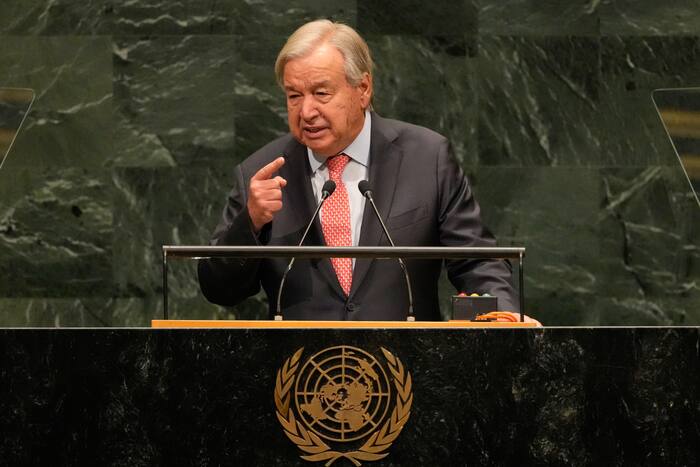
Dawn in Manhattan usually arrives with the sharp, metallic tang of roasted coffee beans and the low rumble of subway cars shuddering beneath the asphalt. But eighty feet above First Avenue, inside a room shaped like a giant horseshoe, dawn smells like nothing at all. It smells like chilled air, expensive wool, and thirty years of stale ambition.
This is the Trusteeship Council Chamber. Its murals depict human progress rising from the ashes of war, yet today the paint looks tired. The ceiling, designed by a Danish architect who wanted light to flood every corner, now mostly catches the glare of television cameras waiting for a miracle that rarely shows up. If you found value in this post, you should check out: this related article.
Right now, an empty wooden chair sits at the head of the curved green marble desk.
That chair is waiting for an occupant who does not yet exist. Or rather, an occupant who will soon inherit a building on the East River that is simultaneously the center of international diplomacy and a ghost town of vetoes. For another angle on this development, see the latest coverage from The New York Times.
Consider what happens when a cyclone slams into the coast of Mozambique or an artillery shell finds a maternity ward in eastern Europe. The ambassadors rush to this building. They draft resolutions with words like deplore, condemn, and deeply concern. They raise their hands. They nod. Then they walk out into the rain and catch town cars back to Sutton Place.
The person sitting in that wooden chair cannot catch a town car. That person has to stay behind and answer for the rain.
For decades, we have treated the role of the United Nations Secretary-General like a glorified receptionist for the globe. We expect a master of ceremonies who can cut ribbons, deliver soaring eulogies at state funerals, and whisper sweet nothingness into the ears of autocrats without bruising their fragile egos. We want a diplomat who never offends, never raises a voice, and somehow cures famine with a well-crafted press release.
It is a comforting illusion. And it is entirely dead.
The world has grown too loud for quiet men in gray suits to manage it with polite memoranda.
Picture Elena, a hypothetical humanitarian logistics officer stationed in a border town where two rival militias have just burned the only bridge carrying grain. She does not care about the five-point preamble of Security Council Resolution 2417. She cares about diesel fuel. She cares about a piece of paper signed by a warlord who smells like clove cigarettes and gunpowder, promising that her trucks will not be blown to scrap metal before sunset.
When Elena calls New York for backup, she is not looking for philosophy. She is looking for an executive who can look a paranoid head of state in the eye and say: If you starve these children, the world will stop feeding your bank accounts.
That requires a very specific kind of stubbornness.
The next leader of the United Nations will not succeed through charm alone. Charm is cheap currency in a room where five permanent members hold a permanent veto over human survival. When Russia or the United States or China decides that national interest supersedes global stability, charm bounces off their shields like rain off a tank.
What is needed instead is operational ruthlessness wrapped in radical empathy.
Look back at the tenure of Dag Hammarskjöld, a man who understood that neutrality does not mean silence. He flew into the Congo while the jungle was tearing itself apart, not to deliver speeches, but to put his own physical presence between the triggers and the targets. He died in a DC-6 plane crash in 1961 under circumstances that still make historians squint in suspicion. He did not leave behind a legacy of comfort. He left behind a blueprint for hazard.
Modern crisis management has evolved past the cold war chess board into something much messier. Climate migration. Autonomous drone swarms operated by contractors whose loyalty belongs to a shell company in the Caymans. Pandemics that spread faster than bureaucratic committees can schedule an emergency briefing.
To navigate this, the next Secretary-General must possess the analytical coldness of a forensic accountant and the fierce moral clarity of a street preacher.
They must be willing to bypass the institutional inertia that makes the Secretariat feel like a museum dedicated to paperwork. Walk down the third-floor corridors of the Secretariat building on any given Tuesday, and you can almost hear the sound of deadlines dying in slow motion. Memos bounce from Department A to Office B, annotated by under-secretaries who specialize in the art of the delayed decision.
A bureaucratic maze protects everyone except the people drowning in the Mediterranean.
The next leader must be ready to smash that maze. They must be willing to fire political appointees who owe their jobs to regional horse-trading rather than competence. They must be willing to pick up a secure satellite phone at three in the morning and wake up a reluctant superpower to demand intervention before a massacre begins, rather than issuing a condolence tweet after it ends.
This is the invisible stakes of the office.
We talk about geopolitics as if it were a game played by algorithms on a glowing map. It is not. It is human flesh against concrete. It is a mother in a basement in Khartoum listening to the whistle of incoming artillery while she tries to quiet her infant daughter. It is an oceanographer in Tuvalu watching the tide lap against the porch steps of her childhood home, knowing that the international climate summits are currently debating procedural amendments while her island sinks beneath her feet.
The person we choose for this job will either become a prisoner of protocol or its executioner.
There are those who argue that the position has been hollowed out permanently, that the General Assembly is a debating society with expensive microphones, and that the Security Council is an incubator for paralysis. They point to Syria. They point to Ukraine. They point to Gaza. They point to a dozen forgotten conflicts where the blue flag flew proudly outside buildings that were subsequently looted.
They are right, up to a point. The structural limitations are real. The veto is real. The budget strangulation imposed by wealthy nations who want global police protection on a discount subscription model is real.
Yet power often pools where courage stands.
When a leader refuses to accept the scripted diplomatic dance, the room changes shape. When someone speaks with such unvarnished truth that diplomats can no longer hide behind their talking points, the television cameras stop broadcasting propaganda and start broadcasting reality.
Think about the sheer audacity required to walk into a chamber filled with men who control thousands of nuclear warheads and tell them that their grandchildren will curse their names if they do not surrender their pride.
That is not management. That is leadership under fire.
The search for the next Secretary-General is already happening in smoke-filled embassy basements in Geneva, London, and Beijing. National governments are running background checks, weighing regional loyalties, and ensuring that no candidate is too independent, too sharp-elbowed, or too inconveniently honest. They want a safe pair of hands to steer a ship that is already taking on water.
That is precisely why we must demand the opposite.
We do not need safe hands. We need hands that are willing to grab the wheel so hard the knuckles turn white. We need someone who is not auditioning for their next job at a multi-national corporate consultancy or a university fellowship once their five-year term expires. We need someone who treats the United Nations not as a retirement home for distinguished diplomats, but as the last functioning emergency ward on a burning planet.
The wooden chair in the Trusteeship Council Chamber remains empty for now. Outside, the traffic on First Avenue surges northward, indifferent to the destiny being cobbled together in the conference rooms above.
When the new leader finally sits down in that chair, the leather will creak. The microphones will hum to life. The ambassadors will adjust their glasses and wait for the usual polite platitudes about dialogue, cooperation, and shared values.
Let us hope whoever is sitting there has the good sense to throw the script away.