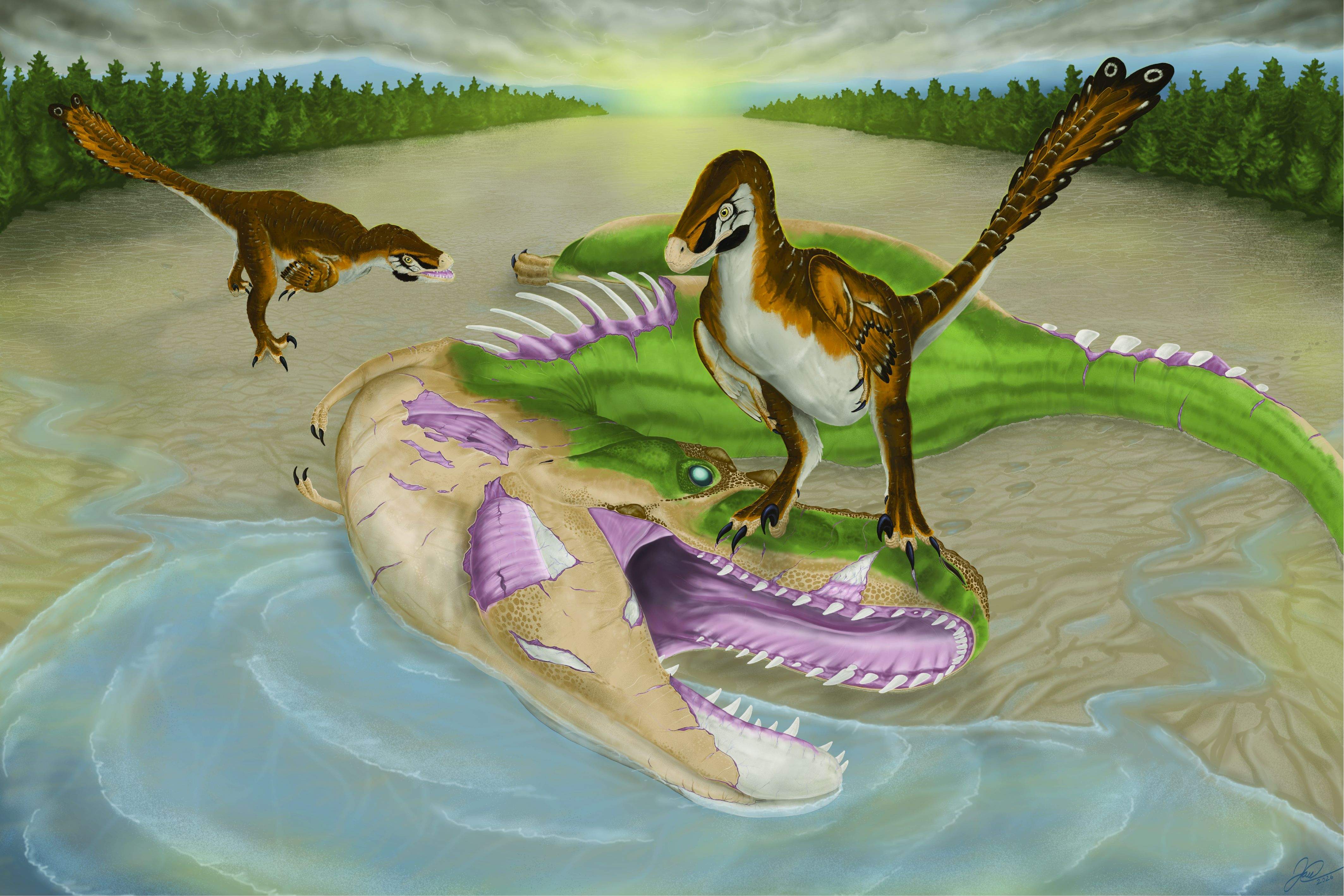
We picture the Cretaceous food chain as a rigid corporate ladder. Big apex predators sat at the top, medium predators fought in the middle, and tiny animals stayed out of everyone's way.
Then a fossil from the badlands of Alberta comes along and flips the whole hierarchy upside down.
Researchers at the University of Alberta recently analyzed a fossil skull belonging to an Albertosaurus, a massive, terrifying tyrannosaur that ruled its ecosystem. Hidden on the bones were microscopic tooth and bite marks. They weren't left by another giant meat-eater looking for a turf war. They matched the serrated, delicate teeth of a dog-sized raptor.
It’s the first concrete evidence that small dromaeosaurids—the group of dinosaurs commonly called raptors—scavenged on apex predators.
Solving a 70-Million-Year-Old Cold Case
The fossil specimen was originally unearthed near Drumheller, Alberta, by field technicians from the Royal Tyrrell Museum. Once pulled from the Horseshoe Canyon Formation, experts spotted unusual grooves etched into the jaw. The bone eventually made its way to the University of Alberta for deep-dive laboratory analysis.
Joshua Doyon, a paleontology master's student leading the investigation, realized something strange about where the marks sat.
"The placement of the tooth marks is in a really awkward spot to be attacking it when the dinosaur was alive," Doyon noted. The grooves sat directly on the lower jaw and even along the inside surface. That anatomical positioning pointed squarely away from active combat and straight toward post-mortem feeding.
Because the marks showed zero signs of healing, the animal didn't survive an attack. Something rolled up to the carcass right after death—or soon after—and started tearing into the flesh.
The Suspects in Question
Whenever you're dealing with ancient forensics, you have to look closely at who lived in the neighborhood. The research team narrowed down the culprits to two very different possibilities.
The primary candidate is a small raptor like Atrociraptor marshalli, a local feathered predator measuring roughly two meters long and weighing a modest 16 to 18 kilograms. Compare that to the subadult Albertosaurus, which tipped the scales at around 533 kilograms. That creates an astonishing thirty-to-one body mass ratio. A tiny predator was feeding on a heavyweight champion.
The second possibility is almost as weird: cannibalism.
The marks could have been left by a very young member of the same species. A baby Albertosaurus, less than two years old and roughly three meters long, might have gnawed on the remains of its own kind.
To figure it out, the team had to invent advanced geometric corrections. When teeth drag across bone at an angle, the spacing between individual serrations warps. By accounting for the drag direction, the researchers confirmed the physical geometry matched the dental profile of a dromaeosaurid raptor, though a juvenile tyrannosaur remains a biological backup suspect.
Why This Changes Our View of Ancient Ecosystems
For decades, popular culture trained us to think of dinosaurs in black-and-white terms. Apex predators hunted, herbivores got eaten, and scavengers cleaned up the scraps left in their specific weight class.
Real ecosystems are far messier.
In modern African savannas, jackals and hyenas will sneak bites off a lion kill given half a chance. They don't care about social standing or body size differences when free calories are sitting on the dirt. This discovery proves that Late Cretaceous ecosystems operated with that same opportunistic hunger.
When a massive predator dropped dead in the Alberta floodplains, it didn't matter that it used to rule the landscape. To a fast, agile raptor weighing less than a large dog, a dead tyrannosaur was simply an open buffet.
Next time you look at a museum display of a terrifying meat-eater, remember that nature wastes nothing. Even the kings of the food chain eventually wind up as lunch for the underdogs.
Jaw-dropping tyrannosaur discovery made in Alberta badlands
This video provides a closer look at the unique fossil excavation site in the Alberta badlands where researchers uncovered the unexpected tyrannosaur evidence.


