The fluorescent lights in the high school gymnasium in Des Moines always hum at a frequency that makes your teeth ache by midnight. I know that sound. I have spent too many January nights on folding metal chairs in Iowa, watching exhausted volunteers count torn slips of paper while breath hung white in the air near the prop-open exit doors. You smell burnt coffee, wet wool, and the sharp, metallic tang of sheer desperation.
That is where every presidential campaign actually begins. Not in the sleek glass towers of Manhattan or the manicured rose gardens of Washington, D.C., but in rooms that smell like floor wax and cold rain.
Right now, two years before the November 2028 presidential election, the political class is already playing its favorite parlor game. They are arranging trading cards on a mahogany table. On one side sits the presumed Republican juggernaut—an administration defined by Vice President JD Vance, the populist heir apparent from the Rust Belt, and Secretary of State Marco Rubio, the foreign policy hawk who once traded barbed insults with Donald Trump before becoming one of his most loyal lieutenants. Together, Vance and Rubio represent a formidable two-headed machine, blending economic nationalism with institutional muscle.
On the other side of the table? Thirteen names. Thirteen Democrats. Thirteen ambitious souls currently checking their reflections in hotel bathroom mirrors across New Hampshire and South Carolina, wondering if the face staring back belongs on a commemorative coin.
If you read the standard political coverage, those thirteen people are reduced to baseball statistics. Polling averages. Fundraising hauls. Demographic appeal in the Blue Wall states.
That misses the point entirely. A presidential primary is not an actuarial table. It is a blood sport played out in the human nervous system. To understand who among these thirteen Democrats can actually survive the meat grinder and stand across a debate stage from Vance or Rubio in the autumn of 2028, you have to stop looking at their resumes and start looking at their scars.
The Heavyweight Contenders in the Ring
Let us introduce a hypothetical voter to ground this madness. Call him Arthur. Arthur is fifty-four, lives twenty minutes outside of Allentown, Pennsylvania, and works as a logistics manager for a regional freight company. He voted for Barack Obama twice, stayed home in 2016, pulled the lever for Joe Biden in 2020, and reluctantly backed the Republican ticket in 2024 because his grocery bill made him feel like a stranger in his own life. Arthur does not care about white papers. He cares about whether the person asking for his vote understands what it feels like to lie awake at three in the morning doing mental arithmetic on a credit card balance.
If the Democratic Party wants Arthur back, they have to decide which version of America they are selling. Right now, the thirteen contenders fall into distinct psychological archetypes, each carrying a different promise—and a fatal flaw.
First, there are the Governing Titans, the executives who have actually run massive states and possess the scar tissue to prove it.
Consider Gavin Newsom, the Governor of California. Watching Newsom work a room is like watching a master watchmaker assemble a tourbillon in the dark. He is effortless, telegenic, and sharp enough to slice glass. He spent years positioning himself as the progressive vanguard, taking the fight directly to conservative media with a grin that never quite reaches his eyes. Yet for Arthur in Pennsylvania, Newsom carries the heavy baggage of San Francisco’s sidewalks and Los Angeles’s housing prices. Can a man who governs the nation's wealthiest, most famously dysfunctional state convince a freight manager in the Lehigh Valley that he understands regular life?
Then there is Josh Shapiro, the Governor of Pennsylvania himself. Shapiro speaks in the crisp, rhythmic cadence of a prosecutor who has never lost a closing argument. He won his state by double digits in 2022, and his approval ratings in the most critical swing state on the map remain stubbornly high. When a section of Interstate 95 collapsed in Philadelphia, Shapiro had it rebuilt in twelve days. Twelve days. In an era when Americans believe their government cannot even fill a pothole without a three-year environmental review, competence is an aphrodisiac. Still, Shapiro faces a treacherous path through his own party’s primary electorate, where fierce debates over foreign policy and progressive orthodoxy could turn his pragmatic appeal into a liability before he ever reaches the general election.
Look north to Michigan, and you find Gretchen Whitmer. She has survived a literal kidnapping plot, governed a purple state through the teeth of a pandemic, and turned Michigan into a laboratory for Democratic policy while keeping her Midwestern warmth intact. Whitmer talks like someone you would trust to watch your kids while you run to the pharmacy. Her challenge is translation. Regional charm does not always survive the jump to national television, where every vowel is dissected by cable news panels looking for weakness.
And we cannot ignore JB Pritzker, the billionaire Governor of Illinois. On paper, a hotel heir worth billions seems like the last person populist Democrats would embrace. Yet Pritzker has spent his tenure signing progressive legislation, expanding reproductive rights, and using his massive personal fortune as a blunt instrument against conservative attacks. He possesses the rare luxury of not needing to beg donors for money, freeing him to speak with an unfiltered bluntness that surprises voters expecting a stiff aristocrat.
The Ghosts of Campaigns Past
History does not repeat itself, Mark Twain supposedly said, but it sure loves to rhyme. Think back to 1976, when an obscure peanut farmer from Georgia named Jimmy Carter walked into Iowa with a garment bag and a smile, exploiting the public's exhaustion with Washington insiders. Or 2008, when a first-term senator from Illinois with a funny name dismantled the most inevitable political machine in modern memory.
In every cycle, there are candidates who carry the weight of previous battles, trying to prove that their moment did not pass them by.
Kamala Harris stands at the very center of this gravitational pull. Having served as Vice President and carried the Democratic banner in the bruising 2024 race, she knows the exact dimensions of the Oval Office better than anyone else on this list. She has weathered scrutiny that would have pulverized lesser politicians. Yet running again after a national defeat requires a delicate alchemy. Voters rarely ask for a sequel to a movie they walked out of. To claim the 2028 nomination, Harris must convince an anxious party that the lessons of 2024 were learned, not merely endured.
Beside her in the memory bank sits Pete Buttigieg, the former Transportation Secretary and one-time mayor of South Bend, Indiana. Buttigieg possesses a mind like a laser beam. He can walk onto hostile television networks, absorb a barrage of bad-faith questions, and dismantle the premise so politely that the host thanks him afterward. During his tenure at Transportation, he dealt with supply chain snarls, rail disasters, and crumbling bridges—unglamorous, gritty problems that give him administrative heft he lacked in 2020. Still, the nagging question remains: has he solved the riddle of building a deep, unshakeable coalition among Black and working-class voters who view polished intellect with quiet skepticism?
The Populist Brawlers and The Outsiders
Wait. Let us pause here.
What if the next president is not a smooth governor or a familiar Washington veteran? What if the anger simmering beneath the surface of American life demands someone who sounds less like a statesman and more like a street fighter?
Enter Alexandria Ocasio-Cortez. By November 2028, she will be thirty-nine years old—well past the constitutional threshold of thirty-five. Dismissing her as merely a social media phenomenon is a rookie mistake made by people who have never watched her question a corporate executive in a congressional hearing. She commands an army of small-dollar donors and young voters who view the traditional Democratic establishment as timid and compromised. If JD Vance represents a right-wing populism aimed at the working class, Ocasio-Cortez offers the mirror image from the left: fierce, uncompromising, and fluent in the language of economic grievance.
From the rugged mountain West comes Ruben Gallego, the Arizona Senator and Marine combat veteran who clawed his way into the Senate in 2024 by refusing to cede working-class Latino voters to the right. Gallego does not talk like a graduate seminar. He talks like a guy who grew up poor in Chicago, worked his way through Harvard, and carried a rifle in Iraq. When he speaks about the border, inflation, or the dignity of labor, he strips away the sanitized academic jargon that drives voters like Arthur in Pennsylvania up the wall.
Then there is Andy Beshear, the two-term Democratic Governor of Kentucky. Read that sentence again. A Democrat winning twice in deep-red Kentucky, a state Donald Trump carried by massive margins. Beshear did it not by abandoning his values, but by wrapping them in genuine empathy, showing up after devastating tornadoes and floods with muddy boots and an open heart. In a fractured nation addicted to outrage, Beshear’s superpower is radical decency. The risk? In a primary electorate hungry for a heavyweight boxer to take on Vance or Rubio, decency can sometimes look like bringing a casserole to a knife fight.
The Quiet Strategists and Dark Horses
Every presidential field hides a few figures whom the pundits underestimate until the votes actually get counted. They are the marathon runners pacing themselves at mile ten while the sprinters burn out in front of the cameras.
Look at Wes Moore, the Governor of Maryland. A Rhodes Scholar, combat veteran, bestselling author, and former nonprofit CEO, Moore radiates the kind of charismatic optimism that has not been seen in Democratic politics since the mid-2000s. When the Francis Scott Key Bridge collapsed in Baltimore, Moore’s steady, commanding presence turned a regional catastrophe into a masterclass in crisis leadership. He is young, magnetic, and deeply aware of his own historical weight as Maryland's first Black governor. Yet charisma alone is not armor; a national campaign tests every crack in a candidate’s foundation.
Consider Raphael Warnock, the Georgia Senator and senior pastor of Ebenezer Baptist Church—the very pulpit once occupied by Martin Luther King Jr. Warnock has won multiple grueling, high-stakes elections in a fiercely contested Southern battleground. He speaks with a moral cadence that can lift a room off its hinges, blending spiritual conviction with sharp political instincts. If the Democratic path to the White House runs through the Sun Belt—through Georgia, North Carolina, and Arizona—Warnock knows the terrain better than almost anyone alive.
Do not overlook Cory Booker, the New Jersey Senator whose relentless optimism and towering oratorical energy make him a perennial force in Democratic politics. Booker has spent a decade in the Senate building relationships across ideological lines while championing criminal justice reform and economic opportunity. He knows the brutal mechanics of a presidential campaign because he survived one in 2020, and candidates who run a second time often arrive leaner, wiser, and far more dangerous.
Finally, there is Ro Khanna, the California Congressman who has spent years bridging the cultural chasm between Silicon Valley’s tech titans and the deindustrialized towns of the Midwest. Khanna understands that artificial intelligence, automation, and domestic manufacturing are the tectonic plates shifting beneath Arthur’s feet in Pennsylvania. He argues tirelessly for a modern industrial policy that rebuilds American factories rather than writing off manufacturing communities as relics of the past.
What Actually Decides the Next Four Years
Let us step back from the biographies and look at the chessboard. Why does this specific lineup of thirteen Democrats matter so desperately right now?
Because the Republican ticket waiting for them in 2028 represents an evolutionary leap.
If JD Vance claims the Republican nomination, Democrats will face a forty-four-year-old Yale-educated venture capitalist who transformed himself into the intellectual architect of working-class populism. Vance knows how to weaponize cultural resentment while attacking corporate globalization—a combination designed specifically to poach union members and suburban parents in Pennsylvania, Michigan, and Wisconsin.
If Marco Rubio emerges at the top of the ticket, the challenge shifts entirely. Rubio brings decades of foreign policy fluency, deep ties to the conservative establishment, and proven appeal among Hispanic voters in key swing states. Against Rubio, Democrats cannot simply run on restoring normalcy; they have to prove they can manage a chaotic world where global alliances are fraying and economic competition with China defines every supply chain.
This is the invisible stake of the 2028 primary. The Democratic Party is not merely choosing a personality. It is choosing a theory of survival.
For twenty years, American politics has operated like a pendulum swinging violently between exhaustion and anger. Voters hire one party to fix the mess left by the other, grow disillusioned when miracles fail to materialize within eighteen months, and throw them out in the next cycle. Trust in institutions—Congress, the courts, the media, corporate boardrooms—has cratered to historic lows.
When trust dies, voters stop listening to policy proposals. They start listening to tone.
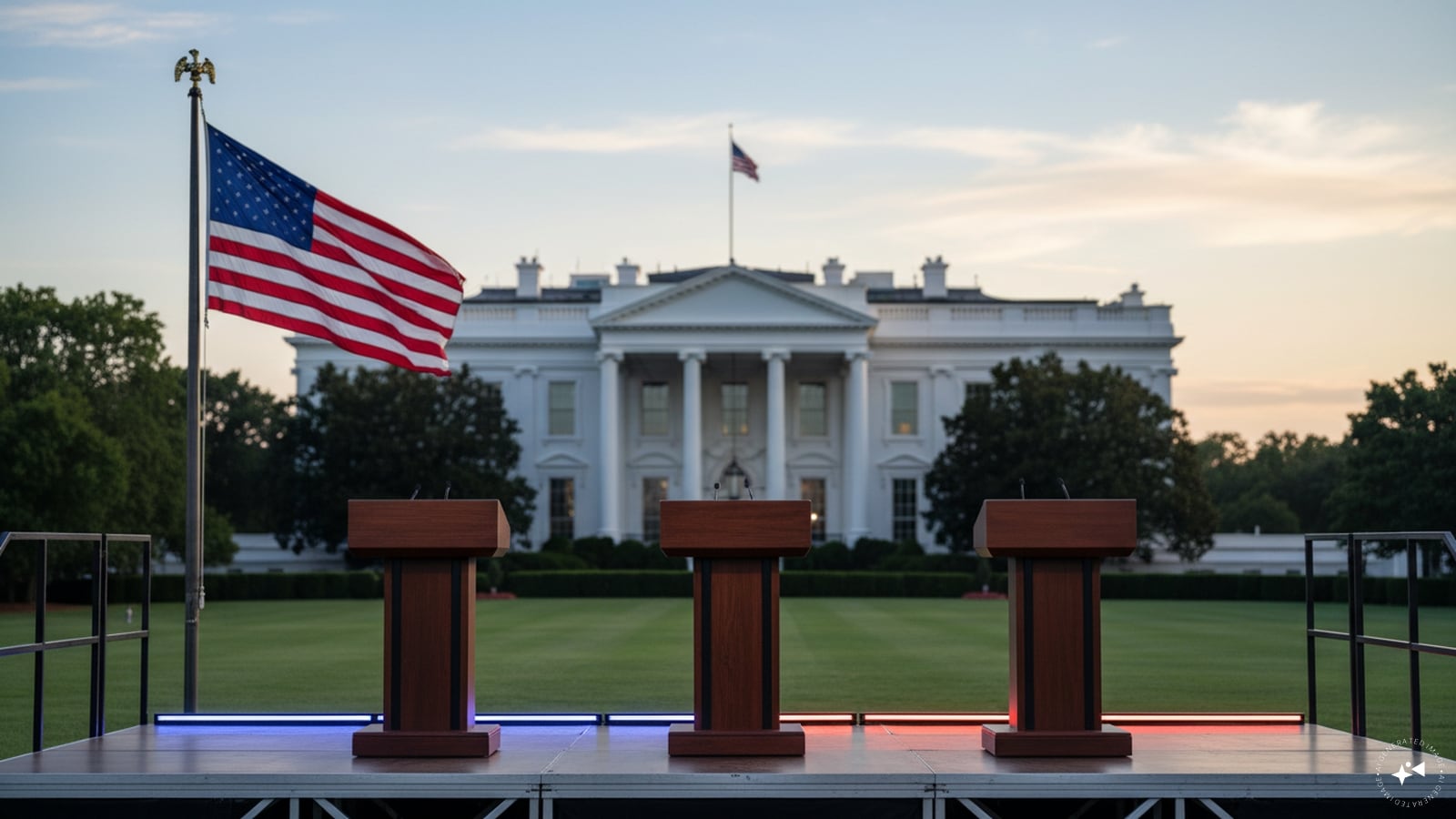
Think back to Arthur sitting at his kitchen table in Allentown at three in the morning. When he turns on the television in October 2028 and sees the Democratic nominee standing beside JD Vance or Marco Rubio, he will not be tallying up their legislative accomplishments. He will be asking three primal questions:
Do you actually see me?
Are you tough enough to fight for me?
And if things go sideways at two in the morning, do you have the nerve to keep your hands steady on the wheel?
The Crucible Ahead
I admit something freely: watching this unfold makes me uneasy. Having covered enough campaigns to know how mercilessly the modern media ecosystem grinds human beings into caricature, I know that most of these thirteen people will have their reputations permanently bruised before a single primary ballot is cast in early 2028.
A stray remark caught on a hot mic in a diner in Manchester. A poorly phrased answer during a three-hour podcast interview. An old vote from fifteen years ago resurrected and stripped of all context. That is how presidential dreams die now—not with a noble concession speech, but with a thousand digital paper cuts.
Yet there is something undeniably stirring about the sheer variety of this field. Look at those thirteen names again. You have governors who rebuilt collapsed bridges in weeks, combat veterans who walked through fire, pastors who command pulpits of conscience, and brawlers willing to take on entrenched power.
Whoever survives the long winter of 2028 will not emerge unscathed. They will be hoarse from speaking in union halls, pale from eating cold pizza on chartered planes, and hollowed out by the relentless demands of millions of strangers projecting their hopes and terrors onto a single human frame.
And then, on a crisp Tuesday night in November, the gymnasium doors will close again. The fluorescent lights will hum. Volunteers will dump cardboard boxes of paper ballots onto folding tables, and a weary nation will find out which ghost was real enough to carry the weight.


