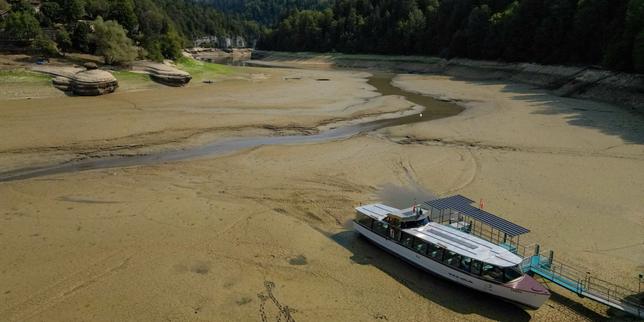
The soil does not shatter with a grand explosion. It happens in silence.
Ask Jean-Luc, a third-generation vigneron in the southern Rhône Valley, how the ground changes when the rain refuses to fall. He will not speak of cubic meters or meteorological anomalies. He will lead you between rows of old-school grenache vines, kneel down, and press his heavy, calloused palm against the grey, pulverized dust. Also making news lately: Fire Season Realities Inside British Columbia.
"It sounds like porcelain," he whispers, his voice dry as the air. "Step on it, and you hear things breaking that took decades to grow."
Across Western Europe, an exceptional drought has taken hold, quietly rewriting the rules of survival for millions. We are accustomed to measuring crises by their immediate violence—the roaring wall of a flash flood, the terrifying orange glow of a wildfire racing up a ridge. But drought is a slow thief. It works in the dark, draining the life from riverbeds, turning emerald pastures into straw, and forcing ordinary people to renegotiate their relationship with the most basic element of existence. Further insights on this are explored by Reuters.
Water. Or the lack of it.
The Shrinking Veins of a Continent
Look at the maps published by environmental agencies, and you will see swathes of crimson spreading across France, Spain, Northern Italy, and parts of Germany. These are not mere ink blots on paper. They represent a systemic fever.
Consider what happens beneath the surface. Beneath our feet lies a hidden architecture of aquifers—underground sponges that filled up over millennia, fed by gentle winter snowpacks and steady spring rains. For generations, we treated these natural reservoirs as bottomless piggy banks. We built cities, irrigated sprawling monocultures, and cooled nuclear reactors with the assumption that the tap would never run dry.
It is running dry.
In the Po Valley of Italy, Europe's agricultural heartland, the great river has withered to a series of muddy puddles where stranded barges sit like rusted skeletons. Farmers look out at fields of rice that require standing water to thrive, only to watch the irrigation canals turn to cracked clay. In France, dozens of villages no longer have potable water coming out of their taps. Tankers rumble down narrow country lanes day and night, pumping precious liquid into municipal reservoirs just so people can wash their hands and cook a meal.
This is not a distant, futuristic dystopia. This is Tuesday.
The Human Cost of the Crackle
When a river drops, the consequences ripple outward in ways the spreadsheets fail to capture.
Take the energy sector. Nuclear power plants along the Loire and the Rhône rely on massive volumes of river water for cooling. When those rivers warm up and drop dangerously low, plants must throttle back their output to avoid cooking the aquatic ecosystems downstream. Power grids strain. Prices fluctuate. An invisible chain reaction links the cracked soil of a riverbank to the electricity bill pinned to a kitchen wall in Paris or Lyon.
Then there is the psychological weight.
Living through a prolonged dry spell changes a community's nervous system. Every cloudless morning feels like a threat. Every restriction—the ban on washing cars, the prohibition against filling backyard pools, the midnight alerts urging residents to limit shower times—serves as a constant, grinding reminder that safety is an illusion.
Maria, who runs a small dairy farm near the foothills of the Pyrenees, describes the exhaustion.
"You spend all day calculating," she says, leaning against the doorframe of her barn while her dairy cows swish flies away in the stifling heat. "Can I afford to water this pasture? Will the well hold out through August? If the feed prices go up again because the corn withered in the fields two departments over, do I sell half the herd?"
She pauses, looking out at the shimmering heat haze dancing off the hills.
"You feel guilty for existing. Every drop you use feels like you are stealing it from tomorrow."
The Illusion of Normalcy
We tell ourselves stories to cope. We call these events "unprecedented anomalies," whispering the word anomaly like a protective charm. It suggests that once this year passes, the universe will apologize, reset the dials, and return us to the temperate, predictable climate of our grandparents' memories.
History offers no such comfort.
The hydrological cycle is broken because the baseline has shifted. Winters are delivering less snow to the Alps and the Pyrenees, robbing the spring thaw of its traditional potency. Higher temperatures bake the soil, turning every week of dry weather into an accelerator that evaporates moisture twice as fast as it did thirty years ago.
We are not dealing with a temporary inconvenience. We are living through the unraveling of a hydrological equilibrium that allowed modern European civilization to build its cities, feed its populations, and expand its industries in the first place.
And yet, resilience persists, stubborn and quiet.
In parts of Catalonia, engineers and citizens are racing to retrofit ancient Roman and medieval water infrastructure, dusting off old cistern designs while deploying modern desalination plants. Vignerons are experimenting with ancient, drought-resistant grape varieties that haven't been widely planted in centuries, betting that the future belongs to plants that remember how to suffer and survive.
Night falls over the Rhône Valley. The cicadas roar in the dry brush, a deafening mechanical scream that fills the pitch-black air. There is no breeze. High above, the stars burn with a hard, unyielding brilliance through a sky utterly devoid of moisture. Jean-Luc sits on a wooden bench outside his stone farmhouse, a glass of last year's wine in his hand, listening to the earth cool and contract in the dark.