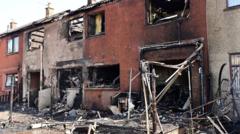
The sound of a home dying is not what you expect. It is not a clean, cinematic roar. It begins with a series of sharp, violent pops—the sound of seasoned timber buckling under immense pressure, of double-paned glass giving up its fight against the heat. Then comes a heavy, suffocating thud as the roof collapses into the living room, sending a pillar of sparks into the midnight sky.
By the time the flashing red lights slice through the smoke of a quiet suburban street, the transformation is already complete. A lifetime of Saturdays, of height marks scratched into doorframes, of inherited porcelain and dog-eared novels, has been reduced to a singular, acrid smell that clings to your clothes for weeks.
When two houses are destroyed by fire on an ordinary weeknight, the official record reads with a clinical, detached briefness. The police report notes the dispatch time. The fire investigator measures the burn patterns. The local news runs a three-paragraph blurb detailing the location, the number of trucks deployed, and the status of the investigation.
But a house fire is never just a line item in a municipal log. It is a sudden, violent tearing of the social fabric. To understand what actually happens when the sirens fade and the smoke clears, we have to look past the blackened drywall and into the quiet, devastating aftermath that the official reports always leave behind.
The Illusion of the Firewall
We live our lives under a comforting delusion of permanence. We lock our front doors to keep out intruders, install security cameras, and sign up for neighborhood watch apps. We treat our homes as fortresses, impervious to the chaos of the outside world.
But fire is a reminder of how thin our defenses truly are.
Consider a hypothetical family—let’s call them the Hendersons—living at number 42. It is 11:30 PM. The dishwasher is running its cycle. The television is humming quietly in the background. To the left, at number 44, their neighbors are already asleep. Between them lies a narrow driveway, barely ten feet of concrete.
When a fire breaks out in a modern residential neighborhood, that ten-foot gap is not a barrier. It is a fuse.
Modern homes are built with incredible efficiency, but that efficiency comes with a hidden tax. The engineered lumber, synthetic fabrics, and polyurethane foam found in today’s furniture burn at a rate that would shock anyone raised in the era of solid oak and wool. Decades ago, a resident had an average of seventeen minutes to escape a house fire after the alarm sounded. Today, because of the high chemical load in our household items, that window has shrunk to less than three minutes.
When the heat inside a burning structure reaches a certain threshold, a phenomenon known as flashover occurs. Everything in the room ignites simultaneously. The windows blow outward, and the fire leaps across the narrow driveway, licking at the vinyl siding of the house next door. Within moments, a single-family emergency becomes a dual-structure catastrophe. The fire does not care about property lines or property deeds. It simply looks for fuel.
The Architecture of Aftermath
The morning after a double house fire brings a peculiar kind of silence. The yellow caution tape flutters in the morning breeze. The puddles of water left behind by the fire hoses are choked with black soot and floating insulation.
For the people who stood on the sidewalk in their pajamas watching their lives burn, this is when the true weight settles in.
The immediate response to a disaster is driven by adrenaline. You check that your partner is breathing; you count your children; you hold the shivering family cat against your chest. You are flooded with a profound, dizzying sense of gratitude. You are alive.
But gratitude is a temporary shock absorber.
The real crisis begins when you realize the sheer logistics of sudden displacement. Where do you sleep tonight? Not just tonight, but next month? Your wallet is ash. Your identification is gone. The birth certificates, the tax records, the passports—all vaporized. You are a ghost in your own town, forced to prove your identity to bank tellers and insurance adjusters using nothing but your own word and a charred police report number.
There is a distinct psychological trajectory to property loss that outsiders rarely understand. People assume the hardest part is losing the big-ticket items—the big-screen television, the new car in the garage, the expensive kitchen appliances. It isn't. Those things have price tags. They can be reordered with a credit card and a few clicks.
The agony lies in the unreplaceable minutiae.
It is the recipe book handwritten by a grandmother who passed away a decade ago. It is the hard drive containing the only photos of a child’s first steps, sitting on a desk that is now a pile of charcoal. It is the specific, comforting weight of a favorite coffee mug. These are the anchors that tether us to our own histories. When they are severed all at once, a profound disorientation sets in. You look at your hands and wonder who you are without the context of your things.
The Forensic Dance
While the displaced families begin the agonizing process of cataloging their lost lives for insurance companies, another quiet drama unfolds within the ruins.
The fire investigators arrive.
They do not look like the detectives on television. They wear heavy boots, white hard hats, and respirators to protect against the toxic dust. They move through the skeletal remains of the structures with a deliberate, agonizing slowness.
Determining the origin and cause of a fire that has completely destroyed two structures is an exercise in reverse archeology. The investigators look at the charring on the remaining studs. They analyze the "V-patterns" left by smoke on the walls, which point like arrows toward the place where the fire began. They dig through feet of sodden debris, looking for the telltale signs of an electrical arc, a failed appliance component, or the distinct odor of an accelerant.
This process is not just about assigning blame or checking boxes for an insurance payout. It is about public safety. Every major shift in building codes, every recall of a faulty space heater, and every warning label on a consumer electronic device was written in the ashes of someone’s home. The data gathered from the ruins of these two houses will be fed into national databases, helping to map out emerging risks in modern manufacturing and construction.
But for the families watching from behind the perimeter tape, the investigation can feel cold, even intrusive. Their private spaces—the bedrooms where they slept, the kitchens where they argued and laughed—have become a crime scene, scrutinized by strangers with flashlights and cameras.
The Ripple Effect
A neighborhood is an ecosystem. When two homes are violently removed from that ecosystem, the shockwaves travel far beyond the immediate victims.
The neighbors across the street look out their front windows and see a reminder of their own vulnerability. The value of their properties fluctuates. The cost of their home insurance policies ticks upward. The sound of a distant siren on a Tuesday night suddenly carries a sharp, metallic edge of anxiety that wasn't there before.
We tend to view disasters through a telescope, focusing only on the epicenter of the destruction. We look at the photos of the collapsed roofs and move on to the next headline. But the true story of a fire is told in the weeks and months that follow, in the temporary apartment rentals, the endless phone calls with adjusters, and the slow, painful realization that things will never be exactly as they were.
The rebuilding process is a marathon of bureaucracy. Permits must be filed, contractors vetted, blueprints approved. For a year or more, the charred footprints of the two homes will sit as an open wound on the street, a daily monument to a terrible night.
Eventually, new structures will rise. The wood will be clean and straight; the paint will be fresh. A new family will move in, carry their boxes through the front door, and marvel at the beautiful natural light in the living room. They will plant flowers in the front yard, completely unaware of the exact spot where someone else's history ended.
The sun sets behind the blackened frame of what used to be a living room. A single sheet of scorched paper, caught by a stray gust of wind, lifts from the debris and tumbles down the empty driveway, disappearing into the dark.