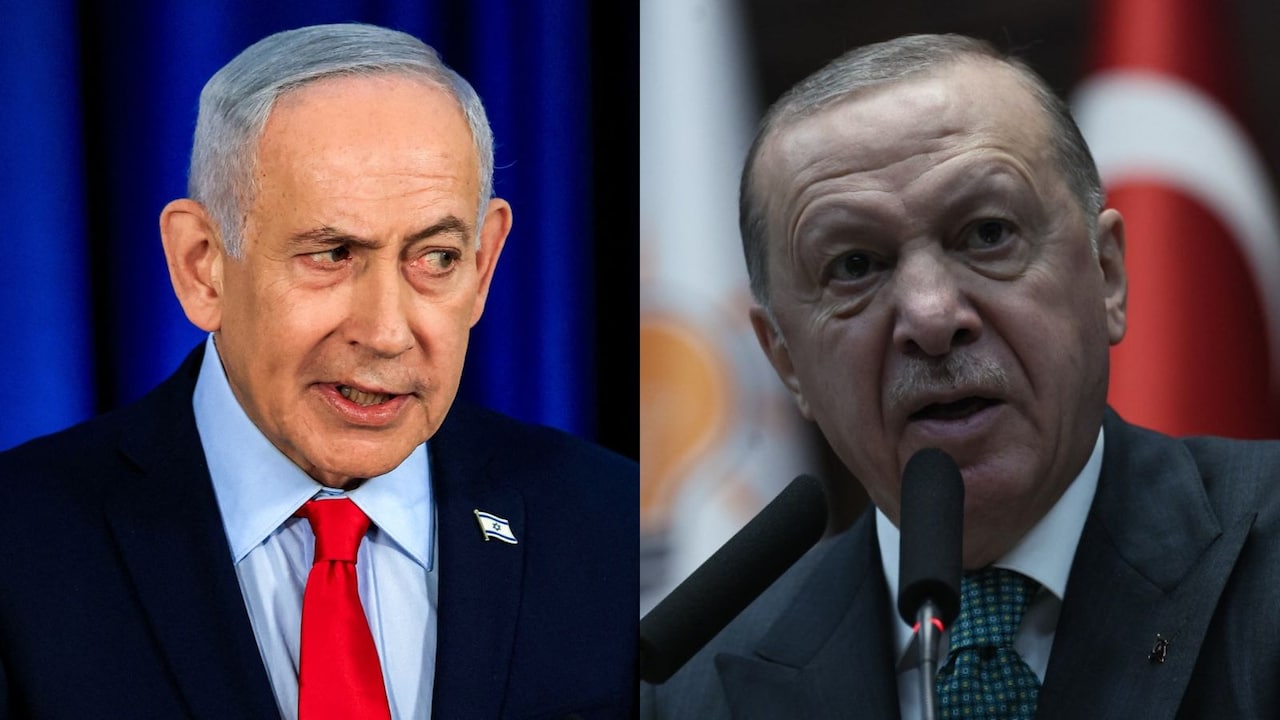
The coffee in the old district of Istanbul tastes of cardamom and ash. It sits heavy on the tongue, much like the rhetoric drifting from the televisions mounted in the corners of every smoke-filled cafe. Outside, the rain slicks the cobblestones of Karaköy, but inside, the air is thick with the weight of geography. Turkey is a bridge that constantly feels the tremors of both sides.
When a leader stands before a microphone and evokes the holy stones of Jerusalem, the sound waves do not just dissipate into the air. They ripple outward. They travel through the narrow alleys, bouncing off the walls of centuries-old mosques and Byzantine ruins, settling into the bones of ordinary people who are tired of being broke, tired of being anxious, and deeply susceptible to the intoxicating pull of grand, righteous anger.
Politics at the highest level is rarely about the words spoken. It is about the choreography.
The Script and the Stage
Turkish President Recep Tayyip Erdogan knows his audience. He knows the exact frequency required to vibrate the hearts of his conservative base. When he calls for the "liberation" of Jerusalem, it is not a declaration of immediate military intent. It is a symphony played on an ancient instrument.
By framing himself as the modern custodian of Islamic honor, he taps into a deep, historical longing—a collective memory of when Istanbul was the center of an empire that stretched across the Levant.
But across the Mediterranean, another master of political survival waits for his cue.
Israeli Prime Minister Benjamin Netanyahu thrives in the friction. To him, Erdogan’s fiery speech is not a threat; it is a gift. It arrives like a perfectly timed lifeline. Within hours, the counter-strike is launched. Netanyahu brands Erdogan a "dictator," a man who bombs Kurdish villages and locks up journalists, a leader with no right to lecture Israel on morality.
The insults fly like guided missiles, predictable and precise.
Consider what happens next: nothing.
The embassies do not close. The cargo ships carrying Turkish steel, cement, and textiles do not reverse their courses in the Mediterranean. The trade routes remain open, humming quietly beneath the surface of the outrage. This is the paradox of modern statecraft. The public is fed a diet of fire and brimstone, while the ledger books remain cool, calculated, and undisturbed.
The View From the Teahouse
To understand the true cost of this theater, you have to look away from the podiums. You have to look at Ahmet.
Ahmet is a hypothetical composite of the dozens of men I have sat with in the backstreets of Istanbul and Ankara. He is fifty-four, his knuckles are stained with tobacco, and his pension has been thoroughly devoured by hyperinflation. When Erdogan speaks of Jerusalem, Ahmet’s chest swells. For a brief, shining moment, he is not just a struggling man in a faded jacket wondering how to pay his electricity bill. He is part of a grand, cosmic struggle. He is a defender of the faith.
"He speaks for us," Ahmet tells me, nodding toward the television screen where the president's fist is clenched. "The West wants us small. He makes us big."
This is the emotional alchemy of populism. It converts economic pain into national pride. It takes the very real, grinding misery of daily survival and repurposes it as a sacrifice for a higher, noble cause.
But if you walk three blocks away to a trendy tech hub where younger Turks sip oat milk lattes, the narrative dissolves into cynicism.
"It's a distraction," says Elif, a twenty-something software developer trying to secure a visa to Germany. "Every time the lira plummets, or there’s a scandal in the ministries, Jerusalem becomes the headline. It’s a magic trick. Look at my right hand, don't look at my left."
The tragedy is that both Ahmet and Elif are right. The rhetoric is a tool of misdirection, but the emotion it unleashes is entirely genuine. That is what makes it dangerous. Fire does not care why it was lit; it burns just the same.
The Anatomy of the Insult
When Netanyahu hurls the word dictator, it is a calculated piece of political branding. It is designed to resonate instantly with Western audiences who view Erdogan through a specific, authoritarian lens. It positions Israel as the lonely outpost of democracy surrounded by hostile tyrants.
It is an effective strategy. It simplifies a labyrinthine geopolitical reality into a black-and-white comic book panel.
But look closer at the mechanics of the accusation. Netanyahu’s domestic critics often accuse him of the very same authoritarian impulses—weakening the judiciary, consolidating power, and using external threats to shield himself from legal peril.
The two leaders are locked in a strange, codependent dance. They are political mirror images, each using the other as the perfect foil to justify their own hardline stances at home. Erdogan needs a villain to prove his piety. Netanyahu needs a tyrant to prove his necessity.
They feed each other.
"In politics, an enemy is often more valuable than an ally. An ally requires compromise; an enemy requires total unity."
The Invisible Stakes
We live in an era where the noise of conflict is deafening, yet the actual mechanisms of power are increasingly obscured. The competitor's headline tells you that two leaders are slamming one another. It invites you to pick a side, to cheer for one champion or the other, to join the digital coliseum where nuance goes to die.
But the real problem lies elsewhere.
The danger is not that Turkey will march on Jerusalem, nor that Israel will launch an armada against Istanbul. The danger is the slow, steady erosion of the possibility of peace. When language is weaponized so completely, it hardens the hearts of the populace. It makes future diplomacy look like treason.
When a generation grows up hearing that the neighbor across the sea is an existential monster, the space for compromise shrinks until it disappears entirely.
The words spoken today become the concrete walls of tomorrow.
I remember walking through Jerusalem’s Old City a few years ago. The stone there is different from Istanbul’s; it is golden, porous, and absorbs the heat of the sun until it glows. In the quiet hours of the morning, before the tourists and the soldiers fill the checkpoints, the city feels fragile. It feels like a place made of glass that everyone is throwing rocks at.
To use that specific, agonizingly beautiful city as a rhetorical football in a domestic political game is a form of sacrilege that transcends religion. It reduces a deeply complex human tragedy—where real families, both Palestinian and Israeli, live in fear and uncertainty—into a applause line for a campaign rally.
The Weight of the Unspoken
It is easy to get lost in the grand scale of international relations. We talk about states as if they are monolithic entities with single minds. We say "Turkey demands" or "Israel rejects."
But Turkey is a mother in Diyarbakir wondering if her son will be conscripted. Israel is a father in Tel Aviv checking the location of the nearest bomb shelter before he goes to sleep.
The theater of rage creates a smoke screen that hides these people from one another. It replaces human faces with national flags.
The cardamom in my coffee has settled to the bottom of the cup, leaving a bitter, gritty sludge. On the television screen, the news cycle has already moved on. A commercial for a new housing development flashes bright, simulated sunshine over the Bosphorus.
The anger generated an hour ago hasn't disappeared, though. It has just gone underground, waiting in the hearts of men like Ahmet, ready to be called upon the next time a politician needs to light a fire to keep himself warm.