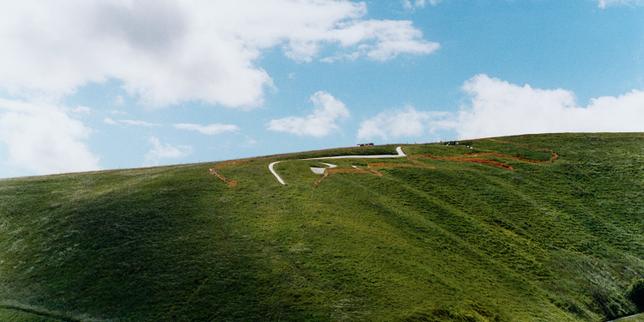
The rain on the Berkshire Downs does not fall so much as it drifts, a heavy, blinding mist that tastes of salt and wet wool. If you stand on the windswept ridge of White Horse Hill on a morning like this, your boots sinking into the spongy turf, you are standing on the spine of an older England. Beneath your feet is chalk—blinding, pure, and ancient.
Cut deep into this hillside is a creature made of that very stone. It is a sprawling, abstract beast, one hundred and eleven meters from the tip of its ribbon-like tail to the point of its split ear. This is the Uffington White Horse. It does not look like a modern horse; it looks like a line of lightning frozen mid-stride, an ancient glyph galloping across the green scarps of Oxfordshire. Don't forget to check out our recent coverage on this related article.
But if you look closely at its head, or where its elegant, needle-thin neck meets the slope, you will see a quiet war being waged.
It is a war of inches. On one side is a three-thousand-year-old ghost. On the other is a blade of grass. To read more about the history of this, AFAR offers an excellent summary.
Consider what happens if we simply walk away. If the volunteers, the archaeologists, and the local dreamers drop their tools and turn their backs, the clock starts. Gravity pulls the surrounding silt downward. Earthworms turn the soil, relentlessly burying the white stone under fine, dark castings. Seeds catch in the crevices. In less than three years, the sharp outlines of the head blur. In five, the legs dissolve into the green. Within a decade, the oldest hill figure in Britain—a monument that survived the fall of the Roman Empire, the arrival of the Saxons, the fury of the Vikings, and the black smoke of the Industrial Revolution—becomes nothing more than an invisible bump under ordinary pasture.
Ten years of human silence is all it takes to erase three millennia of human memory.
The Long Scour
We tend to look at ancient monuments as immovable fixtures, like mountains or rivers. Stonehenge stands because its stones weigh fifty tons. But the White Horse is different. It is not a monument of weight; it is a monument of effort. It exists today only because thousands of nameless people, across roughly one hundred generations, decided it should.
Archaeologists from Oxford Archaeology and the National Trust have been working on the hillside, carefully cutting back the encroaching turf. Over the centuries, the horse’s head and neck had narrowed to less than half their original width. Grass is a patient colonizer. It eats history.
To fight it back, you cannot use heavy machinery. You use your hands. You use small, hand-held shears to trim the turf back to the estimated original edge. You carry buckets of fresh, crushed chalk, and you ram it into the trenches, packing it tight until it gleams against the green again. It is backbreaking, knee-ruining work under a sky that rarely offers shelter.
But this labor is not a modern invention. It is a ritual as old as the hills.
For centuries, this maintenance was known as the "scouring." Every few years, the villages in the Vale of the White Horse would empty. Hundreds, sometimes thousands, of peasants, farmers, and laborers would trudge up the steep slopes to clean the beast. But they didn't just bring shovels; they brought barrels of ale, wheels of cheese, and an appetite for chaos.
By the eighteenth century, these gatherings had evolved into what locals called the "Saxon Olympicks." While some cleared the weeds from the horse's flank, others participated in tobacco pipe-smoking competitions for women, wild horse races, and games of cudgel-playing. It was loud, messy, and fundamentally human. They were keeping a prehistoric god alive, but they were also having a pint with their neighbors.
Then the world changed. The Industrial Revolution pulled people off the land and shoved them into coal-soaked northern towns. The local gentry grew suspicious of large, rowdy gatherings of the "troublesome peasantry." By the mid-nineteenth century, the festival had withered. The horse began to fade.
Healing a Broken Country
It took a boxing coach and a bestselling author to save it. In 1857, Thomas Hughes, the author of Tom Brown’s Schooldays, looked at a fractured Victorian society and saw the neglected white beast on the hill. He believed that by resurrecting the ancient scouring, by bringing the workers and the wealthy back to the hillside to sweat and celebrate together, he could help heal the deep social wounds of his era.
He was right. They returned. They scoured the horse, cleared the weeds, and played their games. It was the last of the great traditional community scourings, but it kept the horse visible just long enough for the modern era of preservation to take over.
The stakes of keeping this creature alive became terrifyingly literal during the dark summer of 1940. As the Luftwaffe flew night missions over the English countryside, navigating by the silver threads of rivers and the gleam of coastal chalk, the British government realized the Uffington White Horse was a perfect, giant signpost pointing toward London.
So, they covered it up.
Soldiers and locals laid down corrugated iron, brushwood, and turf, burying the horse intentionally to hide it from the bombers. For five years, the hill was dark. The ghost was hidden. When the war ended and the covers were lifted, the horse was a mess of weeds and rot. It required an immense, collective effort to scrape away the grime of the war years and let the chalk breathe again.
A Mirror on the Hillside
Why did Bronze Age humans cut a one-hundred-and-eleven-meter trench into a mountain three thousand years ago?
The truth is, we don't entirely know. We know from modern testing—using a method called optically stimulated luminescence, which measures the last time the soil layers beneath the chalk were exposed to sunlight—that it was created between 1380 and 210 BC. This was a time when horses were transforming human society, elevating a new class of warrior elites. In ancient mythology, horses were the creatures that pulled the sun across the sky during the day, returning it to the dawn each morning.
Perhaps the Uffington Horse was an offering to the sky. Perhaps it was a tribal marker.
But the "why" of its creation is ultimately less miraculous than the "why" of its survival. Think of the staggering shifts this hillside has witnessed. The people who dug the horse spoke a language lost to time. Then came Celtic speakers, then Roman legionnaires who buried their dead nearby, then pagan Saxons who looked at the landscape and spun tales of Weland, their blacksmith god. Then came medieval Christians who decided the horse was actually the dragon slain by Saint George on the flat-topped hill just below.
Every time a new culture took the hill, they changed the language, the religion, and the rulers. By all the laws of history, they should have ignored the giant, weird shape on the ridge. They should have let the grass have it.
But they didn't. Each new civilization looked at the white lines, found their own meaning in them, and picked up a tool to clear the weeds. The horse survived because it was a mirror. Whatever humanity needed to see in it—a sun god, a war horse, a dragon, or a symbol of national pride—the horse reflected it back.
Today, the work continues under the stewardship of the National Trust and English Heritage, funded in part by donors from as far away as Australia who feel the strange pull of this Berkshire ridge. The scientists are reopening old excavation trenches, using advanced dating techniques to try and pin down the exact decade the first shovel hit the chalk.
Yet, as you watch the modern volunteers in their high-visibility jackets, bending over the wet stone with hand shears and buckets of white aggregate, you realize they are doing the exact same thing the Bronze Age farmers did. They are spending their limited, precious time on earth to keep a shadow alive.
The mist begins to clear, just for a second, and the valley opens up below. The Vale of the White Horse stretches out like a green patchwork quilt, dotted with tiny houses and ancient trees. Down there, life moves fast. Trains rattle along the tracks; people check their phones; politics rage and fade.
But up here, the horse remains at a gallop that never moves an inch. It is an incredibly fragile thing, a monument made of absence, held together by nothing more than a shared human promise that has lasted three millennia. It reminds us that culture is not a stone fortress. It is a garden. If you want it to survive the winter, you have to get down on your knees and pull the weeds.