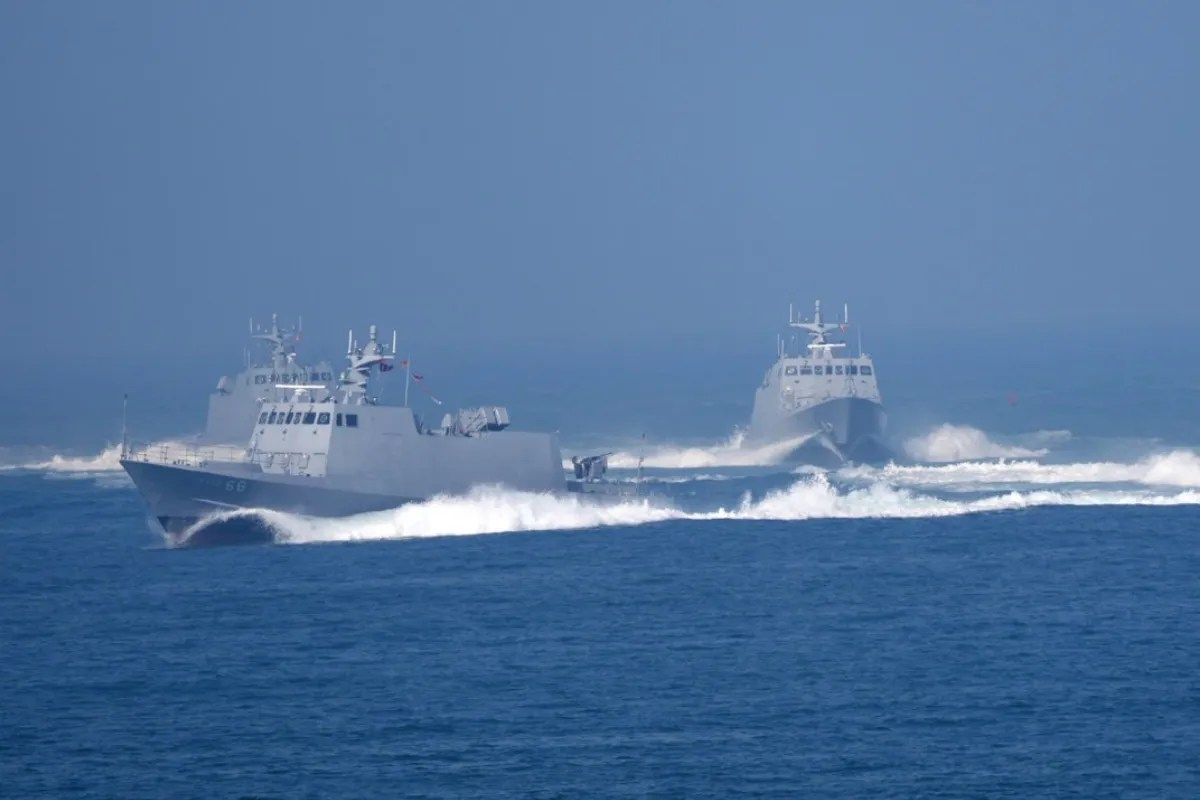
Mainstream media outlets love a predictable formula. A single People's Liberation Army Navy (PLAN) warship and four coast guard vessels drift near the Taiwan Strait, and suddenly the tickers scream about imminent invasion. They track every single hull, count every single hull, and completely miss the actual strategy.
The lazy consensus treats these maritime deployments as a prelude to a massive, D-Day-style amphibious assault. It makes for great television, but it shows a fundamental misunderstanding of modern gray-zone warfare. Stop looking at these deployments as tactical military operations. They are bureaucratic calibration exercises.
The Flawed Premise of the "Imminent Invasion" Narrative
Every time a competitor writes an article tracking a handful of Chinese ships near Kinmen or the Taiwan Strait, they feed into a carefully constructed trap. They assume the primary goal of the Chinese military is kinetic conquest. It isn't.
The true objective of gray-zone operations is normalization through exhaustion, not sudden escalation.
If you look at the historical data from organizations like the Center for Strategic and International Studies (CSIS) and their China Power Project, the pattern becomes obvious. China does not deploy five ships to start a war. It deploys five ships to change the baseline of what constitutes a "normal" day in the strait.
When Taiwan scrambles its own assets or the international community panics, Taipei burns through limited operational budgets, wears out its crews, and stresses its airframes and hulls. By treating every routine patrol as a crisis, media analysts do the psychological heavy lifting for Beijing.
Deconstructing the Five-Ship Illusion
Let’s look at the mechanics of what actually happened. One warship and four auxiliary or coast guard ships do not form an invasion fleet. They form a standard maritime law enforcement blockade simulation.
Here is the difference between what the media reports and what is actually happening:
| What the Media Sees | The Structural Reality |
|---|---|
| An aggressive prelude to a naval blockade | A legalistic assertion of domestic jurisdiction |
| High-stakes military escalation | Standardized training for the China Coast Guard (CCG) |
| A unique, sudden provocation | A predictable response to political shifts in Taipei |
The inclusion of four coast guard or maritime surveillance ships alongside a single gray-hull warship is highly specific. It is a law enforcement footprint, not a strike group footprint. Beijing is shifting the narrative from an international territorial dispute to a domestic policing issue. When you report on this as an "aggressive military move," you ignore the legal warfare (three warfares strategy) being played right under your nose.
Why the Tech Infrastructure Matters More Than the Hulls
I have watched analysts stare at satellite imagery of ship decks for a decade while ignoring the real battlefield: electromagnetic spectrum dominance and logistical data links.
A ship is just a floating platform for sensors and electronic warfare suites. The actual threat isn't the deck gun on a Type 056A corvette; it is the data integration between that corvette, land-based anti-ship ballistic missile units, and civilian roll-on/roll-off (Ro-Ro) ferries.
If you want to know when a real crisis is brewing, stop counting the ships near the median line. Start looking at these indicators instead:
- Civilian Requisitioning: Watch the sudden integration of civilian maritime fleets into state-directed logistics software networks.
- Ammunition Dispersal: Monitor the movement of secure, climate-controlled ordnance storage deep within the Eastern Theater Command.
- Electronic Silence: The real danger signs are not loud, performative patrols. It is sudden, absolute radio and radar silence across entire coastal provinces.
The current strategy of hyper-focusing on daily ship counts is the defense equivalent of checking a company's stock price every five seconds instead of reading their balance sheet. It is noisy, emotional, and ultimately useless for long-term prediction.
Dismantling the People Also Ask Echo Chamber
The public asks the wrong questions because the media gives them the wrong frameworks. Let's fix the most common misunderstandings with some blunt realism.
Is China about to blockade Taiwan?
No. A total blockade is an act of war that forces a global economic collapse, cutting off the world's supply of advanced semiconductor chips. China relies on those same supply chains. What they are actually doing is a "quarantine"—a slow, legalistic choking mechanism where they selectively inspect commercial vessels under the guise of customs enforcement. It undermines Taiwan's sovereignty without firing a single shot.
Why doesn't the US Navy stop these smaller incursions?
Because doing so would require the US to escalate a law enforcement dispute into a military conflict. If a Chinese coast guard vessel stops a Taiwanese freighter, a US destroyer intervening with lethal force looks like the aggressor on the global stage. Beijing wins the narrative war the moment the West uses military force against non-military hulls.
Can Taiwan defend itself against these gray-zone tactics?
Not by copying the Chinese playbook. If Taiwan tries to match China ship-for-ship and plane-for-plane, it will go bankrupt within a few years. Taipei must pivot entirely to asymmetric defense—flooding the strait with cheap, autonomous sea drones, sea mines, and mobile anti-ship missiles rather than spending billions on large, easily targeted surface warships.
The Downside of Seeing the Nuance
Admitting that these ship movements are routine and non-kinetic comes with its own risks. The danger of adopting a contrarian view is complacency. If we dismiss every five-ship patrol as "just another gray-zone exercise," we risk missing the moment when the gray zone transitions into a hot conflict.
The solution isn't to panic every time a hull appears on a radar screen. The solution is to develop better filters. We need to distinguish between performance art designed for domestic Chinese consumption and genuine operational preparation for conflict.
Stop letting superficial headlines dictate your understanding of geopolitics. The next time you see a frantic report about four or five Chinese ships near Taiwan, look past the hulls. Look at the legal framework they are testing, the economic data flowing through the region, and the silent electronic warfare occurring beneath the noise of the mainstream media. The real conflict is being fought in bytes and bureaucratic maneuvers, not in standard naval patrols.