The air inside an airport terminal is unlike any other substance on earth. It is a thick, invisible soup of adrenaline, jet fuel, and quiet desperation. If you sit still enough near a departure board, you can actually hear the collective heartbeat of thousands of people running out of time.
For decades, Hong Kong International Airport operated like a flawless Swiss watch in the middle of this chaos. It was a cathedral of glass and steel rising out of the South China Sea, a place where a traveler could touch down from London and be on a high-speed train to Central within twenty minutes. It didn't just move people. It manufactured efficiency.
But efficiency is a fragile thing.
Spend enough time wandering through the sprawling expanse of Chek Lap Kok, and you begin to notice the subtle stress fractures. A queue that lingers three minutes too long at passport control. The muffled sigh of a logistics manager staring at a cargo manifest. The slight, anxious shift of a business traveler’s weight as they wait for a baggage carousel to churn. These are the quiet indicators that a hub is choking on its own success.
Before the world changed, Hong Kong’s aviation centerpiece was already redlining. It was handling over 70 million passengers a year, stretching a footprint designed for a different era to its absolute absolute limit. The infrastructure was screaming.
The Airport Authority looked at the numbers and saw a crisis creeping over the horizon. The solution wasn't just a paint job or a few extra check-in desks. It required a complete anatomical rewrite. It required reimagining Terminal 2 not as a passenger annex, but as the central nervous system of a massive, three-runway ecosystem.
The Weight of the Invisible Sky
To understand why a building matters, you have to understand the people who never notice the architecture.
Consider a hypothetical traveler named Mei. She is an independent electronics exporter based in Shenzhen. For Mei, the airport is not a vacation destination; it is a high-stakes pipeline. If her high-end components sit on a tarmac for six hours because a cargo bay is bottlenecked, she loses a contract to a competitor in Singapore or Seoul.
When Mei steps into the newly transformed Terminal 2, she isn't thinking about the billions of dollars poured into the Three-Runway System. She cares about a much smaller number.
Seven minutes.
That is the time it takes for a passenger to process through a modern, biometric-driven security gate versus the old, paper-and-plastic gauntlet. Multiply that seven minutes by the 120 million passengers the expanded airport is now scaling to handle annually. Suddenly, you are not just saving time. You are reclaiming entire lifetimes of human frustration.
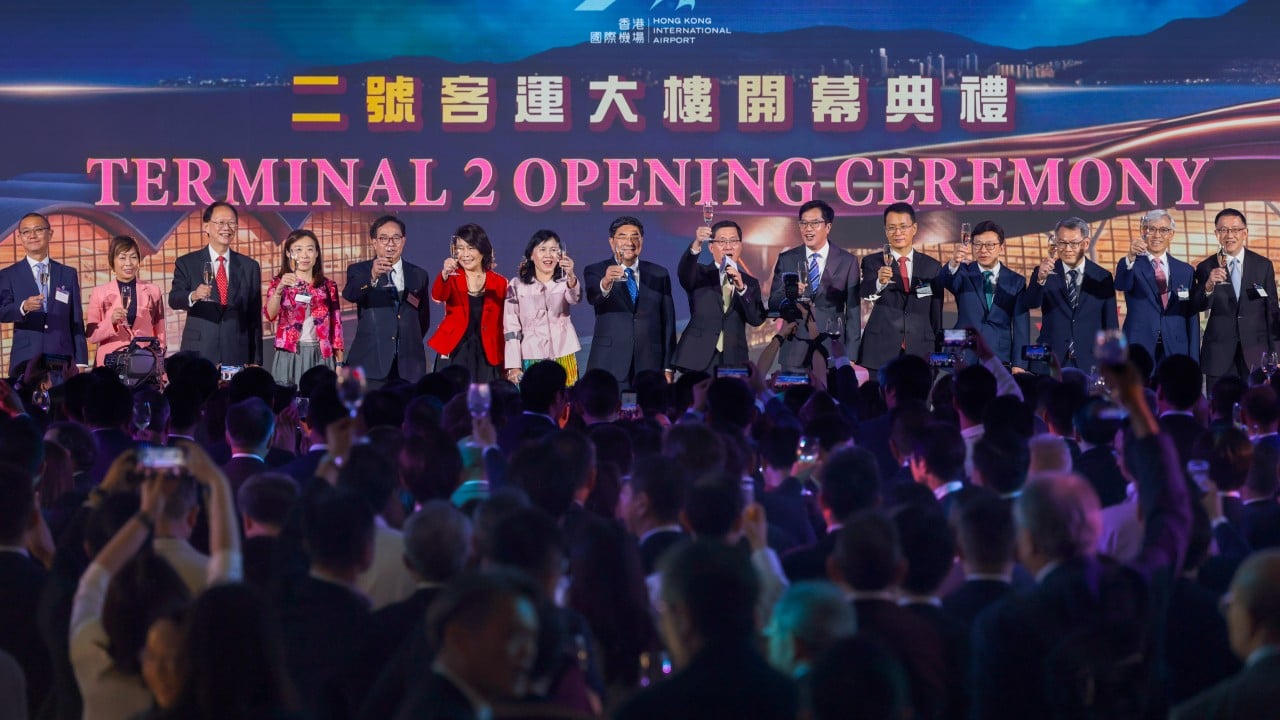
The reimagined Terminal 2 is an aggressive bet on this human scale. The original structure, opened in 2007, was always a bit of an odd duck—primarily a check-in concourse without its own dedicated arrival gates. It was a halfway house for commuters. The new iteration is a beast of an entirely different order. It stands as a full-service gateway, equipped with its own advanced baggage handling systems and an interconnected underground network that links travelers directly to the new Third Runway passenger concourse.
But building a monument to transit during an era of global economic recalibration is terrifying.
There is a distinct vulnerability in pouring resources into concrete and code when global supply chains are twitchy and passenger habits have fundamentally shifted. Critics wondered if Hong Kong was building a cathedral for a congregation that had moved online. The doubt was palpable in boardroom meetings and logistics seminars across the territory. Was the sky still the limit?
When Concrete Meets Code
The answer lies in how the new terminal handles the friction of travel.
In the old days of aviation, expansion meant more tarmac. More gates. More long, soul-crushing walks down sterile corridors with a rolling suitcase clicking against the linoleum. The new Terminal 2 rejects this brute-force approach, relying instead on a marriage of heavy civil engineering and invisible digital architecture.
The centerpiece of this strategy is a massive overhaul of the baggage system. Most travelers never think about what happens to their luggage once it slips behind the black rubber flaps of the check-in conveyor. It enters a subterranean underworld, a labyrinth of high-speed tracks where bags are tossed, sorted, and routed at breakneck speeds.
The new terminal introduces an autonomous, containerized baggage system that tracks pieces with surgical precision. For someone like Mei, this means her cargo and her personal belongings move with the same velocity. It eliminates the single greatest anxiety of international transit: the phantom loss of a suitcase containing a life’s work.
Then there is the physical connection to the broader region.
Hong Kong is no longer just an island city; it is the linchpin of the Greater Bay Area, an economic mega-region of over 86 million people. The revamped Terminal 2 is explicitly designed to act as a multi-modal mixing bowl. A traveler can board a ferry in Zhuhai, check their bags at the pier, cross the Hong Kong-Zhuhai-Macao Bridge, and walk straight into the Terminal 2 departure lounge without ever having to clear double customs.
It turns a multi-leg international ordeal into a suburban commute.
OLD MODEL:
City Center -> Train -> Airport Check-In -> Security Gauntlet -> Gate

NEW MULTI-MODAL MODEL:
Greater Bay Pier -> Seamless Ferry/Bus -> Terminal 2 Core -> Biometric Gate
This isn't just about making life easier for tourists. It is an economic defensive wall. By locking in the transit infrastructure of the entire Pearl River Delta, Hong Kong is ensuring that it remains the indispensable gateway to mainland China, even as rival airports in Guangzhou and Shenzhen expand their own footprints.
The Human Core of Glass and Steel
It is easy to get lost in the staggering statistics of the project. The millions of tonnes of reclaimed land. The kilometers of new automated people mover tracks. The sheer volume of steel spanning the terminal roofs.
But a brilliant airport isn't measured by how big it is. It is measured by how small it makes its problems feel.
The real triumph of the Terminal 2 expansion is an exercise in sensory design. The spaces are flooded with natural light, calibrated to reduce the cortisol spikes that naturally occur when humans are packed into high-density transit zones. The acoustic treatment dampens the harsh, metallic roar of the concourse, replacing it with a soft, ambient hum.
It is an environment designed to acknowledge that travel is inherently stressful, that the person walking through the gate might be flying to a funeral, a multi-million dollar closing meeting, or a first reunion in a decade.
Consider what happens next as the aviation sector pushes deeper into the decade. The physical footprint of the Three-Runway System is complete, but the true test is operational. It is the thousands of ground crew, air traffic controllers, and digital systems working in absolute lockstep every single second of the day.
The Airport Authority didn't just build a terminal to handle more planes. They built an engine to sustain the city's relevance. When an economy relies entirely on its status as a global crossroads, standing still is the equivalent of a slow death.
The evening rush hour at Chek Lap Kok is a spectacle of motion. As a massive wide-body aircraft lifts off into the humid night air, banking sharply over the South China Sea, the lights of the newly expanded terminal glow brilliantly below. It looks less like a building and more like a heart, pulsing rhythmically, pushing lifeblood through the veins of a global network that refuses to slow down.