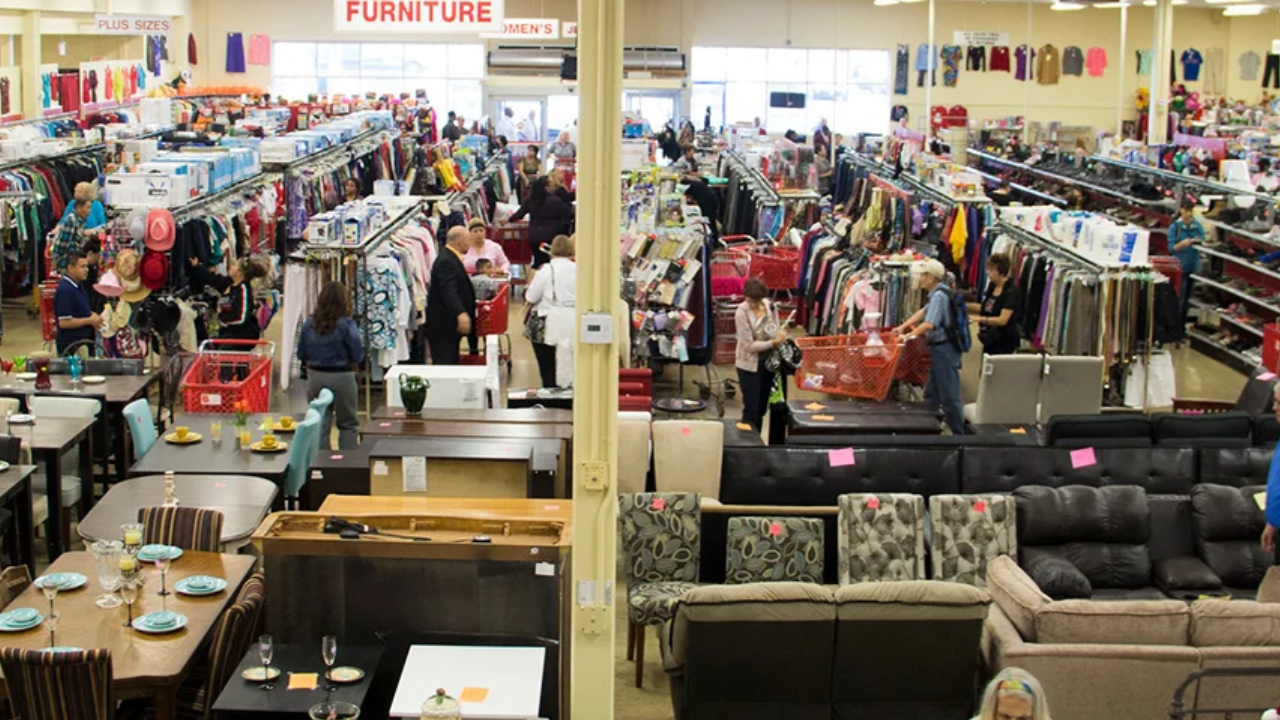
The floorboards of the warehouse do not creak; they groan under the weight of three thousand coats, four thousand plates, and the lingering ghosts of lives half-lived.
Outside, the Illinois winter presses its gray shoulder against the glass. Inside, dust motes dance lazily in shafts of fluorescent light, settling on rows of plastic bins that stretch toward the high, corrugated ceiling.
Consider Margaret. (And understand here: Margaret is a composite, stitched together from the posture and patience of forty different retirees who punch a clock they bought themselves.) Margaret is seventy-two. Her knuckles are swollen like winter walnuts, yet she can fold a fitted sheet into a crisp, square envelope with the mechanical grace of a concert pianist closing a Steinway.
She has been here since 7:30 in the morning. She will stay until two. Nobody is paying her.
"People think it's just junk," Margaret says, not looking up from a cardboard box filled with mismatched silver teaspoons. "They think charity is where you dump the things you're tired of looking at. But look at this."
She holds up a teaspoon. The handle is worn smooth by thumbs that stopped holding it forty years ago. "Somebody had cereal with this spoon every morning while the radio told them about the moon landing. And now it’s here. Waiting for a college kid who doesn’t own a fork yet."
That is the geometry of grace in a Midwestern zip code.
When you hear that a single thrift store in Illinois has quietly amassed more than 100,000 donated items—running entirely on the kinetic energy of 200 volunteers—your brain tends to flatten the news into a statistic. You picture a massive warehouse. You picture efficiency. You picture numbers on a spreadsheet ticking upward like a gas pump.
You miss the human smell of it. The scent of old wool, cardboard, lavender mothballs, and damp earth.
To understand how a mountain of 100,000 discarded objects becomes a sanctuary, you have to look at the math of human loneliness.
We live in a culture that treats consumption as a sport and disposal as an afterthought. We buy things because we are sad, and we throw them away because we are bored. A toaster comes in a glossy box, promises breakfast utopia, and ends up in a landfill three years later because a 10-cent plastic gear stripped out.
Multiply that by a few million households, and you get a civilization drowning in its own wake.
Then comes the friction point. The moment a house is emptied after a funeral. The moment a marriage ends in a quiet courtroom and a man moves into a studio apartment with nothing but a suitcase and a toothbrush. The moment a mother realizes her toddler has outgrown every pair of trousers she bought during the autumn sale.
What happens to the excess?
Most of it goes to the dump. It rots under layers of synthetic topsoil, a monument to our momentary desires.
Unless.
Unless someone decides to catch it on the way down.
In this particular Illinois town—let’s call it a crossroads, because every town in America is a crossroads if you stare at it long enough—the local thrift store isn't a retail outlet. It is a filter. It catches the runoff of human existence and redistributes it like blood returning to the heart.
Two hundred people keep the valves open.
Two hundred volunteers. Think about the logistics of that sentence. Two hundred distinct human beings waking up on Tuesday mornings, pouring coffee into travel mugs, scraping ice off windshields, and driving down to a drafty brick building to sort through other people's laundry.
Why do they do it?
Tax write-offs? No. The store is non-profit, but the volunteers aren't getting paid in deductions. Social status? Hardly. Sorting through donations involves finding things people didn't mean to throw away—old love letters tucked inside paperback thrillers, false teeth wrapped in soiled handkerchiefs, expired coupons from 1994.
They do it because the alternative is sitting in an empty room watching cable news until the colors blur.
They do it because sorting someone else's silverware gives shape to a Tuesday.
Let’s trace the biography of a single green wool sweater.
It was knitted in County Cork in 1984. A woman bought it for her husband to wear on brisk walks along the cliffs of Moher. He wore it for twenty years. He wore it when his knees were strong and his hair was dark. He wore it when his hair turned the color of sea salt.
Then he died.
His daughter cleared out the closet. She didn't want the sweater—it smelled too sharply of pipe tobacco and him, and her own life was streamlined, minimalist, Swedish-modern, devoid of wool that scratched the wrists.
So she put it in a brown paper bag and dropped it into the donation bin behind a strip mall in Illinois.
It sat in the bottom of a nylon bin for four days, compressed under thirty pounds of paperback romance novels and winter boots.
Then came Frank.
Frank is eighty-one. Frank used to be a machinist. Frank has Parkinson’s, which means his hands have a private rhythm of their own, shaking like leaves in a high wind. Frank’s job at the warehouse is grading textiles.
He picks up the green sweater. He feels the tight, heavy weave of real wool. He smells the faint, ghost-like trace of tobacco.
Frank doesn't know about County Cork. He doesn't know about the cliffs or the husband who wore it on windy afternoons. But he knows quality when his trembling thumb rubs the hem.
He sets it on the "A-Grade Winter" pile.
Two days later, a nineteen-year-old art student named Maya walks into the store. Maya has seven dollars in her checking account and an apartment with single-pane windows that let the January wind whistle right through the drywall. She is shivering in a denim jacket that stopped being warm in November.
She browses the racks, her fingers flicking past polyester blouses and stained windbreakers.
And then she stops.
She pulls out the green wool sweater. It is three sizes too big. The cuffs are slightly frayed.
She puts it on.
It swallows her hands. The wool is heavy, dense, practically armored against the draft coming off Lake Michigan.
At the register, she hands over four dollars.
That is the entire transaction. Four dollars for a piece of Irish history that travelled four thousand miles and sat in a cardboard box for a week. But look closer at what actually happened.
Margaret, who folded it; Frank, who graded it; the daughter, who let go of it; the dead man, who lived in it; the student, who needed it—they are all stitched into the same garment now.
That is what 100,000 items means. It means 100,000 small acts of resurrection.
We are obsessed with scale in the modern world. We worship the algorithmic platform, the billion-dollar startup, the global supply chain that moves a plastic trinket from a factory in Shenzhen to a porch in suburban Chicago in thirty-six hours.
We call that efficiency.
We rarely talk about its cost. The cost is rootlessness. The cost is an ocean of plastic waste and a culture that treats everything—from our smartphones to our elderly citizens—as disposable as a paper napkin.
Against that tide of industrial indifference, a volunteer-run thrift store in Illinois looks entirely anachronistic. It looks fragile. It looks like something that shouldn't survive in the age of Amazon Prime.
Yet it does.
In fact, it thrives.
Why? Because efficiency can solve the problem of distribution, but it cannot solve the problem of meaning.
When you buy a brand-new sweater online, you are engaging in a sterile transaction. You give money; you receive cotton. No human eyes rested on that object with care before it was dropped into a polymailer. No one paused to wonder who might wear it next.
When you buy a sweater from a pile sorted by a man with Parkinson’s and folded by a woman who misses her dog, you are participating in a ritual. You are accepting a baton passed from a stranger.
You are being told, silently and without preachiness: You matter. Someone before you mattered. This thing survived, and so will you.
Step back into the warehouse.
The afternoon light is shifting now, turning the gray windows into plates of hammered copper as the sun begins its early winter drop behind the grain silos across the highway.
The sorting tables are almost clear. The volunteers are putting away their plastic bins, winding up extension cords, and pulling on their own coats—some wool, some nylon, some frayed at the collar.
Margaret is wiping down the folding table with a damp sponge. The table is scarred with thirty years of scratches, carved initials, and water rings from Styrofoam coffee cups.
"See you Thursday," Frank says, grabbing his cane.
"Don't be late," Margaret replies without looking up. "We got a whole truckload of paperback mysteries coming in from the estate sale over on Elm Street. Somebody’s grandmother had every Agatha Christie ever printed."
They walk out into the parking lot together, their breath pluming white in the freezing air, two small figures against the vast, flat canvas of the prairie.
Behind them, inside the dark warehouse, the 100,000 items rest in their bins. A mountain of coats, cups, lamps, books, and spoons. Waiting for morning. Waiting for the next stranger who needs to be warmed by the ghosts of the past.