You take it for granted that the ground beneath your feet is spinning at over a thousand miles an hour. Why shouldn't you? You can't feel it. You don't see the room tilting. For thousands of years, the smartest people alive couldn't actually prove the Earth was rotating without looking at the stars. Every bit of evidence we had was circumstantial, based on the sky moving above us, not the dirt moving beneath us.
That changed on a cold Thursday in February 1851.
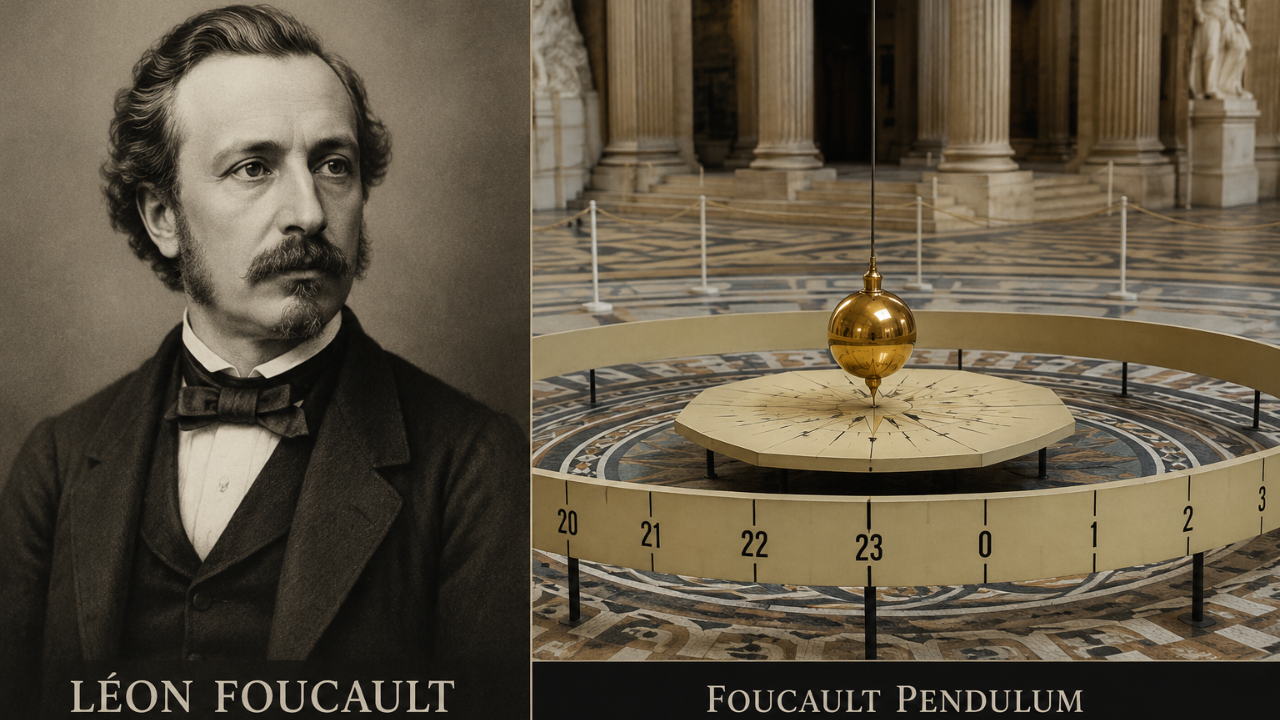
A self-taught French physicist named Léon Foucault walked into the Paris Observatory with a heavy piece of metal, a long wire, and a point to prove. He didn't build a massive telescope. He didn't rely on complex celestial tables. Instead, he hung a 28-kilogram brass-coated lead ball from the ceiling, pulled it back, and let it go.
By afternoon, he had undeniable, visual proof that our planet spins. It remains one of the most elegant experiments in human history. Here is exactly how he pulled it off, why the science works, and why it still leaves people staring in amazement today.
The Problem With Proving a Spinning World
Before Foucault, everyone knew the Earth rotated. Copernicus had laid out the math centuries earlier. Galileo fought the Church over it. Isaac Newton figured out the physics of gravity and orbital mechanics. By the mid-19th century, arguing that the Earth stood still was a quick way to get laughed out of any serious academic circle.
But knowing something is true isn't the same as seeing it.
If you're sitting inside a perfectly smooth, windowless train car moving down a straight track, you can't tell you're moving. You can pour a cup of coffee or toss a coin in the air, and everything behaves exactly as if you were parked at the station. This is classical relativity. The only way to know you're moving is to look out the window at the passing trees.
For humanity, the stars were those passing trees. We watched the Sun rise and set, and we watched the constellations wheel across the night sky. But a stubborn skeptic could always argue that the Earth was stationary and the entire universe was simply revolving around us. It sounds absurd now, but proving otherwise from a fixed position on the ground was a nightmare.
Foucault realized you didn't need to look at the sky. You just needed to build a system that was completely detached from the Earth's twist.
The Secret of the Unchanging Swing
To understand how a swinging metal ball proves the Earth rotates, you have to understand a fundamental law of physics: inertia.
Once you set a pendulum in motion, it wants to keep swinging in the exact same direction forever. If you start it swinging north-to-south, it will stay north-to-south unless an outside force acts on it. Air resistance will slow it down, but it won't change the direction of the swing plane.
Here is the genius part. If you hang a pendulum from a ceiling, the building is attached to the ground. The ground is attached to the Earth. As the Earth rotates, the building rotates with it. The ceiling hook twists around in a circle.
But a perfectly designed pivot point allows the wire to twist without transferring that rotational force to the swinging ball. The ball keeps tracking back and forth along its original path in space, totally oblivious to the building turning around it.
Imagine standing at the North Pole. You set a pendulum swinging toward a specific distant star. As the hours pass, the Earth rotates 360 degrees directly beneath the pendulum. Because you are standing on the Earth, you rotate with it. To your eyes, it looks like the pendulum is mysteriously changing direction, slowly turning clockwise.
But the pendulum isn't turning at all. You are. The entire building, the floor, and your own two feet are spinning around a fixed line of motion.
The Math of the Panthéon Demonstration
Foucault first tested this in his cellar with a short wire. It worked, but the short swing meant air resistance stopped the ball too quickly. He needed a bigger stage. He moved the experiment to the Paris Observatory, and then, under the orders of Louis-Napoleon Bonaparte, he set up the ultimate demonstration at the Panthéon in Paris.
The scale of the Panthéon experiment was massive:
- The wire was 67 meters long, made of hardened steel.
- The bob was a 28-kilogram sphere.
- A small stylus was attached to the bottom of the ball.
- A ring of damp sand sat on the floor beneath it.
Every time the ball swung to the edge of its path, the stylus scraped a tiny groove in the sand. If the Earth were stationary, the ball would track back and forth through the exact same two grooves forever.
Instead, every single swing carved a slightly different line. The tracks moved clockwise at a rate of about 11 degrees per hour. Over the course of roughly 32 hours, the pendulum traced a full circle through the sand.
$$\omega = 15^\circ \times \sin(\lambda)$$
The rate of this rotation depends entirely on your latitude. The formula above dictates how fast the plane appears to turn, where $\omega$ is the rotation rate per hour and $\lambda$ is the latitude of the pendulum.
At the North and South Poles, where latitude is 90 degrees, the sine of 90 is 1. The pendulum appears to make a full 360-degree rotation in about 24 hours. At the equator, where latitude is 0 degrees, the sine of 0 is 0. The pendulum doesn't appear to rotate at all. Paris sits at roughly $48.8^\circ$ North. Plug that into the formula, and you get a rotation of roughly 11.3 degrees per hour, matching Foucault's results perfectly.
Why People Blew Their Minds in 1851
The public reaction was intense. People flocked to the Panthéon to watch a giant ball swing over a pile of sand. It was mesmerizing because it felt like watching the clockwork of the cosmos operating in real-time.
You could stand perfectly still, look at the floor, and watch the Earth move beneath you. It turned a massive, abstract cosmic truth into a physical reality you could watch while eating your lunch.
Before this, Foucault was kinda viewed as an outsider by the elite French scientific establishment. He didn't have a traditional university pedigree; he started out studying medicine but quit because he couldn't stand the sight of blood. He pivoted to photography and experimental physics. The pendulum experiment secured his legacy, proving that brilliant engineering could solve problems that had stumped theoreticians for generations.
Spotting the Optical Illusion
When you look at a Foucault pendulum today in a museum, your brain will lie to you.
You'll watch the ball change its path over twenty minutes, and you'll be convinced that some force is pushing the wire sideways. It takes active mental effort to reverse that perspective. You have to force yourself to realize that the ball is the only stable thing in the room. The museum, the walls, the art on the displays, and the ground you are standing on are slowly wheeling around the wire.
It's a humbling realization. Honestly, it's the closest you can get to stepping outside of your own earthly frame of reference without buying a ticket on a rocket ship.
Where to See One and What to Look For
You don't have to travel back to 1851 to experience this. Hundreds of science museums and universities across the globe maintain working Foucault pendulums.
If you visit one, don't just glance at it and walk away. Spend ten minutes watching it. Most installations place a circle of small pegs or blocks at the edge of the swing path. Every few minutes, the slowly shifting path of the pendulum will knock over a pin.
When you watch that pin fall, remember that the pendulum didn't steer into it. The rotation of our planet drove that pin directly into the path of the falling metal ball.
If you want to track the physics yourself next time you stand over one, look up the latitude of the city you are in. Do the quick math using the sine law. Calculate exactly how many degrees that floor should turn while you're walking through the exhibits, then check back later to see if the pendulum matches the math. It always does.