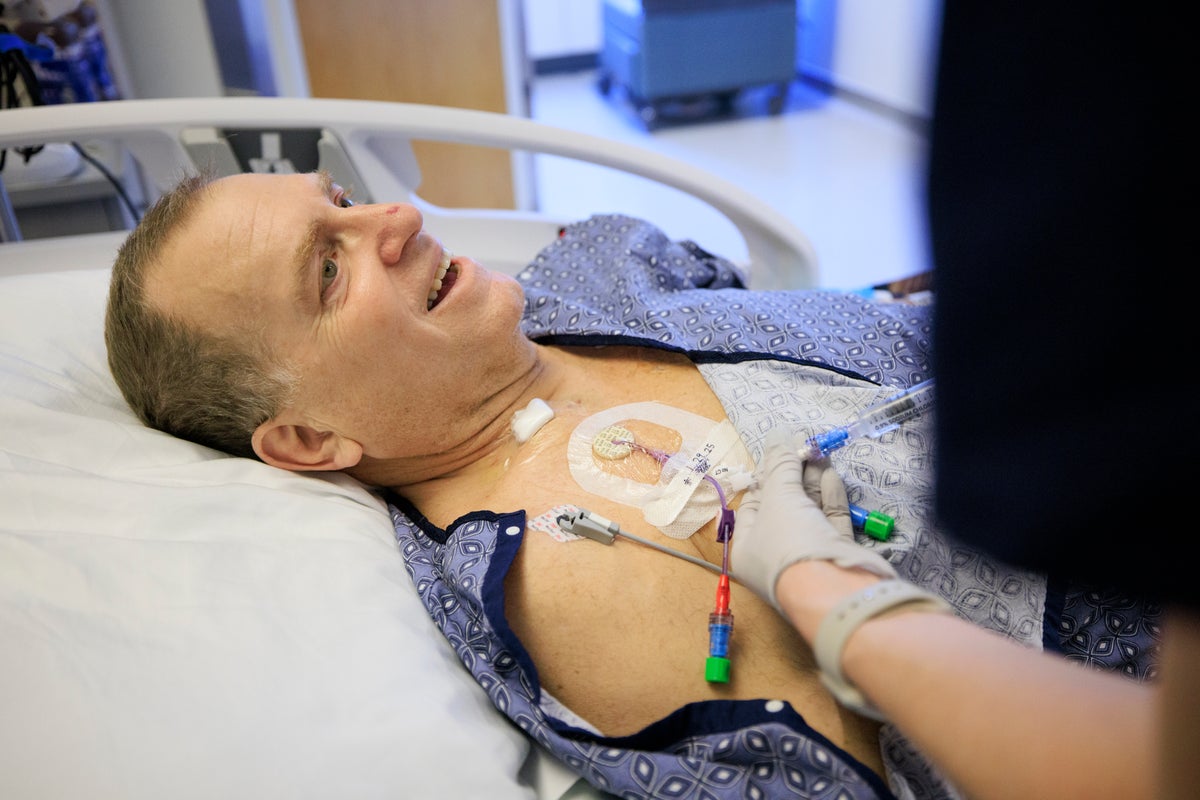
The operating theater is supposed to be the most sterile, precise environment on earth. Under the harsh, unyielding glare of the surgical lights, there is no room for ambiguity. Every instrument is counted. Every staff member has a defined role. The human body is mapped out with sharp, purple ink markers, transforming living flesh into a blueprint for healing.
But maps are only as good as the hands that draw them. If you found value in this article, you might want to check out: this related article.
When a routine procedure goes horribly wrong, we tend to look for a catastrophic failure. We look for a malfunctioning machine, a sudden blackout, or an impaired surgeon. We rarely look at a tiny speck of carbon ink, no larger than a grain of rice, injected into the pink lining of a patient’s colon.
Yet, it was exactly that—a tiny, misplaced dot—that led a consultant surgeon to remove the wrong section of a human being's bowel. It is a mistake that sounds impossible in modern medicine. It is a nightmare born from a breakdown in the very systems designed to keep us safe. For another look on this event, refer to the recent update from CDC.
To understand how this happens, you have to understand the sheer vulnerability of lying on that table. You are asleep. Your voice is gone. You are entirely dependent on the notes in a chart and the marks on your skin.
The Markings in the Dark
The human colon is roughly five feet of twisting, turning tissue, folded tightly inside the abdominal cavity. From the outside, during keyhole surgery, one segment can look remarkably like another. When a gastroenterologist spots a polyp or a cancerous lesion during a colonoscopy, they cannot simply leave a sticky note inside the patient.
Instead, they use a technique called endoscopic tattooing. They inject a small amount of sterile black ink into the bowel wall near the site of the disease. This tattoo acts as a lighthouse. When the surgeon comes in weeks later to cut out the diseased tissue, they scan the horizon of the organ for that specific dark mark.
In this case, the lighthouse was built on the wrong cliff.
During the initial scan, the site of the lesion was incorrectly identified or documented. When the patient was wheeled into the operating room for the definitive surgery, the surgeon followed the map implicitly. They located the ink. They cut where the ink told them to cut.
They removed a perfectly healthy section of the patient’s bowel. The actual site of the disease remained untouched, still lurking inside the patient's body.
Medical errors of this magnitude are classified as "Never Events." These are egregious, preventable blunders that should never occur if standard safety protocols are followed. They are the systemic ghosts in the machine of modern healthcare. When a Never Event occurs, it is rarely the fault of a single person. It is the result of a alignment of hidden failures, a series of falling dominoes where every safety net fails simultaneously.
The Illusion of Absolute Safety
We comfort ourselves with the belief that medicine is an exact science. We want to believe that the checklist taped to the operating room wall is an infallible shield. The World Health Organization's surgical safety checklist is supposed to stop these disasters. It demands a "time out" before the first incision is made, where the team confirms the patient's identity, the surgical site, and the procedure.
But a checklist cannot verify the historical accuracy of a tattoo. If the mistake was baked into the patient's records weeks prior, the checklist merely confirms a falsehood with absolute confidence.
Think of it like an airplane pilot flying through thick fog. The pilot relies entirely on their instruments. If the ground radar has accidentally swapped the coordinates of two different runways, the pilot will land the plane exactly where the machine dictates—even if that runway is already occupied. The pilot executed the maneuver perfectly, but the data was fundamentally flawed.
In the aftermath of such an error, the physical toll on the patient is immense. A bowel resection is not minor surgery. It requires cutting through muscle, disrupting the digestive system, and risking severe infection or leaking at the site where the remaining ends are stitched back together. To endure that trauma once is difficult. To realize you must endure it again—because the original disease is still inside you—is psychologically devastating.
The trust is broken. That is the wound that takes longest to heal. When you sign a surgical consent form, you are signing over your life. You are trusting that the hospital's collective intelligence is greater than any individual human oversight. When that trust shatters, the hospital room stops feeling like a sanctuary and begins to feel like a trap.
Fixing the Broken Compass
How do we prevent a dot of ink from ruining a life? The answer does not lie in scolding the medical staff or demanding they "try harder next time." Human beings, no matter how highly trained, will always be capable of oversight when fatigued or working within flawed systems.
The solution requires a fundamental overhaul of how diagnostic data is handed over to surgical teams.
Some hospitals are now implementing dual-verification protocols for endoscopic tattoos. This means a second clinician must verify the location of the mark, or a secondary imaging method—like a clip that can be seen on an X-ray—must be used to confirm the tattoo's position before the patient ever sees a scalpel.
Furthermore, digital mapping software is beginning to bridge the gap between the internal camera of the colonoscopist and the external view of the surgeon. We need to stop relying on a single, permanent mark made in a moving, flexible organ.
The medical community often talks about E-E-A-T—Experience, Expertise, Authoritativeness, and Trustworthiness—not just as a benchmark for information, but as a cultural standard for patient care. True expertise requires the humility to admit where our systems are weak. It demands that we look at a horrifying mistake not as an isolated anomaly, but as an urgent warning light on the dashboard of public health.
The patient involved in this mix-up survived the physical ordeal, but the narrative of their care was permanently altered. They became a statistic in a report on hospital safety, a cautionary tale discussed in hushed tones during morning rounds.
The surgeon walked out of that theater carrying the heavy, quiet burden of an irreversible mistake. They had done their job with technical precision, executing a flawless operation on the wrong piece of tissue. They followed the map perfectly, failing to realize until it was too late that the map had lied.