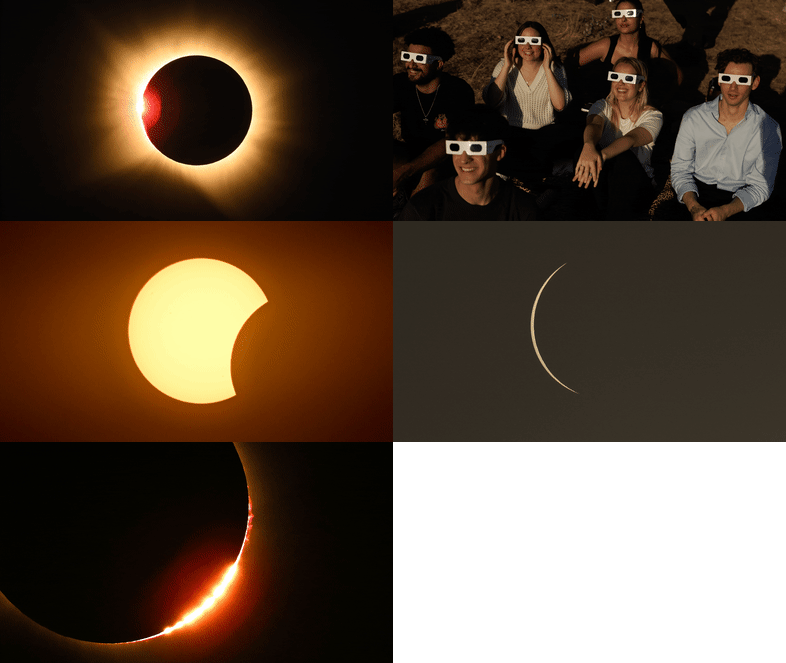
The coffee in Maya’s cup was stone cold. She had stopped drinking it an hour ago, somewhere around the time the temperature dropped three degrees in the middle of a Tuesday afternoon and the pigeons in the town square panicked.
She stood on a ridge outside a small village in northern Spain, surrounded by thousands of strangers who had all collectively decided to look up. They carried heavy camera tripods on their shoulders like modern spears. They wore cardboard glasses that made them look like visitors from a retro-futuristic movie. They spoke five different languages in hushed, nervous whispers, but none of that mattered now.
Because the shadow was coming.
For millions across Europe, the first total solar eclipse in decades was not a calendar event. It was a rupture in the ordinary flow of time. Astronomers had calculated the path to the exact second. Governments had prepared traffic management plans months in advance. Emergency services had stockpiled fuel and water for the influx of humanity choking the rural highways of Spain, France, and parts of the Alps.
Yet spreadsheets cannot measure the weight of an ancient instinct.
When the moon finally bit into the glowing edge of the sun, a collective exhalation rippled through the crowd. It was a strange sound—part gasp, part sigh, part collective prayer. The light changed instantly. It did not fade the way twilight fades, slowly and with amber warmth. Instead, the world lost its color. The vibrant green of the olive groves turned to an ashen, metallic grey. Shadows sharpened. The wind died down completely.
(Note: While the atmospheric cooling and animal behavioral changes are scientifically verified phenomena documented during major eclipses, the psychological impact on Maya and her fellow observers represents the human core of this historic gathering.)
Consider what happens next: the corona blooms.
Suddenly, the black void of the moon is ringed by a ghostly, ethereal crown of white fire, dancing in the vacuum of space. Jupiter and Venus flickered into existence in the bruised indigo sky overhead. For two minutes and forty-two seconds, the middle of the day became an eternal night.
In that silence, the illusion of human dominion over our environment vanished. We spend our lives lit by blue-light screens and municipal grids, pretending we have conquered the dark. We schedule our days down to the minute. We map our roads, predict our weather, and insure our futures. But standing on that Spanish hillside, watching the sun reduced to a silver ring, the machinery of modern life felt terribly small.
We are fragile creatures, tethered to a very specific, volatile ball of rock hurtling through an indifferent void.
Down on the highway, miles away from the ridge, bumper-to-bumper traffic stretched for twenty miles as sightseers tried to escape the bottleneck. Hotels in rural hamlets had been booked out for eighteen months, prices surging into astronomical territory. Local bakeries sold out of bread and wine before noon. The economic shockwave of this celestial alignment was massive, injecting millions into local economies that rarely see tourists in the shoulder season.
Yet no one was thinking about gross domestic product while the corona flared.
An elderly man standing near Maya clutched a pair of binoculars that looked older than she was. Tears tracked freely down his weathered cheeks. He did not wipe them away. He had waited forty years for this, surviving illness, loss, and the slow erosion of time, just to stand under the exact path of totality once more.
That is the hidden truth about these rare alignments. They measure our lives.
We divide our personal histories by them. I was ten years old the last time. My mother was still alive. My children were babies. The universe operates on scales of billions of years, spinning galaxies and collapsing stars in cold indifference. But we borrow a few fleeting moments of its grand theater to mark the passage of our own brief existence.
The diamond ring flashed—a blinding single point of sunlight bursting from the edge of the dark moon—and the spell broke.
Instantly, the ambient temperature surged back. The crows resumed their arguments in the olive trees. People pulled off their cardboard glasses, blinking against the sudden, harsh glare of ordinary reality, smiling awkwardly at strangers they would never see again. The traffic jam would take hours to clear. The highway back to Madrid would test every ounce of patience they possessed.
Maya picked up her cold coffee, poured it onto the dry earth, and turned back toward the car. The sun was high and bright again, completely ordinary, burning just as it had yesterday, and just as it would tomorrow.
Except nothing was quite the same.


