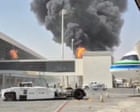
Modern aviation hub economics rely on a frictionless assumption: that airspace security is a constant baseline, and that infrastructure risk is limited to stochastic weather events or localized mechanical failure. When kinetic military actions penetrate primary capital city airports, this baseline dissolves. The cascading flight suspensions across King Khalid International Airport following coordinated projectile impacts expose the fragility of centralized national aviation architectures under asymmetric threat vectors. Deconstructing this crisis requires analyzing three distinct systemic friction points: insurance rate shocks, regulatory Notice to Air Missions propagation, and network hub dislocation.
The Mechanics of Airspace Risk Pricing
Commercial aviation operates on tight yield margins governed by actuarial risk tables. When ballistic or drone ordnance breaches terminal perimeters, the cost function for hull and liability insurance undergoes an immediate step-change. Reinsurance syndicates do not price geopolitical conflict through linear extrapolation; they apply binary exclusion zones or prohibitive war-risk premium multipliers.
International carriers face an operational calculus where the marginal revenue of a flight to a targeted capital no longer offsets the potential catastrophic loss of a widebody asset. This explains why foreign operators suspend services far in advance of official state declarations. The decision to halt operations is an automated response to risk-weighted capital preservation, executed long before diplomatic channels attempt to stabilize the narrative.
Regulatory Cascades and NOTAM Propagation
Civil aviation authorities operate through codified frameworks of safety verification. When General Authority of Civil Aviation entities issue restrictive directives or extend operational suspensions, they trigger a multi-tier regulatory domino effect.
- Primary Notice Issuance: Local authorities restrict or condition runway access, mandating prior permission or daylight-only constraints.
- International Secondary Response: Foreign civil aviation regulators ingest these operational limitations, issuing advisory warnings or mandatory rerouting edicts for national carriers.
- Schedule De-confliction Collapse: Global distribution systems automatically drop suspended legs, removing the city from primary booking engines and severing commercial connectivity.
This regulatory chain creates an access vacuum. Even when physical repairs are completed or defensive counter-measures neutralize incoming threats, the administrative lead time required to restore insurance underwriting and lift NOTAM restrictions ensures prolonged operational paralysis.
Hub Dislocation and Network Economics
Riyadh functions as the administrative and financial nexus of Saudi economic diversification strategies. Centralized hub-and-spoke models dictate that passenger and cargo flows feed through primary terminals to sustain long-haul route profitability. When King Khalid International Airport faces intermittent closures, the domestic carrier network absorbs severe fleet displacement costs.
Airlines are forced to scatter high-value assets to secondary regional fields or international outstations to mitigate ground-strike exposure, temporarily stranding billions in aircraft inventory. This dispersion breaks the rotational efficiency required for profitable scheduling. Secondary airports within the kingdom, such as those in Jeddah or Medina, absorb diverted international traffic, but structural capacity limits prevent them from fully replicating the capital's throughput capabilities. The resulting two-tier aviation architecture increases transit times, inflates operating costs, and dampens commercial velocity across the broader economy.
Strategic Capital Reallocation
The systemic exposure of primary infrastructure forces a structural pivot in state-level economic planning. Capital expenditure models that assumed uninterrupted physical access must now factor in redundant logistics corridors and hardened point-defense integration. As long as asymmetric projectile campaigns target primary metropolitan nodes, foreign direct investment vectors will experience frictional delays, shifting executive participation toward virtual frameworks or decentralized regional alternatives until airspace integrity is mathematically guaranteed.