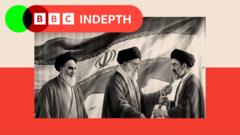
The transition of the Supreme Leadership in Tehran from Ali Khamenei to Mojtaba Khamenei, formalized in March 2026, represents a fundamental restructuring of the Iranian state's decision-making architecture. Western analyses frequently mischaracterize this transition as a simple hereditary succession within an unchanging autocracy. In reality, the emergence of the new regime signifies the institutional formalization of a security-first state, shifting away from the traditional clerical consensus model that defined the previous three decades.
Understanding this transformation requires analyzing the underlying institutional changes rather than focusing purely on ideological rhetoric. The current governance matrix relies on a highly consolidated alliance between the Office of the Supreme Leader and the senior command of the Islamic Revolutionary Guard Corps (IRGC), sidelining traditional clerical factions and limiting the operational autonomy of the elected presidency.
The Bifurcation of Executive Command
Under the previous administration of Ali Khamenei, the supreme leadership operated as an arbiter among competing domestic factions, balancing traditional conservative clerics, technocratic bureaucrats, and security forces. This pluralistic authoritarianism allowed the regime to absorb domestic shocks by deflecting blame onto elected presidents while maintaining the absolute authority of the Velayat-e Faqih.
The structural architecture under Mojtaba Khamenei discards this balancing mechanism. The succession occurred during acute geopolitical instability, accelerating a long-planned transition toward a centralized command structure. The new regime has compressed the decision-making pipeline, prioritizing systemic survival and domestic coercion over fractional equilibrium.
This operational shift manifests in three distinct structural adjustments:
- Clerical Marginalization: The Assembly of Experts and the traditional seminaries of Qom have seen their consultative influence diminished. Selection processes are now heavily managed by internal security metrics rather than theological consensus.
- The Securitization of the Bureaucracy: Senior administrative positions within the Supreme National Security Council (SNSC) and regional governorships are increasingly filled by former IRGC operatives rather than career diplomats or traditional clerics.
- Direct Executive Intervention: The new leadership bypasses standard legislative and consultative channels to issue direct economic and security directives, reducing the structural friction inherent in the old consensus model.
The Institutional Dominance of the IRGC
The most significant divergence from the previous regime is the direct integration of the IRGC into the core civilian governance apparatus. Historically, the IRGC functioned as a parallel military force and an economic conglomerate, but it remained subordinate to the ideological veto of the Supreme Leader. Today, the relationship is co-equal and deeply symbiotic.
Following the operational changes of early 2026, including the appointment of Mohammad Bagher Zolghadr to key security coordination roles, the IRGC has assumed formal oversight of the state’s strategic planning. This structural evolution alters the regime's approach to domestic resource allocation and external deterrence.
[Traditional System Architecture]
Supreme Leader -> Clerical Consensus / Factional Balance -> IRGC / Bureaucracy

[Current System Architecture]
Supreme Leader + IRGC Command Core -> Direct Bureaucratic Implementation
The economic footprint of the security apparatus has expanded into a formal command economy framework. Rather than operating through opaque front companies and foundations (Bonyads), the security forces now exercise overt control over critical infrastructure, monetary policy directives, and energy distribution networks. The strategic objective is to insulate the state apparatus from external sanctions by establishing an autarkic economic core that functions independently of international financial systems.
The Subjugation of the Republican Executive
The presidency of Masoud Pezeshkian highlights the structural constraints imposed on the civilian government under this new regime. While Western commentators initially viewed the elevation of a reform-oriented figure as an indicator of potential policy moderation, institutional realities have forced the civilian executive into a purely administrative role.
The presidency no longer serves as a vehicle for policy formulation; instead, it functions as a shock absorber for public dissatisfaction regarding economic stagnation and infrastructure degradation. The dual-structure system of Iran has effectively collapsed into a singular security hierarchy. The president manages the logistical execution of state functions—such as tax collection, civil service administration, and environmental crisis management—while retaining zero veto power over strategic defense, nuclear development, or regional alignment strategies.
This structural subordination is evident in the current management of macroeconomic policy. The central bank and the ministry of finance operate under strict guidelines dictated by the Supreme National Security Council to ensure the financial prioritization of defense sectors, regardless of the inflationary pressures imposed on the domestic population.
Strategic Realignment in Foreign Policy
The new regime’s external posture reflects a shift from opportunistic regional expansion to rigid deterrence optimization. The previous administration utilized a complex doctrine of plausible deniability, leveraging regional proxies to project power while maintaining diplomatic channels with European and regional adversaries.
The current leadership operates on a doctrine of immediate, symmetric escalation. This strategic pivot is driven by the assessment that ambiguous deterrence invites direct external threats. The regime has integrated its domestic security priorities with its external military posture, viewing any concession abroad as an existential threat to its stability at home.
The management of the Strait of Hormuz and regional maritime choke points has shifted from a tool of diplomatic leverage to a core element of defensive architecture. The decision-making process regarding trade restrictions and asymmetric naval operations has been decentralized, allowing field commanders within the IRGC Navy greater operational latitude to respond to perceived provocations without waiting for lengthy bureaucratic clearances from Tehran.
Long-Term Systemic Vulnerabilities
The consolidation of power within a securitized elite eliminates fractional infighting but creates profound institutional vulnerabilities. By dismantling the traditional mechanisms of factional balancing, the regime has removed the political buffers that previously insulated the Supreme Leader from direct accountability.
- The Loss of Ideological Legitimacy: By prioritizing raw security capabilities over traditional theological justification, the regime risks alienating its remaining religious base, transforming the state from an ideologically driven Islamic Republic into a standard military dictatorship.
- Economic Bottlenecks: The command economy model run by security elites consistently misallocates resources, exacerbating long-term structural issues such as the nationwide water crisis, grid instability, and hyperinflation.
- Succession Friction within the Security Apparatus: The concentration of authority within a small circle of hardline commanders creates potential points of failure if internal disagreements arise over economic distribution or military strategy.
Strategic Forecast
International actors must disabuse themselves of the notion that diplomatic overtures to the civilian presidency can alter Tehran's strategic trajectory. The current regime is structurally incapable of engaging in comprehensive grand bargains regarding its nuclear program or regional posture, as its institutional survival is entirely predicated on maintaining an adversarial stance to justify its domestic securitization.
Western policy must shift from attempting to influence internal political outcomes to a strategy of containment and structural resilience. Diplomatic engagement should be restricted to transactional de-escalation channels managed through third parties, focusing strictly on preventing miscalculation in maritime environments and monitoring nuclear enrichment thresholds. Economic policies should focus on tracking the evolving financial mechanisms utilized by the IRGC's consolidated economic core rather than expecting traditional civilian market behaviors. Expecting internal liberalization or a return to the consensus politics of the past ignores the profound structural evolution that has redefined the Iranian state.